Osmanthus (Osmanthus fragrans, Oleaceae) Cultivation Methods, Pest and Disease Control, and Lifespan
Osmanthus tea, made from osmanthus flowers as the raw material, is a specialty tea of China. It has a mild fragrance and a pleasant taste, and is loved by the public. Osmanthus is widely used in landscaping. So do you know what the cultivation methods for osmanthus trees are? How do you prevent and control pests and diseases? How long can they generally live?
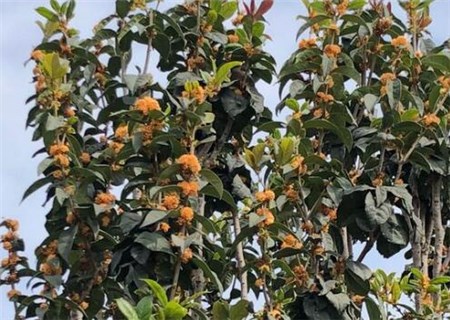
I. What are the cultivation methods for osmanthus trees?
1. Sowing: Osmanthus fruit usually ripens from April to May. It can be harvested when the skin changes from green to purple-black. Osmanthus seeds have an after-ripening effect and require at least half a year of sand storage. After harvesting, sprinkle with water and pile up for fermentation, remove the flesh, place in a cool place to let the seeds air-dry naturally, and store mixed with sand. After sand storage, they can be sown in autumn or spring. Before sowing, prepare the soil well and apply sufficient base fertilizer; they can also be sown in indoor seedbeds. When sowing, place the seed with the hilum facing sideways to prevent the radicle and young stem from bending, which would affect seedling growth in the future.
2. Grafting: Osmanthus grafting rootstock is mostly glossy privet (Ligustrum lucidum), Chinese privet (Ligustrum sinense), Ligustrum quihoui, Ligustrum obtusifolium, etc. When propagating seedlings in large quantities, Chinese privet is mostly used. Before spring sprouting, cut off the rootstock 5 cm above the ground. Cut 1-2 year old strong osmanthus branches 10-12 cm long. Cut one side of the base into a 2-3 cm long cut surface, and cut the opposite side into a 45-degree small bevel. Make a vertical cut about 2-3 cm deep at about 1/3 of one side of the rootstock. Insert the scion into the cut so that the cambium layers align, tie tightly with a plastic bag, and then bury in soil for cultivation.
3. Cutting: Usually before spring sprouting, use one-year-old fully developed branches, cut them into 5-10 cm lengths, remove the lower leaves, keep 2-3 green leaves at the top, and insert them into river sand or loess seedbeds at a row spacing of 3*20 cm. After inserting, water or spray promptly, and shade. Maintain a temperature of 20-25°C and a relative humidity of 85-90%. After 2 months, they can root and be transplanted.
4. Layering: Osmanthus can be propagated by two methods: low layering and air layering. The low layering method involves selecting relatively thick 1-2 year old branches from the lower part of a low-trunk mother tree in spring to early summer, choosing a part that bends easily, cutting with a sharp knife or girdling, and pressing it into a trench 3-5 cm deep, then fixing the pressed branch with a wooden stick. The air layering method involves selecting 1-2 year old thick branches from the mother tree in spring, cutting a ring or girdling in the same way as the low layering method, then applying culture medium to the wound, tying tightly above and below with plastic bags, and after rooting in autumn, cutting it off from the mother plant for maintenance.
II. How to prevent and control pests and diseases of osmanthus trees
Brown spot disease
In the early stage of the disease, small chlorotic yellow spots appear on the leaves, gradually expanding into nearly circular lesions with a diameter of 2-10 mm, or becoming irregular lesions because the expansion of the lesion is restricted by leaf veins. The lesions are yellowish-brown to grayish-brown, with a yellow halo around the outside. Brown spot disease generally occurs from April to October, and old leaves are more susceptible than young leaves. The pathogen overwinters as mycelium on diseased fallen leaves, and in the following spring produces conidia for primary infection. Conidia are spread by airflow and raindrops.
Withering spot disease
The pathogen of this disease mostly invades from the leaf margin and leaf tip, occurring at the leaf margin and leaf tip. In the early stage of the disease, light brown small spots appear on the leaves, gradually expanding into circular or irregular lesions, then expanding into nearly circular or irregular grayish-brown large spots with dark brown edges. Withering spot disease occurs from July to November, and can occur year-round in poorly conditioned greenhouses. The pathogen spreads and infects via conidia carried by wind and water. High temperature, high humidity, and poor ventilation are favorable for the disease. When the plant grows weakly, and on old leaves after overwintering and leaves in the lower part of the plant, the disease is more severe.
Anthracnose
This disease infects osmanthus leaves. In the early stage of the disease, small chlorotic spots appear on the leaves, gradually expanding to form circular, semicircular, or elliptical lesions. The lesions are light brown to grayish-white, with a reddish-brown ring at the edge. Under moist conditions, light pinkish slimy acervuli appear on the lesions. Anthracnose occurs from April to June. The pathogen overwinters as acervuli in diseased fallen leaves and is spread by wind and rain.
Control measures
First, reduce the sources of infection. In autumn, thoroughly remove diseased fallen leaves. For potted osmanthus, promptly remove diseased leaves. Second, strengthen cultivation management. Choose fertile soil or substrate with good drainage for planting osmanthus; increase the application of organic fertilizer and potassium fertilizer; the planting density should be appropriate to facilitate ventilation and light transmission, reduce leaf surface humidity, and reduce the occurrence of diseases.
Use chemical control scientifically. In the early stage of the disease, spray Bordeaux mixture at 1:2:200. Afterwards, spray 50% carbendazim wettable powder at 1000 times dilution or 50% benomyl wettable powder at 1000-1500 times dilution. In severely affected areas, when seedlings leave the nursery, soak them in a 1000 times potassium permanganate solution for disinfection.
Pest control
The main pest in household osmanthus cultivation is mites, commonly known as red spider mites. Once an infestation is found, it should be dealt with immediately. Miticide, aphid-mite killer, and azocyclotin can be used for foliar spraying. The front and back of the leaves must be sprayed evenly. Once a week for 2-3 consecutive times, and it can be cured.
III. How long can osmanthus trees generally live?
Speaking of its lifespan, we can actually describe it with one word, and that is “long”. So exactly how long is it? At the very least, several decades is certainly no problem, and some can even grow to a hundred years. The reason osmanthus trees live so long is mainly that they themselves have few pests and diseases, and they also have strong adaptability to the environment.