June Snow Cuiguan Pear Seedling Prices, Producing Areas, How Many Years Until Fruiting, and Development Prospects
Cuiguan pear is a honey pear, also known as “June Snow”. Its skin is thin and fine, its flesh crisp and juicy, its flavor rich, fresh and tender, with abundant juice and sweet taste. It reaches the market 2 to 3 months earlier than northern Ya pears and Dangshan crisp pears. So how much does a Cuiguan pear seedling cost? How many years until it bears fruit? What are its producing areas? What are its development prospects? According to Mr. He, a Cuiguan pear grower in Shandong, it generally buds in mid-March, flowers in late March, and the fruit ripens in late July. After grafting and planting, the seedlings try to flower and set fruit in the second year, and enter full production in the third year.
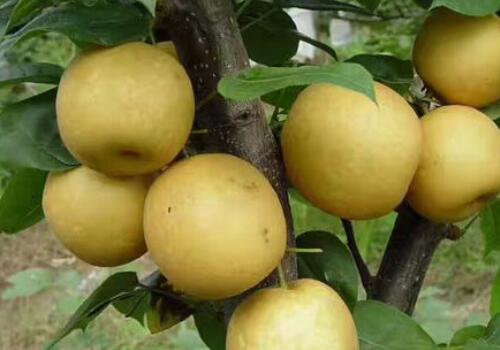
How much does a Cuiguan pear seedling cost?
Cuiguan pear belongs to the sand pear group. The fruit is nearly round, with a fruit shape index of 0.96. It is yellow-green, with snow-white flesh that is tender, soft, juicy, and melting in the mouth, with very few stone cells and a rich, sweet flavor. The soluble solids content is 12—14%, and the quality is superior. The single fruit weighs 200 g, with a maximum of 500 g, and the edible rate of the fruit is 96%. Seedlings with a trunk diameter of 6 cm cost about 1.3 yuan each.
What are the producing areas of Cuiguan pear?
1. In China, Cuiguan pear is distributed in all provinces, municipalities, and autonomous regions, from north to south and from east to west. It reaches the market in early to mid-July. The fruit is flat-round, with a clean surface and white flesh. The core is small, the flesh is thick, fine, tender, and refreshing, with abundant juice and a sweet taste and a honeyed aroma, offering a distinctive flavor. It has the reputation of being the “ancestor of a hundred fruits.” This variety ripens early, with a fruit development period of 110 days. In this region it ripens in late July, more than 20 days earlier than Huanghua pear and more than 2 months earlier than northern Ya pear. The fruit is large, with an average fruit weight of more than 230 g and a maximum of up to 450 g.
2. The general yield is 2500-3500 kg per mu, and high-yield orchards yield 7500-10000 kg per mu. Individual trees bearing more than 500 kg are relatively common in pear-producing areas in both the north and south. Pears have a long economic life; the normal fruiting period is generally 40-50 years, and some can reach more than 100 years. Pear fruit stores and transports very well, so producers need not worry about fruit rotting when sales are difficult.
What are the development prospects for growing Cuiguan pear?
1. The Cuiguan pear fruit is nearly round and large, with an average single fruit weight of 230 g and a maximum single fruit weight of 400 g. The fruit is green, and bagged fruit is yellow, with a smooth surface. The skin is thin, the core is small, and the flesh is white, tender, and juicy, with a sweet taste and superior quality. The soluble solids content is 12%-13%. Cuiguan pear has effects such as clearing the heart, moistening the lungs, reducing internal heat, promoting body fluid, moistening dryness, clearing heat, and resolving phlegm. It contains various nutrients, such as protein, fat, carbohydrates, vitamin B1, B2, C, and other organic components. It also contains potassium, sodium, calcium, magnesium, selenium, iron, manganese, and other inorganic components, as well as dietary fiber. It can be stored for 10—15 days, and refrigerated for 40—60 days.
2. Pears contain various nutrients. For example, every 100 g of flesh contains 4 mg of vitamin C, 0.1 mg of vitamin P, 0.02 mg of vitamin B1, 0.01 mg of vitamin B2, 0.01 mg of carotenoids, 0.1 g of protein, 0.1 g of fat, 9 g of sugar, 0.6 g of crude fiber, 0.4 g of ash, 5 mg of calcium, 6 mg of phosphorus, 0.2 mg of iron, and 217 KJ of calories.
3. Pears are not only nutritious; traditional Chinese medicine holds that pears are sweet and cold in nature and can moisten the lungs, clear the heart, relieve cough, dissolve phlegm, and clear lung heat, excess internal fire, alcohol toxicity, chest tightness, and shortness of breath. According to the Compendium of Materia Medica, they moisten the lungs, cool the heart, dissolve phlegm, reduce internal heat, resolve sore toxins, and detoxify, and can be used for colds, bronchitis, cough, thirst with loss of voice, constipation, and alcohol toxicity.
Cuiguan pear is delicious, and in major cities such as Macao, China, its selling price often reaches more than 10 yuan per jin, so the growing market is broad.
Appendix: Fertilizer and Water Management Measures for Cuiguan Pear
Cuiguan pear is an early-maturing variety and has relatively high requirements for fertilizer and water. Reasonable fertilizer and water management measures are the guarantee for obtaining high yield and high quality.
1. Fertilization techniques
(1) Base fertilizer: Pear fertilization is mainly based on base fertilizer. Base fertilizer can be applied in autumn or winter, and is best applied in autumn after fruit harvest and before leaf fall. Applying base fertilizer in autumn helps root wounds recover and new roots grow, and after absorbing part of the fertilizer, it can also prevent freezing and advance budding. It can be applied at 35-50 kg of organic fertilizer per plant, plus 1 kg of superphosphate.
(2) Topdressing: Generally applied three times a year, namely pre-flowering fertilizer, fruit-swelling fertilizer, and pre-harvest fertilizer. Pre-flowering fertilizer is applied after budding and before flowering, mainly nitrogen fertilizer, which can promote the growth of branches and leaves and increase the fruit-setting rate. For young trees and vigorously growing trees, nitrogen fertilizer should be applied sparingly. Fruit-swelling fertilizer is applied after new shoots stop growing, mainly nitrogen and potassium fertilizer, combined with phosphate fertilizer, which helps flower bud formation and fruit enlargement. Pre-harvest fertilizer is applied before harvest, with phosphorus and potassium applied together, which helps improve fruit quality and also prepares for budding, flowering, and fruiting the following spring. Alternatively, fertilize according to tree condition, applying in divided doses: 20 days after flower drop, during the fruit enlargement period (May-June), and 20-30 days before harvest (early July), applying a total of 1-2 kg of compound fertilizer per plant. Young trees receive 100-150 g each time, and mature trees 250-500 g. You can also combine this with pesticide spraying by topdressing outside the roots with 0.3%-0.5% monopotassium phosphate, or 0.3%-0.5% potassium sulfate. During the flowering period, 0.1%-0.3% agricultural borax can be sprayed to increase the fruit-setting rate and prevent fruit cracking.
2. Water management: Pear trees have four periods with relatively high water demand: before and after budding to before flowering, the young fruit enlargement period after flowering, the middle and late fruit growth period, and from before and after fruit harvest to before leaf fall. Among these, the young fruit enlargement period after flowering is the critical water-demand period for pear trees. Timely irrigation can promote the growth of new shoots and leaves, expand the assimilation area, enhance photosynthesis, increase the fruit-setting rate and enlarge the fruit, and also has a good effect on later flower bud differentiation.