Clematis Cultivation Methods and Precautions: Winter Taboos and Differences from Clematis patens
Clematis likes fertile, well-drained alkaline loam soil and dislikes waterlogging. So what are the cultivation methods and precautions for clematis? What are the winter cultivation taboos? What is the difference from Clematis patens? According to available information, clematis has strong cold tolerance and can withstand low temperatures of -20°C. However, it often suffers from leaf-eating pests such as red spider mites, so ventilation needs to be strengthened. Summers are relatively dry, and if the soil cannot retain water, the plant can easily die.
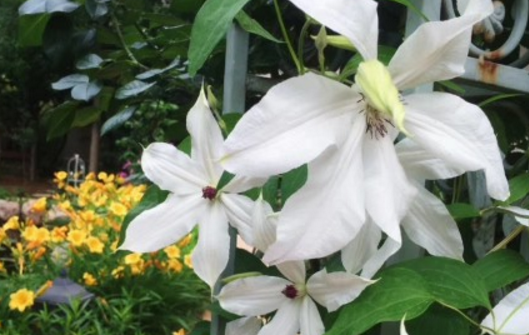
I. What are the cultivation methods and precautions for clematis?
Soil:
Clematis likes well-drained, loose, fertile alkaline soil.
Watering:
It is very afraid of waterlogging, so to avoid root rot, the amount of water given must be small. During the rainy season, drainage measures must be taken to prevent root rot caused by excessive water accumulation.
Light:
From autumn to the following spring, it can be placed in a spot exposed to sunlight without any shading measures. In summer, when the sunlight is strong, it should be shaded, as strong light exposure will cause its leaves to turn yellow, which is detrimental to its growth and development.
Fertilizing:
Clematis does not have strict requirements for fertilizing; simply apply fertilizer once about every 15 days during vigorous growth.
Precautions:
1. Pruning: There is no fixed rule for pruning it. Generally, it also enters dormancy in autumn and winter, and this is the best time to prune. Small shoots can be cut off, and relatively large branches can be kept.
2. Support: A support should be found for it. You can attach the support as you wish, and this will guide its growth direction.
3. Pests and diseases: Clematis is very susceptible to pests and diseases. Once discovered, they should be removed promptly, and the plant should be placed in a ventilated location. Do not keep it in an enclosed environment. Prune off diseased leaves or withered parts, and then use pesticides in combination to eliminate pests and diseases so as to prevent them from spreading to more plants.
II. Winter cultivation taboos?
1. Do not let the temperature get too high
In winter, clematis enters a dormant state at 0 to 10°C. In winter, we must keep the temperature within this range and not let it get too high, so that it can grow well. In fact, it is also very cold-tolerant and will be fine even at -25°C. Except for potted plants in North China, which need to be wrapped with some foam or plastic sheeting for insulation, no other measures are needed.
2. Do not water too much
When the temperature has not yet dropped below zero, watering is generally no different from other seasons, that is, do not water when it is not dry. But do not water too much, otherwise it is most likely to cause root rot in winter. We can put a finger 4 to 5 cm deep into the soil, and if it feels very moist, there is no need to water. When winter is about to freeze, whether potted or planted in the ground, it needs to be watered once with freeze water at this time, and it should be watered thoroughly in one go. After that, until spring, do not water again. So remember this in winter: there must never be too much water.
3. Do not fertilize too much
Generally, many people, in order to make their clematis grow better, want to apply a little more fertilizer. In fact, this is wrong. We must insist on using dilute fertilizer and applying it frequently, so that it can grow better. There are also many types of clematis, and many are not tolerant of fertilizer. Also, winter is generally the best season to apply fertilizer to it. At this time, we only need to apply it once a month, and then it will be fine for several months without further fertilizing. And remember that the fertilizer should not be too concentrated; it is best to use some thinner, more dilute fertilizer, so that it can grow in winter.
III. What is the difference from Clematis patens?
1. Differences in roots
Both belong to the Ranunculaceae family. Although both have woody stems and fleshy roots and grow as climbers, there are obvious differences in the shape and color of their roots. First, the colors are different: the yellow-brown roots are those of clematis, while the roots of Clematis patens are reddish-brown. Second, in terms of shape, clematis roots are slender with many fibrous roots, while Clematis patens roots are very thick and short, with very few fibrous roots.
2. Different flowering characteristics
For clematis sold as potted seedlings, customers cannot directly see the bare roots, so they can distinguish whether it is clematis by observing the flowering characteristics.
Clematis has a relatively large number of flowers, a very long flowering period, and very bright flower colors, which are also very rich. By comparison, Clematis patens has extremely strong adaptability, commonly known as wild in nature, and is very cold-tolerant. It does not need much care and can overwinter outdoors in cold conditions. Its flower colors are fewer than those of clematis, only white or yellow, and only one flower blooms on each vine, with very few flowers. Therefore, the one with rich flower colors is the genuine clematis.
3. Different flowering positions
In addition to the differences in roots and flower color, the third method is to observe the flowering positions of Clematis patens and clematis respectively.
Clematis flowers grow in the leaf axils, while the pedicels of Clematis patens are very straight and thick, and the flowers grow at the tips of the branches, usually a single solitary flower. If the clematis you purchased has flowers at every leaf axil, then it is genuine clematis.
In fact, clematis and Clematis patens can also be distinguished by observing the morphological characteristics of the leaves, but this observation method is relatively difficult unless you are a veteran clematis enthusiast. By mastering the above three methods, we can make a correct judgment as to whether it is genuine clematis.