Saraca: Flower Language and Detailed Guide to Planting and Propagation Methods
Saraca is a sun-loving tree species that prefers full sunlight and has slightly higher requirements for water and fertilizer. So what is the flower language of Saraca? How do you plant it? What are the propagation methods? According to available information, when Saraca blooms, the entire tree turns yellow, like a torch, extremely dazzling. From a distance, it looks like a golden pagoda. It is said that when Shakyamuni Buddha was born, he was born beneath this tree, so Saraca is also regarded as a sacred tree in Buddhism.
I. What is the flower language of Saraca?
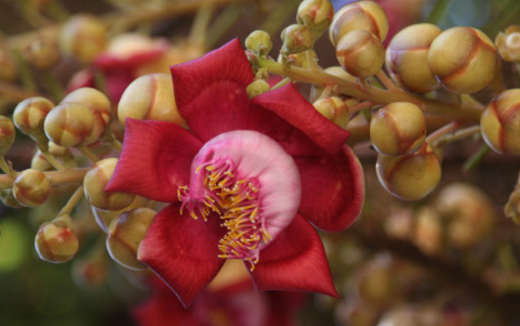
When Saraca blooms, the entire tree turns yellow, like a torch, extremely dazzling. From a distance, it looks like a golden pagoda.
It is said that when Shakyamuni Buddha was born, he was born beneath this tree, so Saraca is also regarded as a sacred tree in Buddhism.
There is also a saying that sitting beneath a Saraca tree allows you to forget all your worries and be carefree.
The legend of Saraca:
In Xishuangbanna, the Dai people follow Theravada Buddhism, and many plants associated with Buddhism are widely cultivated, such as Saraca.
There is a legend related to Buddhism about Saraca.
It is said that in ancient India over 2,000 years ago, there was a kingdom called Kapilavastu. The king and queen had been married for many years without having children. When the queen was 45 years old, one day she dreamed of a white elephant flying through the air and entering her womb. Then she became pregnant.
According to the customs of ancient India at that time, a woman pregnant with her first child needed to return to her parents' home to give birth. Before going into labor, the queen traveled back to her parents' home in an elephant-borne palanquin. Along the way, she passed through Lumbini Garden and felt somewhat tired, so she stopped to rest. When the queen walked to a Saraca tree, she reached out to hold the trunk, which stirred her labor, and she gave birth beneath the tree. The child she bore was Shakyamuni.
Therefore, many Buddhist temples plant Saraca around them, because Buddhism regards the Saraca tree as a sacred tree.
Some families without children also plant Saraca in front of their homes.
II. How to plant?
1. Environmental requirements for planting:
Saraca does not have strong cold resistance. Temperatures around 5°C may cause frost damage, and 13°C will cause it to stop growing. This is also why this plant is rarely seen outdoors in the north. It can tolerate high summer temperatures and prefers to grow in a warmer environment. During the seedling stage, it can be kept in a semi-shaded location; at other times, it can be moved to a spot with ample sunlight.
2. Planting methods:
Saraca seeds are relatively large, with an average weight of about 6.8 g per seed based on 1,000 seeds. The seeds should not be stored for too long; 3 months is enough to render them inviable. So after collecting mature seeds in August each year, they can be sown in late August. But for the seeds to germinate quickly, the temperature must be kept above 18°C while maintaining a certain humidity, so that sprouts will emerge in late September, and by October all will have germinated successively. Only by March of the following year can the seedlings be moved and transplanted for permanent planting. However, during this period, cold protection measures must be taken to prevent the newly emerged sprouts from freezing to death in winter. Spring and summer are its most vigorous growth periods, and it has very few pests and diseases. During these two seasons, fertilize once a month, but stop fertilizing in autumn, which is very helpful for the seedlings to survive the winter.
III. What are the propagation methods?
Generally, Saraca fruit matures in August, at which point the fruit can be harvested and then dried in a cool, ventilated place. To ensure the germination rate, the seeds of Saraca need to be kept from losing moisture, so do not sun-dry the seeds and do not store them for long periods. Saraca is generally sown immediately after harvesting.
For Saraca to germinate, the temperature needs to be above 18°C, so sowing is generally done in late August, with seeds sown directly on a moist sand bed. By around September, the Saraca seeds can germinate, and germination will be vigorous in October.
After Saraca seeds germinate, attention should be paid to maintaining temperature, and cold protection measures should be taken in winter.