How is Lycoris squamigera (resurrection lily) cultivated and propagated, and how does it differ from Lycoris sprengeri?
Lycoris squamigera likes to grow in sunny, moist environments, such as shady damp hillsides, rocks and under rock cliffs. So what cultivation methods are there for Lycoris squamigera? How does it differ from Lycoris sprengeri? How is it propagated? According to the available information, Lycoris squamigera rather likes light, and it is suited to growing in moist environments. However, it can tolerate partial shade and drought. Lycoris squamigera is also cold-tolerant, with very strong vitality. It has low requirements for soil; fertile and well-drained soil is enough.
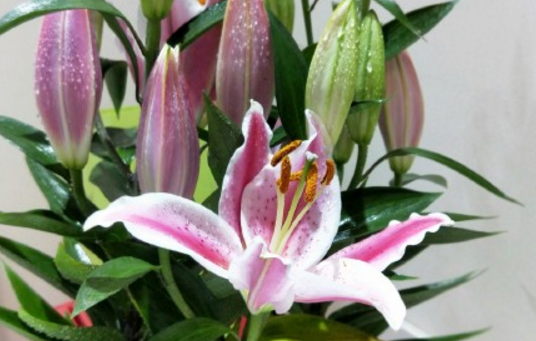
I. What cultivation methods are there for Lycoris squamigera?
1. Open-field cultivation of Lycoris squamigera
Open-field cultivation is one method of cultivating Lycoris squamigera; choose a spot with higher terrain and good drainage for cultivation.
Remove the small bulbs from the mother bulb of Lycoris squamigera for propagation, while the main bulb should have its roots trimmed and be dried in the sun before planting. Keep the plant spacing at about 15cm, cover with soil, and be careful to leave the top of the bulb exposed.
Note that for open-field cultivation, fertilizer should be applied reasonably during growing to support the plant's growth and flowering. During dormancy, the bulbs should be dug up and placed in a greenhouse to rest. Keep the outdoor temperature at about 5°C, dry and ventilated.
2. Greenhouse cultivation of Lycoris squamigera
For potted greenhouse cultivation of Lycoris squamigera, bulbs that have grown for about 3 years and can flower are generally chosen. When potting, generally one bulb is planted per flower pot, or 3——4 are planted in a large pot. When planting, it is usually planted shallowly, with the bulb exposed above the soil surface.
When potting up, be careful to water to keep it moist, and fertilize once every half month. Repot in good time, and water less during the plant's dormant period.
3. Basket-style cultivation exposed to the air
Basket-style cultivation means that bulbs can be planted in a basket, generally 16 of them. Lycoris squamigera grown this way is quite convenient to transplant, and care is relatively simple. Be careful to weed in good time.
II. How does it differ from Lycoris sprengeri?
1. Differences in the petals of Lycoris sprengeri and Lycoris squamigera
The floral tube of Lycoris sprengeri is about 1.5 cm long, and the whole flower is purplish-red with blue at the tip; the petal edges are not wrinkled, the flower is cup-shaped, the petals are broad and the stamens are short. The floral tube of Lycoris squamigera is about 2.5 cm long, the whole flower is purplish-red, the petal edges are slightly wrinkled, and it resembles a smaller lily. Compared with Lycoris sprengeri, the petals of Lycoris squamigera are relatively larger. The upper one is Lycoris sprengeri, and the lower one is Lycoris squamigera.
2. Differences in the bulbs of Lycoris sprengeri and Lycoris squamigera
The bulbs of both Lycoris sprengeri and Lycoris squamigera are egg-shaped, but the bulb of Lycoris sprengeri is clearly smaller than that of Lycoris squamigera. The diameter of a Lycoris squamigera bulb is about 5 cm, while that of Lycoris sprengeri is about 3 cm.
3. Differences in the leaves of Lycoris sprengeri and Lycoris squamigera
Researchers dissected plants of Lycoris sprengeri and Lycoris squamigera and found, when observed from the side, that the leaves of Lycoris sprengeri are relatively flatter than those of Lycoris squamigera, with a smaller V-shaped angle. Lycoris sprengeri produces leaves in early spring, while Lycoris squamigera produces leaves in autumn, growing to about 8 cm before withering immediately. The upper picture shows Lycoris sprengeri leaves, and the lower picture shows Lycoris squamigera leaves.
III. How is it propagated?
1. Division method
The division method is the simplest method for propagating Lycoris squamigera. It is generally done during its dormant period or after it has flowered. The specific method of division is to first dig out the entire plant of Lycoris squamigera, then cut off the offsets growing near the mother plant and plant them, and beautiful flowers can probably be produced the following year.
2. Scale cutting and plant regeneration
This can generally be done once about every four years. First place the small bulb of Lycoris squamigera into soil about five cm deep, then use a knife to score a cross from the very bottom of the bulb upward and then cut it lengthwise, with the cut going to about three-quarters of the way, and finally bury the bulb in the soil. After some time, you will see many spherical offsets growing at the cut sites of the bulb; then remove these small bulbs and plant them.