Sowing and Cutting Methods for Blue Flax (Linum perenne) in the Subclass Rosidae, and When It Blooms
Blue flax loves plenty of light and is highly cold-tolerant. Because of its strong adaptability, it can be used as an ornamental edible plant. So how do you sow blue flax seeds? How do you take cuttings? When does it bloom? According to available information, blue flax is a plant that quite likes light, has fairly strong adaptability and decent cold tolerance. It prefers a cool environment, and the soil is generally chosen to be fertile and well-draining.
I. How do you sow blue flax seeds?
1. Planting method
Clean and soak the seeds produced by blue flax, then put them into fine sand, mix the two together and spread them on the ground to dry in the sun. This practice allows the seeds to grow better in the soil. After the seeds are dried, sow them in seedling-raising soil for cultivation, cover the surface of the seeds with fine sand, and moisten them. Once the seeds germinate, move the seedlings into normal potting soil for growth and development; during this process, seedlings that develop poorly can be pulled out.
During the growing period, weeds usually grow alongside them. At this time, pay attention to how the weeds are growing and pull them out regularly; during this period, fertilizer should also be applied several times in small amounts.
2. Management method
The growth of blue flax cannot be separated from water and fertilizer. In the early stage, ensure the nutrients needed for growth, and fertilize and water regularly. After the seedlings have grown, reduce the amount of fertilizer, while irrigation should still be kept at an appropriate level. Once blue flax has grown into shape, the flower center needs to be removed by hand, which allows it to branch and grow better. After branching, blue flax also needs its growing tips pinched out. After two rounds of pinching, blue flax can bloom normally, and at this point it will look especially lush.
II. How do you take cuttings?
1. Time for taking cuttings
This flower can be propagated by cuttings. As for timing, it is best to choose a period when growth is going well, but before it blooms. This is because during this period, both the temperature and the surrounding environment are relatively suitable for the plant's growth, and after a successful operation it will survive more easily. There is also no need to control the surrounding environment too much for it to grow well.
2. The cutting process
The selected branches must not be too tender; if they are too tender, their survival cannot be guaranteed, because their ability to absorb nutrients has not yet reached the point where they can survive on their own. But you also must not choose plants that are already diseased. That goes without saying; you cannot let them be in a diseased state from the very beginning. However, you must ensure the temperature during the cutting process, because below 18°C they are reluctant to root. But too high is also no good; above 25°C it is very easy for the cut to become infected with bacteria, and it may even cause the cut to rot. So this aspect must be well controlled.
Before starting, it is best to disinfect, then apply a rooting agent. After the lower part of the plant has dried, you can take the cutting. After taking the cutting, water it immediately; this way the substrate will bind better with the cutting, and it can also ensure the water the plant needs to survive in the early stage.
3. Care after cutting
For a period at the beginning, shade should be provided, because the plant may not adapt to the surrounding environment. When the plant's growth becomes relatively stable, the shading device can be gradually removed and it can enter the normal care stage. Besides this method, you can of course also choose sowing, but relatively speaking, this method is a bit simpler and also faster.
III. When does it bloom?
1. When blue flax blooms
Blue flax generally blooms in summer. Its flowering period is between May and July, and it is a biennial plant. When blue flax blooms, the flowers open one after another; generally each flower does not stay open for very long, but the flowering time of the whole plant is relatively long.
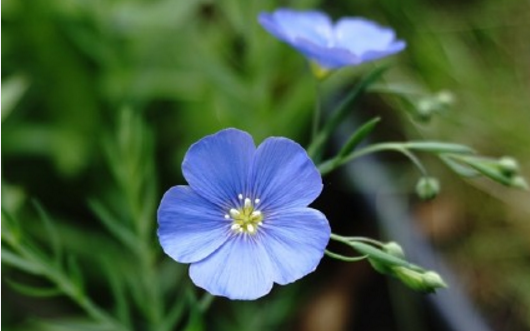
The flowers of blue flax are very delicate, generally terminal or axillary, with 5 petals, and the color is blue or light blue.
2. Controlling the flowering period of blue flax
Blue flax is a fairly vigorous bloomer, and its flower quantity is relatively large. When growing it, appropriate fertilization is needed, but do not overdo it; excessive fertilization will cause it to grow leggy and reduce flowering.
In order to help it bloom better, grow more flowering branches, and have a full plant shape, timely pinching out of growing tips is very important.
Generally, when the blue flax seedlings grow to 6-10 cm, they should be pinched once, so they can grow more branches. About 3-5 weeks after the first pinching, a second pinching can be done; at this time, pinch out the growing tips of the side branches that blue flax has grown, which can encourage it to branch again.
If, after blue flax finishes flowering, you want it to bloom a second time, you need to cut off the upper part of the plant, leaving 15-20 cm on the lower part, which can encourage it to grow new branches and bloom again in October.