When is the best month to take Bougainvillea cuttings? Detailed guide to propagation and pruning methods
Bougainvillea is planted in courtyards and parks, and cultivated in greenhouses in the north; it is a beautiful ornamental plant. So when is the best month to take Bougainvillea cuttings? What are the propagation methods? How do you prune it? According to available information, Bougainvillea is best propagated by cuttings from late May to early June, before the rainy season begins.
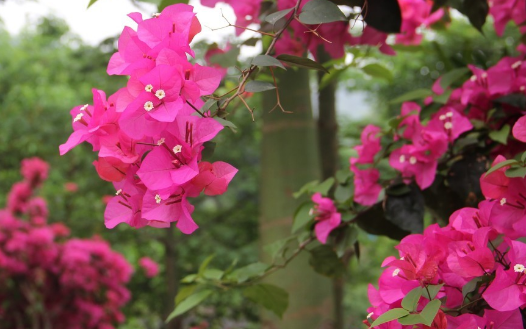
I. When is the best month to take Bougainvillea cuttings?
From late May to early June, before the rainy season begins, is the best time for cuttings.
Bougainvillea roots very easily from cuttings: for some varieties, as long as you get the season right, you can simply stick a cutting in the soil and it will survive; but some varieties are a little harder to root and require some extra care.
1. Selection of cuttings: Bougainvillea branches as thick as an arm or as thin as a stick of incense can all be used for cuttings; thick branches root slowly but take shape quickly; one-year-old lignified green branches easily produce new roots and have a high survival rate. Generally choose tightly structured, thick 1-2 year old outer branches facing the sun, (do not use overly thin branches, immature branches, leggy branches, or shaded branches). Use a sharp knife to cut them into sections of 3-4 nodes (about 8-10cm long), with the lower diagonal cut made 5-10 millimeters below a node; remove the lower leaves and keep the upper two and a half (or whole) leaves as the cutting.
2. The rooting medium should preferably be vermiculite, perlite + vermiculite, clean sand, or sandy loam (plain soil). Before use, place it in a basin and pour boiling water over it several times to sterilize, then use after it cools. Water propagation can also be used.
3. Take cuttings at the right season. In Hangzhou, late May to early June, before the rainy season begins, is the best time for cuttings. (Conditions vary by region; some articles say that in Hainan, October to March of the following year is best, while in Fuzhou, spring, summer and autumn are all suitable.) At this time the temperature is suitable (20-30 degrees), humidity is high, and management is convenient. First use a small wooden stick slightly thicker than the cutting to make diagonal holes in the medium. Insert the cutting about 4-6cm deep, water it, then move it to a slightly shaded place for care.
4. Care: Light should be appropriate: within 15 days, provide sparse light (not too shady; on sunny days shade about fifty percent), then gradually increase light; new roots grow in 20-30 days, and full sun after about 25 days; only with full sunlight can the new roots become robust. Moisture retention: within 20 days, if the weather is dry, cover with plastic wrap to retain moisture, leaving ventilation holes. In the evening, uncover for ventilation, spray with water, then cover again. Foliar feeding: spray once about every ten days with one part per thousand monopotassium phosphate + urea. Watering: keep the medium moist in the early stage (air humidity around seventy percent); after 40 days, gradually switch to "alternating dry and wet".
II. What are the propagation methods?
1. Cutting propagation
When taking cuttings, make preparations in advance. First is the soil: you can prepare sandy soil, or add some perlite or peat to the soil. Then prepare the flowerpot; an ordinary plastic pot or clay pot will do. Finally, the most important thing to prepare for the cutting process is the branch; choose a healthy branch that grew in the current year.
Insert the branch 7-8 centimeters into the soil, leaving the part with leaves exposed above the soil. After cutting, water thoroughly, then cover the outside of the pot with plastic wrap to prevent moisture loss, and finally place the pot in a position with scattered light.
2. Air layering propagation
① The advantage of this method is that it is relatively easy to keep alive. As long as the roots are not damaged, a branch that has grown new roots can generally be cut off and planted to grow into a new plant. Another advantage is that it is relatively easy to shape. Once a branch propagated by air layering is planted in a new pot, with proper pruning it will quickly grow into a beautiful bonsai-style flowering plant.
② First, at a point about two cun above where the branch to be layered connects to the parent plant, use a knife to make a ring cut around the bark about 3 millimeters wide. Wrap soil around the outside of the branch, then wrap it with a plastic bag, and tie both ends of the plastic bag tightly to prevent water loss. If the soil dries out, replenish water promptly. After about a month, you can see many roots growing on the branch, and at this point you can cut the branch off and plant it.
III. How do you prune?
Heavy pruning
Heavy pruning, as the name suggests, is certainly very extensive pruning: the branches must basically all be cut off, leaving only the trunk and a few main branches, and the few main branches left must also be cut very short.
In particular, unwanted branches must be completely removed. With heavy pruning, as the name suggests, a great deal must be cut off, so this pruning method is generally used when changing the shape.
Moderate pruning
Moderate, meaning in the middle, is naturally lighter than heavy pruning; it only cuts off some dead branches and unwanted branches, and merely shortens the well-growing parts, without changing the overall tree shape too much. Moderate pruning is generally used on established Bougainvillea bonsai.
Light pruning
This only slightly shortens some weak branches, cuts off diseased and dead branches, and slightly shortens healthy branches.
It is generally used on seedlings, small plants and young trees. The aim is to preserve as many branches as possible, so that a strong tree structure can form later, making good use of photosynthesis to let the young plants grow quickly.
Renewal pruning
Cut all branches short, so that the tree shape after this year's pruning is not much different from the tree shape just after pruning last spring.
The purpose of renewal pruning is actually to free up enough space and room for the plant to grow.
The four pruning methods sometimes cannot be completely separated and must be combined organically.