When Does a Chestnut Tree Bloom, Bear Fruit, and How to Harvest It, Where Is It Suitable to Grow, and What Excellent Varieties Are There
The chestnut tree is a tree up to 20 m tall, and its fruit has long had the reputation of “king of dried fruits”; it is also called kuili, maoli, fengli, and zhuili, and is widely cultivated. So when does the chestnut tree bloom and bear fruit, and when is it harvested? Where is it suitable to grow? What excellent varieties are there? What trees can be used for grafting? Learned from the Hubei termination base, grafting chestnut generally uses chestnut saplings to graft new chestnut varieties; chestnut propagation mainly uses seeding and grafting. If there are good rootstocks among Fagaceae plants——zhuili, white oak, sawtooth oak, Portuguese oak, and others, they can all be used for grafting. Because they all belong to the Fagaceae family, they have good compatibility and a high survival rate.
When does the chestnut tree bloom and bear fruit, and when is it harvested?
Flowering and fruiting:
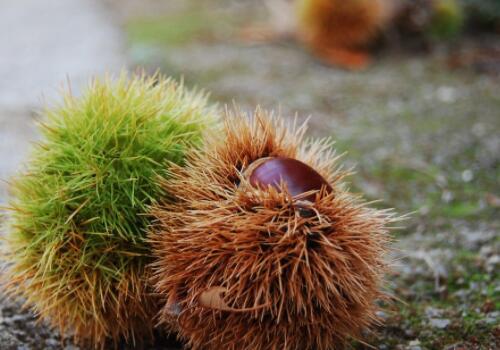
1. The fruit of the chestnut tree is enclosed in a densely spiny involucre; the involucre is 5-11 cm in diameter, and one involucre contains 1-7 nuts. The flowering period is May-June, and the fruit ripening period is September-October.
2. Chestnut trees generally take 4-8 years of planting before bearing fruit, and enter full fruiting at 15-16 years of planting. Generally, the fruiting life of a chestnut tree can reach about 20-35 years.
Harvesting:
1. In northern regions, the suitable sowing period for chestnut trees is mid-to-late March. When the soil temperature reaches above 12°.
2. Chestnuts mature roughly between September and October. There are many chestnut varieties, and different varieties differ somewhat in their maturity period, but most mature in autumn. Chestnut flowering usually occurs in May-June, and the fruiting period is September-October. In some regions, chestnuts have already matured and reached the market in mid-to-late August, but generally all chestnuts mature before November, and eating seasonal chestnuts in autumn is also the most delicious and most nutritious.
Where is the chestnut tree suitable for growing?
1. Chestnut has a relatively wide range of adaptation to climate and soil conditions. Its suitable annual average temperature is 10.5-21.7°C. If the temperature is too high and winter dormancy is insufficient, it will lead to poor growth and development; if the temperature is too low, chestnut is prone to freezing damage. Chestnut likes moist soil but also fears the effects of waterlogging. If rainfall is excessive and the soil is waterlogged for a long time, it can easily affect root growth, especially mycorrhizal growth. Therefore, chestnut orchards should not be developed in low-lying, easily waterlogged areas.
2. Chestnut is relatively sensitive to soil pH and is suitable for growing in slightly acidic soil with a pH of 5-6, because the chestnut tree is a manganese-loving plant; under acidic conditions, nutrient elements such as manganese and calcium can be activated, which is beneficial to the absorption and utilization by chestnut. The Xuzhou area is located on the southern edge of the Yellow River Floodplain; its annual average temperature is 13.7-14.1°C, and annual precipitation is 782-946 mm, which is relatively suitable for the growth and development of chestnut trees.
What excellent varieties of chestnut trees are there?
1. The main northern chestnut varieties include Jinfeng (Xujia No. 1), Haifeng, Shifeng, Yanshan Hongli (Yanhong), Hongguang Li, Hongli, Zaofeng, Houhanzhuang 20, Qingfeng, Yufeng, Shangfeng, Dongfeng, Tancheng 207, Wuhuali, Songjiazao, Tai'an Baoke, Huagaili, Wucili, Chuizhili No. 1, Chuizhili No. 2, Xiangzili, Banwuhua, Huafeng, Huaxing, Yimeng Duanzhi, Yanqing, and Yanquan, among others.
2. The main southern chestnut varieties include Jiujiazhong, Jiaozha, Qingmao Ruanci, Duanzha, Chushuhong, Chenguo Youli, Zhandiban, Dahongpao, Yelicang, Dabanli, Guduili, Jiebanli, Shaoyang Tali, Shuangjili, Yangmaoli, Zaoli, Jiuyuehan, Zhongci Banli, Qianci Banli, Chili, Zhongguo Hongyouli, Daguo Wupili, Zaoshu Youmaoli, Xiaoguo Youmaoli, Zhongguo Hongyouli, Zhongguo Youmaoli, Zhongguo Huangpili, and Paoche No. 2.