How to Grow Mock Orange (Philadelphus) from the Saxifragaceae Family: Propagation Methods and Value
Mock orange is highly adaptable, loves light, and likes warmth while also tolerating cold and heat. So what are the cultivation methods for mock orange? How do you propagate it? What value does it have? According to available information, mock orange is quite adaptable; it likes light and warmth, tolerates cold and heat, but is afraid of waterlogging. Mock orange does not have high soil requirements.
1. What are the cultivation methods for mock orange?
When cultivating mock orange, pay attention to choosing the soil. It does not have high soil requirements itself, but it likes fertile soil and needs sufficient fertility; secondly, the soil must have good drainage.
Propagation
When cultivating mock orange, there are mainly four propagation methods to choose from, including seed propagation, cutting propagation, layering, and division. Among these, cutting propagation, layering propagation, and division propagation can be carried out before spring budding.
Watering and fertilizing
After mock orange is planted out, it should be watered and fertilized reasonably to meet the plant's needs. In winter, apply some organic fertilizer around the plant and water it with overwintering water. In spring, apply some phosphorus and potassium fertilizer again to promote flower bud differentiation.
Pests and diseases
When cultivating mock orange, the more common diseases are root rust and leaf spot, while the more common pests are nettle caterpillars, aphids, and so on. Measures should be taken promptly for prevention and control.
2. How do you propagate it?
In fact, when propagating mock orange, there are still quite a lot of propagation methods that can be used.
Generally, the main methods that can be used for propagating mock orange are four, including seed propagation, cutting propagation, layering propagation, and division propagation.
When mock orange is propagated by seed, because the seeds themselves are relatively small, they are generally not covered with soil when sown, or only a thin layer is covered.
When mock orange is propagated by cuttings, layering, and division, this is generally done before spring budding; cuttings can also be done during the plum rain season, but at this time it is mainly softwood cuttings. During propagation, attention should be paid to providing shade.
If transplanting is to be carried out, then it is generally done in late autumn or early spring.
3. What value does it have?
1. Medicinal value of mock orange
Mock orange has fairly good medicinal value. Its main medicinal parts are its roots, as well as the bark and leaves. Take the stems and leaves, etc. from the mock orange plant, dry them in the sun for use or use them fresh. Note that mock orange generally can clear heat and remove dampness. It treats cystitis and hepatitis.
2. Ornamental role of mock orange
In fact, the most important role of mock orange is still its ornamental role.
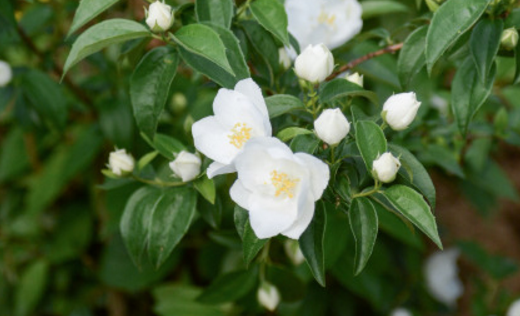
The flowers of mock orange are beautiful and very fragrant, and the flowering period is long-lasting, making it very suitable for viewing. So it is a very beneficial ornamental flower.
Generally, when mock orange is used for ornamental purposes, it can be grown in courtyards or scenic areas, either planted in masses or in clumps, and it can also be used as cut flower material.