How do you care for Hibiscus syriacus (rose of Sharon) of the Malvaceae family? What are the propagation methods? How is it different from Chinese hibiscus?
Hibiscus syriacus (rose of Sharon) is a very common shrub flower species in gardens. In landscaping it can be used as a flowering hedge or green hedge, and can be planted alone or in groups. It is native to the central provinces of China and is cultivated everywhere. So do you know how to care for rose of Sharon? What are the propagation methods? How is it different from Chinese hibiscus?
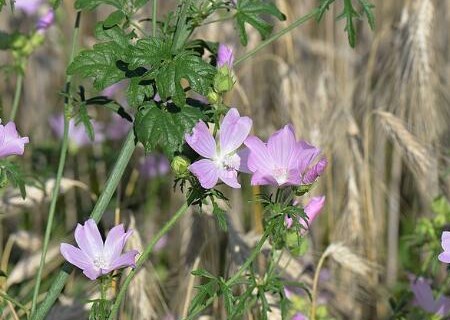
I. How to care for rose of Sharon
1. Soil for growing rose of Sharon
Rose of Sharon has a very strong adaptability to soil and is not at all strict about soil requirements. Even in poor gravelly sandy soil or slightly alkaline soil it can still grow vigorously. Of course, fertile, loose soil is the most suitable for the growth of rose of Sharon.
2. How to water rose of Sharon
Rose of Sharon loves light and tolerates partial shade. During the growing period, be sure to provide sufficient light; the light it receives should not be too intense, and it must not be exposed to the blazing sun. In the hot summer, shade it appropriately or move it indoors to avoid direct sunlight, which would cause its flowers to lose their beauty.
3. Suitable temperature for the growth of rose of Sharon
Rose of Sharon loves light and loves warmth. Therefore, a warm growing environment is most suitable for the growth of rose of Sharon; 18-25°C is the optimal temperature for its growth, and it can also tolerate cold slightly.
4. How to fertilize rose of Sharon
When rose of Sharon begins to bud and sprout, apply a top dressing in time; the top dressing should mainly be quick-acting fertilizer, which can promote vegetative growth. Before flowering and bud formation, apply 1-2 more applications of phosphorus and potassium fertilizer to promote bud formation and flowering of rose of Sharon. May to October each year is the flowering period of rose of Sharon. During this period, combine weeding and earthing up with two more top dressings to ensure the flower yield of rose of Sharon and the growth of the tree.
II. What are the propagation methods of rose of Sharon
1. Division: For rose of Sharon, divide in early spring before sprouting. Dig up a vigorous mature clump, take 3 main branches as 1 clump, and plant at a spacing of 50×60 cm between plants and rows.
2. Cuttage: For rose of Sharon, cuttage can be done from mid-March to early April together with pruning and shaping. For open-air cuttage in red soil or sandy soil, keep the soil moist; at a temperature of 17°C to 20°C it roots very easily.
3. Sowing: For rose of Sharon, sowing propagation is generally carried out in April in spring. After the fruit matures in October, November to December is the most suitable time to collect seeds. After collection, shell out the seeds and store them dry at low temperature, then drill-sow or broadcast-sow in April of the following spring.
4. Layering: The branches of rose of Sharon root very easily. Before sprouting in spring, dig a shallow trench beside the mother plant, lay a 1-year-old branch horizontally into the small trench, cover with soil, and keep the soil in the layering trench moist; it will soon root and send out shoots.
III. What is the difference between rose of Sharon and Chinese hibiscus
1. Difference in height
Rose of Sharon can grow to 4 m tall.
Chinese hibiscus can grow to a maximum height of 3 m.
2. Difference in flowering period
The flowering period of rose of Sharon is from July to October.
Chinese hibiscus is in a flowering state all year round.
3. Difference in origin
The original producing area of rose of Sharon is the African continent, and it is now planted in most areas of our country.
Chinese hibiscus is originally from our country.
4. Difference in growing environment
Rose of Sharon has stronger adaptability to the growing environment than Chinese hibiscus, and has good resistance to heat, cold, drought and shade. When planting in winter in the north, cold-proof measures need to be taken for it, or it can simply be moved indoors. Its soil requirements are lower than those of Chinese hibiscus; it can grow even in nutrient-poor or uneven soil.
Chinese hibiscus likes to bathe in sunlight at all times and is very intolerant of shade; its cold resistance and drought resistance are also very weak. In the Yangtze River basin and areas to the north, Chinese hibiscus is only suitable for pot planting, and the growing temperature in winter must be maintained between 12°C and 15°C. If the temperature drops below 5°C, its leaves easily turn yellow and fall off, and below 0°C it will affect its health. Its soil requirements are somewhat higher than those of rose of Sharon.
5. Difference in leaves
The leaves of rose of Sharon tend toward rhombic, and the edge of the upper half of the leaf is irregularly semicircular. The leaf length is about 3 cm to 10 cm, and the width is 2 cm to 4 cm.
The leaves of Chinese hibiscus tend toward ovate, but both ends are pointed. The leaf edge is irregularly serrated. The leaf length is 4 cm to 9 cm, and the width is about 2.5 cm.