Introduction to the planting methods, medicinal effects and symbolic meaning of Hibiscus (Furong flower)
Hibiscus is suitable for planting in courtyards, on slopes, along roadsides, at forest edges and in front of buildings, or grown as a flowering hedge; in the cold north it can also be grown in pots for ornamental viewing. So do you know what the planting methods for Hibiscus are? What effects and functions does it have? What does it symbolize?
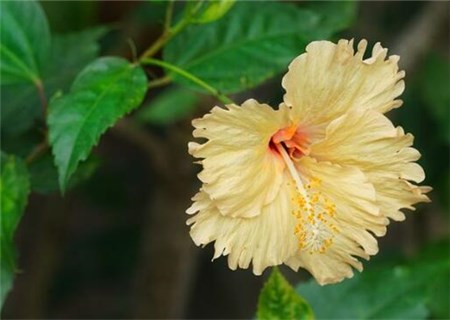
I. Planting methods for Hibiscus
1. Soil: Hibiscus mutabilis has no strict requirements for soil, but it grows best in fertile, moist, well-drained sandy soil. For potted Hibiscus mutabilis, a large wooden pot is best. The potting soil can be a growing medium made of 7 parts garden soil and 3 parts compost soil.
2. Temperature: Hibiscus has poor cold tolerance, so in winter it should be moved indoors, ensuring the temperature is kept at 0-10°C, allowing the Hibiscus to enter natural dormancy.
3. Sunlight: Hibiscus mutabilis prefers a sunny environment and tolerates light partial shade; it is best to plant it in a sunny spot, and potted plants should also be kept in sufficient sunlight.
4. Watering: Hibiscus is not drought-tolerant, and during the growing season it needs sufficient water to meet its growth needs. When the flower buds begin to show color, watering should be appropriately reduced to control leaf growth and concentrate nutrients in the flowers; in winter, watering should be reduced.
5. Fertilizing: Hibiscus needs more fertilizer and water during the spring budding period, and a small amount of phosphorus and potassium fertilizer should be applied before and after the flowering period. Each winter or spring, a trench can be opened around the plant and some decomposed organic fertilizer applied, to help the plant grow vigorously with abundant flowers and lush leaves.
6. Pruning: Hibiscus tolerates pruning well and can be trimmed into shape as needed. Cut dead branches and fallen leaves into small pieces to ensure light penetration, and it is best to train the plant into a shrub form.
7. Pests: The most common pest and disease of Hibiscus is the ordinary red spider mite, which can be sprayed with 73% propargite 3000-fold solution or 20% amitraz emulsifiable concentrate 1000-fold solution. The small green leafhopper and cotton leafhopper are also common pests of Hibiscus, and can be sprayed with 5% carbaryl powder.
II. What effects and functions does Hibiscus have
As a very common flower in daily life, Hibiscus has many effects and functions. Besides being enjoyed ornamentally, it can also be used in industry. More importantly, Hibiscus is neutral in nature and pungent in taste, with the functions of clearing heat, cooling blood, detoxifying, reducing swelling and eliminating toxins; it is suitable for diseases such as lung-heat cough, excessive menstruation, excessive vaginal discharge, carbuncles and toxic swellings, boils, and burns and scalds from water and fire. Next, let us take a closer look.
1. Ornamental
When it comes to the effects and functions of Hibiscus, the first is of course ornamental, which is probably the purpose for which the vast majority of flower lovers grow it! Hibiscus has a long flowering period and blooms abundantly, with many varieties. Its flower color changes according to the intensity of light: in the morning when it opens it is generally white or light red, and from noon to afternoon it becomes deep red, giving it relatively high ornamental value.
2. Industrial raw material
Unlike other flowers, the stem bark of Hibiscus contains 39% cellulose. The stem bark fiber is flexible and water-resistant, and can be used as a raw material for cables and textiles, and can also be used to make paper, so it also has certain value in industrial applications.
3. Medicinal use
Hibiscus can be used as medicine. Its flowers, leaves and roots are rich in medicinal components such as flavonoids, hyperoside, inulin glycosides, phenols and reducing sugars, all of which can be used medicinally. Traditional Chinese medicine believes that Hibiscus is neutral in nature and pungent in taste, with the functions of clearing heat, cooling blood, detoxifying, reducing swelling and eliminating toxins; it is suitable for diseases such as lung-heat cough, excessive menstruation, excessive vaginal discharge, carbuncles and toxic swellings, boils, and burns and scalds from water and fire:
① Treating excessive menstruation
Take equal parts of Hibiscus flowers and lotus seedpod shells, grind into powder, 6 grams each time, 3 times a day, taken with rice water.
② Treating cough
Take 60 grams of Hibiscus flowers and an appropriate amount of pig heart and lung, stew them together until cooked, then add 60 grams of brown sugar; eat the meat and drink the soup.
③ Treating excessive vaginal discharge in women
Take 50 grams of Hibiscus flowers and 30 grams of cockscomb flowers, decoct in water, 1 dose per day.
④ Treating gout
Take 30 grams each of Hibiscus leaves and Hibiscus mutabilis flowers. Clean the Hibiscus mutabilis, place it in a medicinal pot, add an appropriate amount of clean water, soak for 5-10 minutes, then decoct in water and take the liquid; place it in a foot bath basin, and when warm, soak the feet, twice a day, 20-30 minutes each time, 1 dose per day, for 2-3 consecutive weeks.
⑤ Treating rheumatism
Take 10 grams each of Hibiscus flowers and mulberry mistletoe. Clean the Hibiscus mutabilis, place it in a medicinal pot, add an appropriate amount of clean water, soak for 5-10 minutes, then decoct in water and take the liquid; place it in a foot bath basin, and when warm, soak the feet, twice a day, 20-30 minutes each time, 1 dose per day, for 2-3 consecutive weeks.
⑥ Treating burns and scalds from water and fire
Take fresh Hibiscus flowers, dry them in the sun, grind into powder, mix evenly with sesame oil and apply to the affected area.
⑦ Treating toxic swellings
Take equal parts of Hibiscus leaves and cocklebur, grind into powder, mix evenly with honey and apply to the affected area.
⑧ Treating mumps
Grind Hibiscus leaves into powder, mix evenly with egg white, apply to the affected area, twice a day.
⑨ Treating mastitis
Take equal parts of fresh Hibiscus roots and fresh leaves, mash them together, mix with white liquor and apply to the affected area.
⑩ Treating sores, carbuncles, swelling and pain
Take 30-60 grams of fresh Hibiscus flowers (halve the amount if dried) and 15 grams of rock sugar. Add water to the fresh Hibiscus mutabilis flowers, decoct, take the liquid and add rock sugar to dissolve; drink frequently as a tea substitute.
III. What does Hibiscus symbolize
Hibiscus symbolizes a noble and pure gentleman. Hibiscus is divided into two types: land Hibiscus and water Hibiscus, and because of the difference between land and water they have different flower meanings. Land Hibiscus flower meaning: precocious, because in the morning the land Hibiscus flower is white or pink, and by the afternoon it turns bright red. A flower that can change so much in such a short time is quite special; therefore, its flower meaning is “precocious”. Those born under the blessing of this flower are mostly rather precocious. This is the land Hibiscus. Water Hibiscus is what we usually call the lotus; lotus flower meaning: innocent, the lotus stands gracefully among the swaying field of lotus leaves, and seen from afar it is peerlessly beautiful. Lotus - pure and white, emerging from mud unsoiled, rinsed in clear ripples yet not coquettish, expressing steadfast purity. This is the water Hibiscus, the lotus.