Cultivation Methods, Time to Fruit, and Main Producing Areas in China of the National-Treasure Miracle Fruit
The miracle fruit is a typical tropical evergreen shrub, native to the West African, Ghana and Congo regions. It began to be cultivated in China in the 1960s, mainly in Guangdong, Guangxi, Yunnan, Hainan and other places. So how is the miracle fruit grown? How many years until it bears fruit?
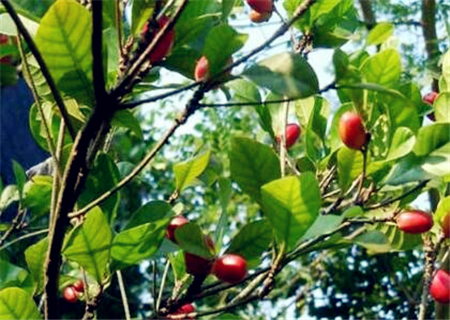
How many years until the miracle fruit bears fruit?
The miracle fruit grows slowly, generally flowering and fruiting only 3-4 years after planting. With vegetative propagation, fruiting can be advanced by 1-2 years, and the tree can be dwarfed to increase its ornamental value. The flesh is sour and astringent, and contains rich and unusual glycoproteins, vitamin C, KI, citric acid, succinic acid, oxalic acid and so on. It can make sour bread sweet and tasty, and make sour palm wine and beer sweet. After eating sour, spicy, bitter or salty foods, chewing a few miracle fruits immediately turns the taste sweet.
When does the miracle fruit ripen?
The fruit ripening period of the miracle fruit is not uniform; the peak fruiting periods are usually March, June and October. The fruit is small and oval; when ripe, the fruit is bright red with white, juicy flesh. It is pollinated by ants and other insects. The miracle fruit was introduced to China in the 1960s and is now cultivated as an ornamental garden plant in many regions. It produces small white flowers in September each year, sets fruit in October, and in November the fruit turns from green to red and ripens.
Miracle Fruit Cultivation Techniques
Site Selection
The miracle fruit is native to the tropics and prefers fertile, slightly acidic or neutral soil with high organic matter content and good moisture retention. It is suitable for cultivation in tropical and subtropical low-altitude areas. The temperature requirements of the site are an average temperature of 25°C, an average January temperature above 8°C, and a minimum temperature not lower than 5°C. Choose a south-facing, southeast-facing or southwest-facing sheltered gentle slope to establish the orchard, and preferably a site with abundant water and convenient transportation.
Propagation Techniques
Sowing: Miracle fruit seeds are not suitable for long storage and should be sown as soon as they are collected. Pick ripe fruits, leave them for 2-3 d until the skin and flesh change color, then wash off the skin and flesh and dry them. They can be sown in holes, dibbled, broadcast or drilled in rows on the seedbed, covered with about 2 cm of loose potting soil, and kept moist. Seedlings emerge in about 30 d, with an emergence rate above 85%. 25 d after emergence, spray a mixed fertilizer of 0.1% urea and 0.1% potassium dihydrogen phosphate. When the seedlings grow 3-4 true leaves, they can be transplanted.
Cuttage: The miracle fruit is best propagated by cuttings in March-April; cuttings can also be taken in September, but the survival rate is relatively lower. For cuttings, choose current-year mature, pest-free, robust branches as material. Cutting branches should be cut to about 15 cm, with 1-2 half-leaves or young leaves, and the base cut into a 30°-45° slant. Disinfect and sterilize the branches with 500-600 times diluted 40% carbendazim suspension, and treat with 800 mg/L naphthaleneacetic acid for about 10 s. Insert 1/2-2/3 of the entire branch length into a sterilized sand bed, maintain a relative humidity above 80% and 75% shading conditions [6], and check the growth of the fruit seedlings once every 5 d.
Air layering: Choose robust 2-3-year-old branches with a diameter above 0.5 cm, and carry out layering in the high-temperature and high-humidity season of April-May; roots can form in 60-70 d. According to experiments, stimulating rooting with 500 mg/L IBA or 500 mg/L ABT No. 2 rooting powder gives good results, with a rooting rate of up to 80%. About 2 h before layering, girdle the layering site, with a width 2-3 times the branch diameter, reaching deep to the xylem, and scrape the cambium clean; mix a small amount of yellow soil with the prepared IBA or ABT No. 2 solution into a paste, then apply it above the girdled part and at the upper cut, wrap with cultivation substrate (mushroom residue : humus soil at 2:3). The substrate moisture should be such that it forms a ball when squeezed by hand without falling apart, and the hand crevices feel slightly moist. Shape the substrate into the size of a fist and wrap it around the girdled part with plastic film. Check the moisture every 15 d, and if it looks dry, inject clean water with a syringe.
Field Planting
Choose March-April or September-October for field planting, with a spacing of 1.5 m × 2.0 m, and dig planting holes of 0.4 m × 0.4 m × 0.4 m. Apply base fertilizer to the planting holes according to the soil conditions; generally use 45% compound fertilizer and 250 g of organic fertilizer mixed with topsoil, spread about 20 cm at the bottom of the planting hole, and cover with about 10 cm of topsoil. When planting, build a planting mound with a diameter of 0.6 m and a height of 25 cm at the base of the tree, water thoroughly, and then press firm with the foot. Keep the soil moist for 10 d after planting, and afterwards decide whether to supplement water according to the humidity.
Fertilizer and Water Management
Fertilizer management: The miracle fruit can sprout, flower and fruit multiple times a year, so it has a relatively large demand for fertilizer. During the seedling stage, apply compound fertilizer scientifically, following the principle of light fertilizer applied frequently, and combine with foliar fertilizer spraying to promote the vegetative growth of the fruit seedlings. For mature fruiting trees, organic fertilizer and compound fertilizer should be used in combination. In early spring, reasonably increase nitrogen fertilizer to promote the growth of branches and shoots, and when the flower buds are still unopened, spray 0.2% borax to promote fruit set. When applying fruit-preserving and fruit-strengthening fertilizer, use 45%-48% compound fertilizer, combined with trace elements (such as Shima Red) and 0.2% potassium dihydrogen phosphate for spraying. Apply base fertilizer in late winter and early spring to restore tree vigor and promote growth, and heavily apply farmyard manure and phosphorus-potassium fertilizer deeply.
Water management: The miracle fruit has certain requirements for water and humidity. After field planting, not only should the soil moisture be maintained, but the branches and leaves should also be sprayed with water to keep them moist. In summer, to prevent water evaporation, the tree base should be covered with dry grass or a shade net for moisture conservation. Especially during the full flowering and full fruiting periods and the dry seasons of autumn and winter, water management should be strengthened.
Pruning and Training
Prune the miracle fruit while it grows slowly; heavy pruning is not advisable. For young trees, focus on promoting growth and shaping, and it is best to prune into a natural open-center shape or natural round-headed shape. Combine bud removal and shoot setting with pinching to promote rational distribution of branches, and select 2-3 robust buds in different directions as lateral branches to train. Thin out dense inner branches and cut off water sprouts to favor short pruning of the shoots on the outer part of the main branches. After harvesting fruit in winter, cut off diseased and pest-infested branches, water sprouts, drooping branches, overly dense branches, crossing and overlapping branches, etc., and keep 1-2 branches with strong branching ability to replace the branches on the outer part of the main branches as rotating fruiting branches.
Flower and Fruit Management
Preserving flowers and fruits: Spray 1-2 times with 0.2% borax and 0.1% potassium dihydrogen phosphate at the flower bud stage, and spray once with 0.5% borax at full bloom. Combined with artificial pollination, this can greatly promote fruit set. After flower fall and before physiological fruit drop, spray a full-element foliar fertilizer to promote fruit expansion and fruit retention, and it can be applied together with pest and disease control.
Flower and fruit thinning: The miracle fruit has a large number of flowers during the main flowering period, so flowers should be thinned in time to reduce nutrient consumption and promote fruit growth. During the young fruit stage, diseased-spotted fruits and deformed fruits should also be thinned out, and appropriate topdressing should be carried out to improve fruit quality.
Fruit harvesting: Since the miracle fruit produces fruit at different times, it should be harvested in time so as not to affect the growth of the next batch of fruit. Harvest when the fruit is 90% ripe; when harvesting, pick the fruit together with the stalk, as this can extend the storage time of the fruit.
How to Grow Miracle Fruit in Pots
Sowing propagation: Take plump seeds, wrap them in gauze to germinate, and keep the gauze moist. Sow when the seeds crack and show white, at a depth of about 2 cm. When 3-4 leaves have grown, they can be moved to a pot. During the growth period, water and fertilizer management needs to be strengthened. Fruiting is relatively slow, generally flowering and fruiting in three to four years.
Cuttage propagation: The cuttage propagation method is relatively simple. Take a branch of about 10 cm, and it can root in about 30 days; afterwards, normal management is all that is needed.
Management methods: The miracle fruit suits acidic soil, and garden soil plus sawdust plus cake fertilizer can be mixed together; the suitable growth temperature is about 22°-32°. Note that the temperature must not be too low, as too low a temperature affects plant growth and causes withering and leaf drop. In summer and the growing season, keep the soil moist, and water promptly when the soil is found to be dry. In autumn and winter, water about once every 7 days.