Flowering Time and Seed Propagation Methods of Mussaenda pubescens (Rubiaceae)
Mussaenda pubescens has strong adaptability, tolerates shade, grows quickly, and has strong sprouting ability. So when does Mussaenda pubescens bloom? How do you plant the seeds? How do you propagate it? According to the available information, the flowering period of Mussaenda pubescens is actually quite long-lasting; basically, from the first ten days of April to the middle ten days of June each year, Mussaenda pubescens will bloom successively, and by August, Mussaenda pubescens may still continue to bloom. Sometimes, the flowering period of Mussaenda pubescens can last about 100 days, which is truly long-lasting.
1. When does Mussaenda pubescens bloom?
The flowering period of Mussaenda pubescens is actually quite long-lasting; basically, from the first ten days of April to the middle ten days of June each year, Mussaenda pubescens will bloom successively, and by August, Mussaenda pubescens may still continue to bloom. Sometimes, the flowering period of Mussaenda pubescens can last about 100 days, which is truly long-lasting.
The flowering mechanism of Mussaenda pubescens:
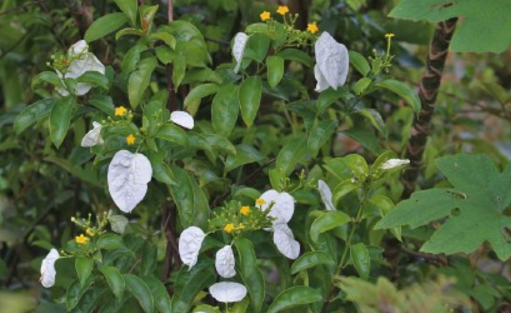
The flowering of Mussaenda pubescens is always very distinctive: the white sepals look like leaves, and the golden-yellow small flowers are dotted among them; together with the green leaves, it is all very interesting, just like golden flowers set off against white-jade-like leaves, a breathtaking sight.
Actually, the "jade leaves" in Mussaenda pubescens refer to its sepals. Generally, a single Mussaenda pubescens flower will have 5 sepals, one of which will transform into the shape of a leaf. And the "golden flower" refers to its golden-yellow blossom, which is very small and delicate.
2. How do you plant the seeds?
1. Seed treatment
Mussaenda pubescens seeds can be collected in May. The collected seeds need to be placed in a cool, shady place to dry out their moisture before sowing.
2. Soil selection
Mussaenda pubescens is afraid of waterlogging, so when choosing soil, it is best to select sandy loam soil that will not become waterlogged as its growing medium.
Its growth and flowering require a large amount of nutrients, so choosing a growing medium with relatively high fertility can provide sufficient nutritional support for its growth and ensure that it can grow smoothly.
In order to ensure that its seeds can sprout quickly, it is best to choose soil with strong aeration capacity as its growing medium.
3. Sowing method
First, choose a flower pot of suitable size, neither too large nor too small, otherwise it will affect the ornamental effect of the mature plant.
Then spread a layer of small stones at the bottom of the flower pot to improve the water retention of the growing medium.
Then pour the selected growing medium onto the small stones; there is no need to fill the entire flower pot, just fill it to about 6cm from the top of the pot. This ensures that water will not overflow when watering, and also ensures that the water will not wash away the growing medium.
Then gently scatter the dried seeds on the soil surface and cover with about 1cm of soil. At this time, be careful to scatter the seeds evenly, otherwise the ornamental value of the whole pot of flowers will be reduced.
Water it with tap water to keep the growing medium in the pot moist, neither too dry nor waterlogged, giving the seeds good conditions for sprouting.
Finally, place it in a shaded, ventilated place. After about 7~10 days, the seeds will break through the soil and emerge.
4. Later management
After the seeds of Mussaenda pubescens germinate, you must take careful care of it to ensure it can grow healthily.
First, give it a suitable growing temperature, about 20°C~30°C.
Second, pay attention to watering in a timely manner to ensure the growing medium has sufficient moisture.
Also pay attention to the use of fertilizer; normally you can apply a fertilizer containing humus once a month, but during the bud stage, pay attention to topdressing.
In addition, do not forget to provide reasonable light, timely pruning and pinching, to help it bloom better.
3. How do you propagate it?
There are mainly two propagation methods for Mussaenda pubescens: the cutting method and the sowing method.
Cutting method
For the cutting of Mussaenda pubescens, first select a section of cutting wood; it is best to choose healthy branches that are more than one year old, cut a length of about 5 cm to 8 cm as the cutting, and use professional cutting tools to cut the lower end of the cutting at a 45-degree angle downward, which is more conducive to the cutting process. Then place the cutting in a low-concentration potassium permanganate solution to soak for about 1 hour, and then it can be used for cutting. The cutting medium should be river sand or similar with good air permeability. Insert the cutting into the medium to a depth of about one-half, then water thoroughly in one go, do a good job of shading the plant, and maintain good humidity for the plant in its growing environment. After the cutting is completed, it will take about 10 days to 15 days to survive.
Sowing method
First, collect the seeds well and place them in a cool, ventilated place to dry. After drying, they can be sown. Before sowing, the seeds can also be subjected to germination treatment by placing them in a low-concentration potassium permanganate solution for about 1 hour. Then evenly scatter the seeds in the pot soil, cover with a layer of soil on top, and place it in a cool, moist, and ventilated place. After about 10 days, they will survive.