Fritillaria imperialis (crown imperial) of the Liliaceae family: cultivation methods and precautions, when it blooms and what it is used for
Plants of the genus Fritillaria have traditionally been cultivated in China mainly as medicinal herbs, and Fritillaria imperialis is one of the most famous and most widespread species. So what are the cultivation methods and precautions for fritillaria? When does it bloom? What is it used for? According to the available information, Fritillaria imperialis has fairly high soil requirements. For field soil where Fritillaria imperialis is planted, choose a loose, fertile, organic-matter-rich, well-drained sandy soil; for potted Fritillaria imperialis, an equal mix of leaf mould, garden soil and sand can be used as the growing medium.
I. Cultivation methods and precautions for Fritillaria imperialis
Soil requirements for Fritillaria imperialis
Fritillaria imperialis has fairly high soil requirements. For field soil where Fritillaria imperialis is planted, choose a loose, fertile, organic-matter-rich, well-drained sandy soil; for potted Fritillaria imperialis, an equal mix of leaf mould, garden soil and sand can be used as the growing medium.
Temperature requirements for Fritillaria imperialis
Fritillaria imperialis tolerates sun and shade and is cold-hardy, so it needs low-temperature treatment. It is best to keep the temperature at 5-9°C. The growing temperature for Fritillaria imperialis is 7-20°C. When Fritillaria imperialis goes dormant in summer, the bulbs can be lifted and stored, at a storage temperature of around 13°C.
Precautions:
Common diseases of Fritillaria imperialis and their control
The common diseases of Fritillaria imperialis are rust and grey mould. Rust mainly occurs on the leaf undersides, leaf stalks and stem bases of Fritillaria imperialis, showing symptoms of numerous brown spore masses; in severe cases, Fritillaria imperialis dies back early. Rust control relies mainly on strengthened management and timely removal of leftover plant debris. To prevent rust, a 1000-fold dilution of thiophanate-methyl plus Xinguozhi film can be sprayed together before the disease appears. Grey mould shows as water-soaked-looking lesions on the leaf margins and leaf tips of Fritillaria imperialis, and in severe cases the plant withers and dies; the method for controlling grey mould is to spray a mixture of a 500-fold dilution of amobam and Xinguozhi film.
II. When does it bloom?
Fritillaria imperialis generally blooms in spring, with the flowering period concentrated in April——May.
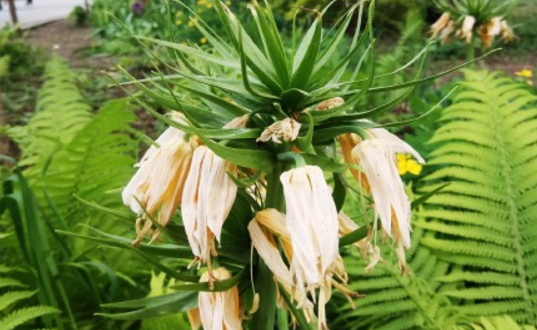
The flowers of Fritillaria imperialis are quite beautiful and vivid, mainly bright red, as well as orange-yellow and yellow. Fritillaria imperialis is a medium-sized plant, and when in bloom the flowers usually open at the top of the plant; the large bell-shaped flowers, usually several clustered together, hang downward and are very unusual.
In addition, there are other species of fritillaria, such as Fritillaria persica, which has long flower spikes and generally blooms in early summer;
Fritillaria michailovskyi, whose flower spikes are relatively small and whose flowers are bell-shaped, blooms in early summer.
III. What is it used for?
1. Ornamental value of Fritillaria imperialis
There are many varieties of Fritillaria imperialis suitable for cultivation; the plants are tall and upright, the flowers are large, and the flower shape is attractive with vivid colours, making it very suitable as an ornamental flower. Some varieties of Fritillaria imperialis have extremely high ornamental value, such as 'Aureomarginata', whose petals are orange; 'Crown Imperial', which likewise has orange petals and is notable for its two whorls of flowers; 'Lutea Maxima', whose petals are deep yellow; and finally 'Premier', whose orange-yellow petals bear slight purple markings, making it especially distinctive.
Compared with growing Fritillaria imperialis in pots, it is more suitable for cultivation in courtyards or gardens, where it can be used for landscaping and decoration. Of course, relative to short-stemmed plants, it can be grown in pots and used as a floral art piece placed indoors for viewing, which is also a good choice.
2. Medicinal value of Fritillaria imperialis
The most common medicinal effect of fritillaria is to resolve phlegm and moisten the lungs. The effects of different species of fritillaria are discussed specifically. Fritillaria cirrhosa is bitter in taste and cold in nature and is mainly used to resolve phlegm and stop cough; Fritillaria thunbergii is sweet and bitter and is mainly used for detoxification; Fritillaria verticillata has notable effects in clearing heat and detoxifying and in reducing swelling and discharging pus. But whichever kind of fritillaria it is, its medicinal value should not be underestimated.
Overall, these species of fritillaria all help relieve symptoms such as cough with phlegm and externally contracted cough. And with the progress of science and technology over time, modern pharmacological experiments have gradually revealed that fritillaria also has blood-pressure-lowering and blood-sugar-raising effects.