Production, Care and Management of Golden Bullet (scientific name Bottle Orchid) Bonsai and Its Main Varieties
Golden Bullet, scientific name Bottle Orchid. An evergreen shrub or small tree, with beautiful flowers and fruit; the fruit remains on the tree for a long time and is shaped like a pellet, hence the name “Golden Bullet”. It is suitable for planting in courtyards for ornamental viewing and for making stump bonsai. So do you know how to make a Golden Bullet bonsai? How to care for and manage it? What are the main varieties?
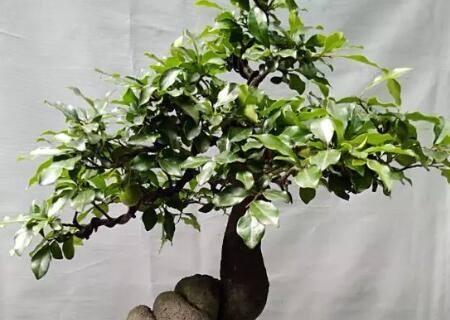
I. How to Make a Golden Bullet Bonsai
Golden Bullet has tough wood, a robust tree form, a thick and sturdy root base, and a peculiar trunk, vigorous and majestic. It often displays twisted sinews and turning bones, with bulging muscles, forming strange and distinctive scenes of grooves and channels, holes and cavities, pits and hollows, buds and tumors. The bark of Golden Bullet is dark black, ancient and solemn, with luxuriant branches and leaves, overflowing floral fragrance, and abundant brightly colored fruit, majestic and beautiful. Potted Golden Bullet easily bears fruit; with proper care of a collected wild stump, it can bloom and fruit in the third year, while ground planting requires 5-10 years or more. Golden Bullet has strong plasticity; when making bonsai, branches can be pruned, bent, and twisted, and the trunk can be hollowed, split, and carved. Golden Bullet has strong adaptability and can be planted in both north and south, east and west, traveling long distances to foreign lands and taking root there. Golden Bullet bonsai and stump material from Xiangxi, Hunan, China, have been sold to Guangdong, Fujian, Yunnan, Sichuan, Guizhou, Chongqing, Hubei, Shandong, and within the province to Changsha, Changde, Yueyang, Zhuzhou and other places, all growing well. In a follow-up visit, a batch of Golden Bullet bonsai sold to Guangzhou Baiyun Airport not only grew well but had already bloomed and fruited.
The Golden Bullet family has many members, colorful and mysterious, and is worth studying. By leaf shape, it can be divided into three categories: large leaf, medium leaf, and small leaf. Large leaves are generally 10cm×4cm to 13cm×6cm, medium leaves are generally 5cn×2cn-m to 10cm×4cm, and small leaves are generally 2cm×1cm to 5cm×2cm. By the number of flowers and fruit, it can be divided into three types: single-flower single-fruit type, double-flower double-fruit type, and multi-flower multi-fruit type. Regardless of which of these three types, all have male and female distinctions. By fruit shape, there are long round fruit shapes, slightly round fruit shapes, upper cone-shaped fruit, lower cone-shaped fruit, pomelo-shaped fruit, gourd-shaped fruit, and so on. By the color of mature fruit, there are golden yellow, orange-red, and pure green (with no change in color from young fruit to mature fruit). By the volume of mature fruit, there are large-fruit, medium-fruit, and small-fruit shapes. Large fruit diameter is 5-6cm; the leaves of trees bearing this fruit are large-leaf shaped, and the number of fruits set is small. Medium fruit diameter is 3-4cm, and the leaves may be medium or small. Small fruit diameter is about 2cm; trees bearing small fruit bloom especially abundantly, with a very high fruit-setting rate, and the fruits form clusters and strings. Some produce a string of five fruits in one bud, or strings of six or seven fruits, and some produce three fruits on one stem, that is, three fruits in one cluster. Golden Bullet combines flower viewing, fruit viewing, form viewing, greenery appreciation, and fragrance in one, with extremely high ornamental value, easy transplant survival, and the easiest care, with outstanding tree species advantages, making it the preferred material for making bonsai. The main method of bonsai production is a combination of trunk chopping and branch cultivation with wiring, shaping, and pruning.
Bonsai styling: mainly includes ancient tree forms such as straight trunk, slanted trunk, curved trunk, and lying trunk, as well as cliff, waterside, literati tree, forest style, and various pictographic bonsai, with diverse forms and rich variety. Enthusiasts can give free rein according to personal preference. After Golden Bullet is formed, it has good stability and is not easy to deform. To improve the ornamental effect, when styling Golden Bullet bonsai, take care that branches and leaves are not too dense, ensuring the advantage that Golden Bullet bonsai can be enjoyed both for its tree form and its fruit.
II. How to Care for and Manage Golden Bullet
Golden Bullet bonsai should be placed in a ventilated and sunny place for cultivation, with sufficient light and guaranteed water and fertilizer. During the growing season, generally apply decomposed farmyard manure once every 10-15 days. Excessive fruiting of Golden Bullet in the previous year will affect fruiting in the following year. If you want fruit every year, you must use artificial control methods to limit the number of fruits set, ensuring a strong tree form and abundant, brightly colored fruit, while also promoting flower bud differentiation without affecting the next year's fruiting. If you want to experience the spectacular scene of a bumper harvest, you can appropriately thin the fruit, maintain a certain number of fruits, and strengthen water and fertilizer management. In autumn and winter, you can enjoy the spectacular scene of red fruits all over the tree, in clusters and strings. A tree that has borne abundant fruit generally needs to rest the following year to recuperate, and water and fertilizer management must be strengthened. In the spring growth stage, supplement nitrogen, mainly with farmyard manure, and appropriately apply additional compound fertilizer. In the two months of autumn, July and August, apply phosphorus and potassium fertilizer twice to promote flower bud differentiation, so that the following year will again display the spectacular beautiful scene of abundant fruit. During the care of Golden Bullet bonsai, due to limited conditions, if bonsai are placed too densely, ventilation is poor, or due to insufficient light and long-term damp and shaded conditions, they are susceptible to scale insect damage. Control methods: first, adjust the placement position to improve ventilation and lighting conditions; second, spray with Supracide and fenpropathrin solution to control it.
III. What Are the Main Varieties of Golden Bullet
Golden Bullet is distributed and cultivated in East China, South China, and Central China in China. Currently, those on the market and exhibited are mainly Golden Bullet from Sichuan and Hubei, but these two kinds of Golden Bullet differ somewhat. First, let us look at Sichuan Golden Bullet. This variety has the characteristics of small leaves and many fruits, and as long as the cultivation years are met, small and miniature bonsai, or even very small stumps, can also bear fruit in pots.
Hubei Golden Bullet is divided into three types: large leaf, medium leaf, and small leaf. Large leaf has small fruit, medium leaf has large fruit, and small leaf has medium fruit. Some small stumps, even after many years of cultivation, rarely bloom and fruit. The biggest special feature of Hubei Golden Bullet is that it does not shed leaves in winter either. Every year from New Year's Day to the Spring Festival period, fruit-bearing Golden Bullet turns from green to red among the green leaves, with red and green complementing each other, iron-like trunks and twisted branches, full of vitality.