How to Grow Aerides multiflora, Potting Techniques, and How It Differs from Rhynchostylis
Aerides orchids like warm, humid environments and dislike strong light, making them suited to semi-shaded conditions. So what are the cultivation methods for Aerides? How does it differ from Rhynchostylis? How do you pot it? According to available information, the suitable growing temperature for Aerides is 15-28°C, and it can overwinter as long as the winter temperature stays above 8°C. It is suited to growing in soil rich in humus, and under suitable conditions its flowering period can last up to 3 months.
I. What Are the Cultivation Methods for Aerides?
1. Light
Aerides multiflora has its own unique cultivation methods, but for people who like this plant, these requirements are certainly not too much trouble compared with their love for the flowers.
Compared with most flowers, which prefer warm places with suitable sunlight as their growing environment, since such an environment allows the plant to carry out better photosynthesis and grow quickly and healthily, the best growing environment this flower needs is very different from theirs. It prefers cool, shaded places and dislikes direct sunlight, so it must never be placed in the sun to be scorched. However, we also cannot place it in too shady a spot; I will explain the specific reasons below.
2. Watering
This plant likes shady, humid environments with good ventilation. Generally, around 20 degrees is the most suitable growing temperature for this plant. 35 degrees and below 5 degrees will both affect its growth strength. Too high a temperature will cause corresponding burns to its delicate leaves, and too low a temperature will cause frost damage, so we must be sure to watch the weather and move it indoors and outdoors accordingly. If we want it to grow faster, we should water it regularly, because it likes to grow in moist soil.
3. Fertilizing
If you want to grow this plant, I suggest you choose to grow it from April to October, because the weather in October is the most suitable temperature of the whole year for its growth. We should fertilize it once every one or two weeks, mainly relying on natural organic matter. After regularly completing its care, we can slowly wait for the plant to grow. After growing, the plant's flowering period is generally in July, while the fruiting period is from August to May of the following year.
II. How Does It Differ from Rhynchostylis?
1. Different Genus and Species
Because their genus and species are different, many of their characteristics are also different. Specifically, the first plant belongs to the species Rhynchostylis gigantea and the genus Rhynchostylis; while the second plant belongs to the tribe Vandeae, the genus Aerides, and the species Aerides. The first plant also has other names, such as "Rhynchostylis gigantea," "foxtail orchid," and so on, while the second plant does not.
2. Different Appearance
(1) First is the difference in their leaf shape. Compared with the first plant, the leaves of the second plant are narrower and also longer, while the leaves of the first plant are wider and shorter; this difference can be observed. Next is the difference in their degree of hardness: the leaves of the former are relatively hard, while the leaves of the latter are relatively soft. This point cannot be seen through pictures; it can only be felt by touching them on site.
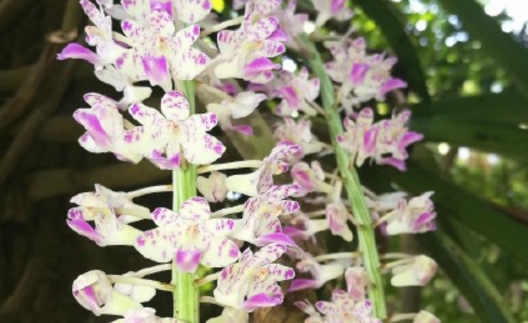
(2) Next is the difference in their flower color. For the first plant, the petals of its flowers are white with purplish-red spots on them, and the lip is purplish-red; while for the second plant, the front part of its flower is purple, and the back part is white, though slightly with purple spots and stripes.
3. Different Places of Origin
Here we mainly refer to their respective places of origin. The first plant originates in Hainan Province, China, while the second plant originates in Yunnan Province, China. As for their distribution after being introduced abroad, it is basically the same.
4. Whether They Have Fragrance
The former has a strong fragrance; some people may think of French perfume as soon as they smell it. However, the latter does not have such a strong fragrance.
III. How Do You Pot It?
Method 1: Prepare the orchid pot and various materials (soil, scissors, water, fertilizer).
Place the Aerides with its roots up and leaves down, and rinse it under a faucet with a gentle stream of water to wash the soil off the roots.
After washing, do not touch the roots with your hands. When potting, hold the roots with chopsticks and plant it directly without letting it touch the pot wall.
After planting, add soil: first put in one third gravel, then cover with fine soil.
Water appropriately, apply a small amount of fertilizer, and then care for it normally.
Method 2: First spread a layer of large-particle soil in the pot, 3-5 cm. When potting, take care that the roots extend naturally. Add grass and soil at the same time. Hold the orchid plant with your left hand and add soil with your right hand. After adding the soil, lift the orchid plant slightly to let the roots spread out.
Shake the pot; this is a very important step, allowing the soil to bind closely with the roots. After shaking the pot, press the soil around the roots firmly with your hands, and spread a layer of green moss on top. Water immediately, then place the orchid pot in a shady spot. Within one month, do not expose it to sunlight and simply control the water appropriately.