How to Grow Vanda Orchids, How They Differ from Ascocenda Orchids, and What to Do When the Leaves Turn Yellow
Vanda orchids, also known as Vanda, are tropical orchids with a southern charm. So how do you grow Vanda orchids? How do they differ from Ascocenda orchids? What should you do when the leaves turn yellow? According to available information, Vanda orchids are strongly cold-tolerant, poor at resisting heat, prefer dry conditions and dislike water, and still grow well at high temperatures of 35°C. They need relatively little potting medium for cultivation. In Thailand, you only need to tie the container holding the plant to a tree with rope, and it will grow with regular watering and fertilizing.
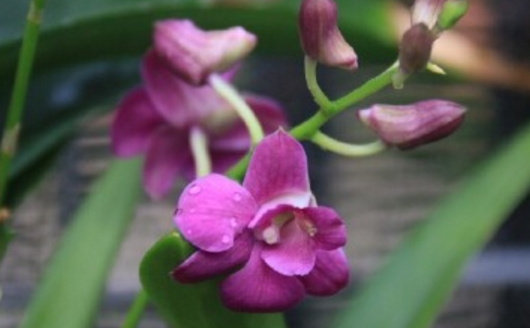
I. How Do You Grow Vanda Orchids?
1. Growing Environment
Soil: Vanda orchid roots are relatively thick and long, and they are mostly exposed to the air, so if you grow them in a pot, you must choose soil with good water permeability and air permeability, but leaf mold and potting soil are not recommended.
Temperature: It is best to plant when the temperature is above 20°C, and the most suitable growing temperature is between 20°C and 30°C.
Humidity: Humidity is very important to it because its roots like to be exposed to the air, so it needs relatively high humidity. During cultivation, humidity can be maintained between 70% and 80%, so you should spray water around it from time to time. This is especially true in winter, when it is best to have a humidifier, since manual spraying cannot be done all the time.
Water: Although the soil should be kept moist during cultivation, this does not mean waterlogging can be allowed, otherwise it will affect its survival.
2. Growing Method
Collect fresh seeds, rinse them clean with water, and scatter them on potting soil. Keep the temperature at 25°C, and it is best if they can receive sunlight for 12 hours a day. On cloudy days, a fluorescent lamp can temporarily take the place of sunlight. After about 2 to 3 months, corms will grow. Then cut these corms into pieces, put them in water and wait for them to root. Once rooted, they can be planted in their final position.
In fact, Vanda orchids have very strong vitality, and their flowers are large and vivid, so they are very much worth growing.
II. How Do They Differ from Ascocenda Orchids?
1. Vanda Orchids and Ascocenda Orchids Are Different Varieties
Vanda is the general name for plants in the genus Vanda. This genus has roughly 60 to 80 species and an extremely wide distribution, being found in China, India, Malaysia, the Philippines, Hawaii in the United States, as well as New Guinea and Australia. Ascocenda orchids are produced by crossing Ascocentrum orchids and Vanda orchids.
2. Vanda Orchids and Ascocenda Orchids Have Different Morphological Characteristics
Vanda orchids are typical epiphytic orchids. Their sepals are well developed, and the two lateral sepals are larger, making them the most eye-catching part of the entire flower, but the petals of Vanda orchids are relatively small, and the lip is even smaller. The flower shapes of Vanda orchids are very diverse; some are recurved and twisted, while others are round and flat. Vanda orchids have a very long flowering period, and a single flower can even stay open for several weeks in a row.
Ascocenda orchids are relatively short plants, only about half the size of Vanda orchids. Ascocenda orchids come in a profusion of flower colors, and some varieties bloom all year round, but most still concentrate their blooming in spring or in summer and autumn. The flower color variation of Ascocenda orchids is also very rich, with diverse colors.
III. What Should You Do When the Leaves Turn Yellow?
1. Water-Induced Yellowing
This is caused by long-term water accumulation in the pot making the soil too wet, which results in a lack of oxygen in the soil. This condition causes a small portion of the roots to show symptoms of rot, and it also leads to poorer water absorption capacity and weakened fertilizer absorption capacity. New tender leaves take on a dark yellow color and have no gloss on the surface. The tips of new leaf shoots shrink, and the stems become small and appear yellow-green.
Treatment Method
You should loosen the soil in time, reduce the amount of watering, and stop using fertilizer. In severe cases, you can take the soil and plant out of the pot, let them dry, and then put them back.
2. Fertilizer-Induced Yellowing
This is caused by excessive fertilization, especially nitrogen fertilizer, leading to yellowing leaves. In this case, new leaves are large and thick with unusual gloss, the leaf surface is uneven, and old leaves gradually turn yellow and then fall off.
The treatment method is
You should stop fertilizing and appropriately increase the amount of watering to dilute the nutrients.
When fertilizer is insufficient, or when the plant is large and the pot is small, or when the roots in the pot age and become too crowded, the leaves of the flowering plant will become thin and yellow.
Change the potting soil. Generally, it is better to do this around the time from Rain Water to the Beginning of Summer.