How do you care for the Moraceae Ficus elastica 'Black Prince'? Is it toxic? Does it purify the air?
Although the Ficus elastica 'Black Prince' likes sunlight, it is also tolerant of shade, has strong adaptability to light, and is extremely suitable for indoor decorative arrangements, often used to beautify living rooms and studies. So do you know how to care for the Ficus elastica 'Black Prince'? Is it toxic? Does it purify the air?
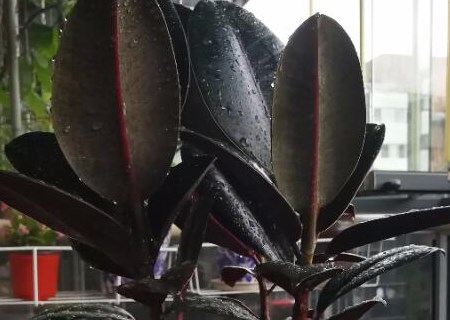
I. How to care for the Ficus elastica 'Black Prince'
1. Potting soil:
Ficus elastica dislikes clay soil. When potting, choose a loose, breathable, slightly acidic humus soil. You can mix garden soil : leaf mold : river sand at 2:2:1. For balcony growers, garden soil may be hard to get, so you can mix peat : leaf mold : perlite at 2:2:1 and add a small amount of organic fertilizer as base fertilizer. Many people like to spread stones or moss on the surface of the flower pot. The editor of Huinong Network personally does not recommend top dressing, especially for beginners. They already have trouble judging watering, and after top dressing the pot it becomes even harder to observe the wet and dry condition of the potting soil. At the same time, top dressing also has a relatively large impact on the wet-dry cycle of the potting soil. It is still best to choose carefully.
2. Placement (light):
Different placement of Ficus elastica will directly affect its form. Many flower enthusiasts like to keep Ficus elastica indoors under bright scattered light. After a period of time, they find that the branches of Ficus elastica are very long, prone to falling over, and not upright enough. This is often due to leggy growth caused by insufficient light. Ficus elastica likes an environment with ample sunlight. Although it is shade-tolerant, long-term cultivation in an environment without direct light will cause Ficus elastica to grow leggy, with sparse leaves and soft branches. Just like people who work in offices for a long time definitely have less strength than those who do outdoor labor; it is actually the same principle. Without direct sunlight and with insufficient light, the branches of Ficus elastica will not lignify enough, so they will be relatively soft, prone to drooping and leaning. The best way to grow Ficus elastica is to place it in the inner part of a south-facing balcony, so that it gets oblique direct light and can also avoid the strong direct light at noon, allowing Ficus elastica to grow robustly, with dense and deep green leaves.
3. Water and fertilizer management:
Ficus elastica grows vigorously in spring, summer and autumn. Along with watering, apply liquid fertilizer every 10-15 days, and you can alternate pure nitrogen fertilizer with nitrogen-phosphorus-potassium compound fertilizer. This can promote the growth of Ficus elastica. After the beginning of autumn, increase the application of phosphorus and potassium fertilizer to improve the plant's resistance and prepare for safe overwintering. When watering, be sure not to do it arbitrarily, watering whenever you feel like it. During the growing season, it is best to keep the potting soil moist. If you cannot judge it well, then wait until the surface of the potting soil is dry before watering, and water thoroughly each time. In winter, keep the potting soil of Ficus elastica on the dry side, otherwise it is easy to freeze to death.
4. Temperature:
Ficus elastica can also grow well at temperatures above 30°C, so in spring, summer and autumn there is no need to worry about the effect of temperature. In summer, just be careful not to expose it to strong sun. If it is really too hot and you feel sorry for it, then give it some air conditioning. The main issue is winter. Ficus elastica, like other indoor foliage plants, is not cold-tolerant, and in winter it requires temperatures above 5°C. Sigh,
5. Pruning:
Ficus elastica is a child with very poor self-control. If you do not manage it and want it to branch and leaf out on its own, the possibility is very small. Therefore, during its growth process, it must be managed. According to the height of the trunk you want, pinch and prune it to promote branching.
When Ficus elastica grows to a height of 1 m, pinch and prune it in time, because the leaves of Ficus elastica are very large. If it branches after growing too tall, the future trunk will bear a lot of pressure. Of course, if you want a shorter plant shape, you can also pinch at the height you want.
In addition to pinching to promote branching, for established plants, renovation pruning should also be carried out in spring, cutting off branches inside the crown. Dead branches and thin, weak branches should also be cut off. At the same time, excessively vigorous shoots that stick out should also be shortened to maintain the plant shape.
Furthermore, throughout the entire growth process, overly dense branches should be cut away at any time, and leggy branches should be shortened.
II. Is the Ficus elastica 'Black Prince' toxic?
Ficus elastica is toxic. Keeping Ficus elastica at home can be said to have more advantages than disadvantages. The toxicity of Ficus elastica is mainly in its sap. Under normal circumstances, if it is not eaten, there will be no poisoning, and the plant does not release toxic gas.
III. Does the Ficus elastica 'Black Prince' purify the air?
Do not think Ficus elastica is just leaf after leaf; its functions are very powerful. Ficus elastica has a natural effect of purifying dust, and can also purify indoor formaldehyde. Not only that, it can also absorb gases such as carbon monoxide, carbon dioxide and hydrogen fluoride in the air. It is most suitable to place in offices with more dust. Of course, the living room and entrance hall at home are also good choices.