How to grow and sow Bird's-foot Trefoil? Notes and value introduction
Bird's-foot Trefoil (scientific name: Lotus corniculatus Linn.) belongs to the genus Lotus in the family Fabaceae, order Rosales. So what are the growing methods and notes for Bird's-foot Trefoil? How to sow it? What values does it have? According to information, Bird's-foot Trefoil originates from the temperate zones of Europe and Asia, and is now found throughout the world. In China it is mostly used as forage grass, and it is distributed more widely in the southwestern region of China. It is also an excellent plant for soil and water conservation.
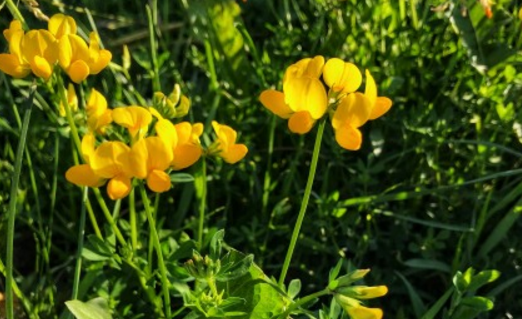
I. What are the growing methods and notes for Bird's-foot Trefoil?
Light and temperature
Bird's-foot Trefoil likes suitable light, is not tolerant of shade, likes a warm climate, and is not tolerant of cold. To grow Bird's-foot Trefoil, you need to provide long-day conditions; only with sufficient sunlight hours can it flower well. If the sunlight hours are shorter, flowering will be reduced and it will grow prostrate. The suitable temperature for the growth of Bird's-foot Trefoil is between 18°C and 25°C, and the temperature for flowering should be between 21°C and 27°C. Bird's-foot Trefoil is relatively intolerant of cold; in winter, if the temperature is too low, it is prone to cold damage, and below -3°C the stems and leaves of Bird's-foot Trefoil will turn yellow and withered. It has a certain degree of heat tolerance.
Watering and fertilizing
Bird's-foot Trefoil likes moisture. After planting, be careful to give the plants sufficient water to meet their growth needs, and fertilize reasonably. Bird's-foot Trefoil actually has a relatively large demand for fertilizer. When planting, you need to first apply sufficient base fertilizer; organic fertilizer or some phosphate fertilizer can both be used. Before fertilizing, it is better to sprinkle water on the fertilizer, pile it up, and let it ferment, then apply thoroughly decomposed fertilizer solution.
Soil
Bird's-foot Trefoil likes fertile soil that can be irrigated. Clay, sandy soil, acidic soil, and slightly alkaline soil are all soil options for Bird's-foot Trefoil. Bird's-foot Trefoil can tolerate poor and barren soil, and can also grow in poor and barren soil. However, the soil is best if it is deep, fertile, well-drained sandy soil.
Notes:
Pests and diseases
During the growth of Bird's-foot Trefoil, various pests and diseases often appear. The main diseases include gray mold, sclerotinia rot, southern blight, powdery mildew, rust, and black spot; the main pests are red spiders, aphids, white grubs, scale insects, alfalfa moths, and whiteflies.
Propagation methods
The propagation of Bird's-foot Trefoil is mainly by sowing, and it can also be propagated by cuttings. Propagation is relatively simple.
II. How to sow?
1. Seed treatment
Because its seeds are enclosed in a hard outer shell, this hard shell must be removed before sowing, otherwise germination will be affected. Mechanical assistance can be used to remove the shell, but it is easy to damage the seeds inside; they can also be soaked in warm water, but this takes a relatively long time. After about 24 hours, take them out of the water, dry them in the sun, then rinse them with clean water and dry them in the sun again before sowing.
2. Sowing method
Sprinkle the treated seeds into the soil, then cover with a layer of soil about 1 cm to 2 cm thick. The spacing between seeds is best at about 30 cm.
3. Sowing time
If sowing in spring, do it as early in spring as possible; if sowing in autumn, it must be completed before the end of August.
4. Management after sowing
After sowing, keep the soil slightly moist, and the environment must not be too dry. You can spray mist around the plants from time to time.
When small sprouts emerge, always pay attention to removing weeds, and loosen the soil from time to time. Because the sprouts grow extremely slowly, doing this can ensure that the sprouts grow more robustly.
If the temperature in early spring or after autumn is below minus 3°C, take cold protection measures in time, otherwise the small seedlings are very easily frostbitten. The cold tolerance of the small seedlings is very weak. Its optimal growth temperature is between 18°C and 25°C.
III. What values does it have?
1. The forage value of Bird's-foot Trefoil
Bird's-foot Trefoil has high grass yield, a long lifespan, a high seed reproduction coefficient, strong adaptability, and rich nutrition, ranking first among leguminous forage grasses. Its stems and leaves have a strong ability to retain nutrients, and after harvesting, nutrient loss is small, so the quality remains excellent; the stems and leaves of Bird's-foot Trefoil are tender and juicy with good taste, suitable for all kinds of livestock; in addition, Bird's-foot Trefoil has a relatively low saponin content and strong grazing tolerance, so livestock will not experience bloating after eating it.
2. The medicinal value of Bird's-foot Trefoil
Bird's-foot Trefoil is a Chinese herbal medicine that is sweet in taste and bitter-cold in nature, and mainly the root is used as the medicinal material. On the one hand, Bird's-foot Trefoil is a tonic type of medicine that tonifies deficiency and clears heat, and can quench thirst; on the other hand, Bird's-foot Trefoil has the effect of clearing heat and detoxifying, and can treat cough and pharyngitis; finally, Bird's-foot Trefoil can be used externally to treat eczema.
3. The soil improvement effect of Bird's-foot Trefoil
The root system of Bird's-foot Trefoil has numerous root nodules and a good nitrogen-fixing effect, which can increase soil organic matter, improve soil structure, and enhance soil fertility. It can be rotated with oilseed crops or cash crops to ensure good soil structure and nutrient supply.
4. The soil and water conservation effect of Bird's-foot Trefoil
Bird's-foot Trefoil tolerates barren soil, has a developed root system, prostrate stems and branches, strong ground-gripping ability, wide coverage, and strong ability to stabilize soil and prevent erosion, making it an excellent plant for soil and water conservation.