How many years does the nationally second-class protected plant Mucuna birdwoodiana take to bloom after planting, and when does it bloom?
Mucuna birdwoodiana, also known as white flower oil hemp vine, flower oil hemp vine, and sparrow flower. It is a nationally second-class protected plant and is cultivated throughout southern China. When in bloom, the flowers hang in clusters like sparrows in flight, giving it considerable ornamental value. So how many years after planting does Mucuna birdwoodiana bloom? When does it bloom?
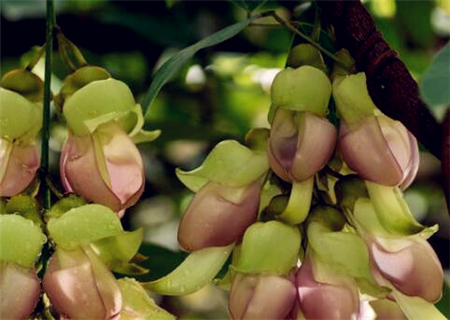
The specific blooming time of Mucuna birdwoodiana
Mucuna birdwoodiana mostly grows in warm and humid climates; it tolerates shade and drought but is not cold-resistant. It is vigorous and fast-growing, with strong climbing ability. Its flowering period is generally from early March to mid-April each year; in months with cold weather or frequent rain, it is delayed by about half a month.
When the flowers bloom, the petals curl into wing shapes, and the whole flower is exquisite and translucent. Because it has “head, eyes, beak, wings, and tail” all complete, it looks just like little sparrows huddled together, making visitors linger and take photos as souvenirs. Mucuna birdwoodiana flowers are light green or milky white when they first open, lemon yellow when in full bloom, and then turn pink and orange-red. Usually each cluster has 10-20 flowers, and some can grow to 20-30 flowers. A single tree usually bears hundreds or thousands of clusters of Mucuna birdwoodiana flowers, which is very spectacular.
How does Mucuna birdwoodiana propagate?
Choose the cutting method to propagate Mucuna birdwoodiana. First, the branch selected as the cutting must be strong enough. We also need to prepare a solution with rooting hormones such as rooting powder, and soak the lower end of the selected branch in the solution to prompt the cutting to root quickly. After that, we can insert the branch into a wet sand bed. At this time, pay attention to shading and keep the soil moist at all times. Roots can grow in about one month. The cutting propagation method is generally carried out in spring, because cuttings sprout more easily then; when cutting in summer, be sure to protect from sun and keep moisture.
Layering propagation of Mucuna birdwoodiana
Layering propagation requires the vines of Mucuna birdwoodiana that have fallen to the ground. After scratching the lower part of the vine's node, bury it in the soil. At this time, keep the soil moist. Wait until the buried vine grows roots, then cut the vine from the original plant and it can be cultivated. We can fertilize appropriately to promote the growth of the new plant.
Seed propagation of Mucuna birdwoodiana
Mucuna birdwoodiana can also be propagated by seed. Mucuna birdwoodiana produces fruit in autumn, and at this time we can get 5-10 seeds from the fruit. When propagating by seed, we should choose plump seeds that have not been stored for many years, as these seeds have relatively strong vitality. Before sowing, we should soak the seeds in water so that the Mucuna birdwoodiana seeds absorb water and swell. Generally, they need to be soaked for 7-10 days. After the seeds have swollen to a certain extent, place them in a dark and moist place. Once the seeds grow true leaves, they can be transplanted into soil for planting, and in about one year they can grow to about 1 m.