Amaranthus tricolor: Growing Methods and Precautions, Propagation Techniques, and Benefits and Effects
Amaranthus tricolor is also known by the names leaf cockscomb, laolai jiao, small sky-blue hydrangea, laolai shao, and others. So what are the growing methods and precautions for Amaranthus tricolor? How do you propagate it? What benefits and effects does it have? According to available information, Amaranthus tricolor is a relatively easy plant to grow; it can tolerate drought but is not very cold-hardy, and it likes a moist environment with plenty of light, requiring fairly good ventilation. It is not demanding about soil and prefers loose, fertile soil with good drainage.
I. What are the growing methods and precautions for Amaranthus tricolor?
Soil
Amaranthus tricolor is not strict about soil. Potted Amaranthus tricolor generally uses a mixed soil, blending garden soil, leaf mold, and fine sand; it requires loose, fertile soil with good drainage and has a certain tolerance for alkalinity.
Light and temperature
Amaranthus tricolor likes sunlight. During the growing period, sufficient light must be ensured for vigorous growth; controlling light within a certain range of time helps the formation of flower buds. As for temperature, the growing temperature must be kept between 18°C——25°C to ensure a relatively warm growing environment. Amaranthus tricolor is not cold-hardy, and in winter the overwintering temperature must be kept above 10°C.
Watering and fertilizing
Amaranthus tricolor requires a sufficient water supply during the growing period, and watering must be controlled. Keeping the potting soil moist will make the stems and leaves of Amaranthus tricolor grow well, but it may also cause leggy growth; however, it must not lack water either. Although Amaranthus tricolor can tolerate drought, it must not be too dry, as this will make the leaves turn yellow or even drop off. Fertilizing does not need to be excessive; Amaranthus tricolor is generally given sufficient base fertilizer at planting time, and during the growing season it can be fertilized 2——3 times to meet its needs for various growth elements.
Precautions:
Propagation methods
Amaranthus tricolor can be propagated by sowing or by cuttings. Sowing is done in spring, and cutting propagation is done during a good growing season, but cuttings produce a relatively small number of plants, so this method is generally not used.
Pinching
During the growing period, Amaranthus tricolor can be pinched back, mainly to encourage more branching. You can also skip pinching and let it grow freely. Potted Amaranthus tricolor plants that are not pinched will have a relatively tall plant shape, so measures need to be taken to prevent lodging.
Pests and diseases
The more common diseases of Amaranthus tricolor are mostly root rot and stem rot, mainly caused by excessive moisture. The main pest is the whitefly, and preventive measures need to be taken.
II. How do you propagate it?
1. Seed propagation of Amaranthus tricolor
For flowers like Amaranthus tricolor, seed propagation can be said to be the most commonly used propagation method. In addition, seed propagation is relatively feasible, and after sowing, the survival rate of Amaranthus tricolor is also relatively high, so in home settings people always choose the sowing method to propagate Amaranthus tricolor. Below we will specifically explain the steps of seed propagation for Amaranthus tricolor. First is the best time for sowing Amaranthus tricolor, generally in May. When sowing, a certain amount of shading treatment is needed. The reason for choosing May is that in May the seeds mature; if they are not picked in time at this point, the seeds will fall to the ground. After picking the seeds, scatter them evenly in the soil, which should be loose, breathable, well-drained, and somewhat nutrient-rich and fertile. After scattering, cover the seeds with a thin layer of soil, water thoroughly, and care for them. Amaranthus tricolor sown this way generally has the entire base of its leaves turn red by September. It can be used for decoration.
2. Cutting propagation of Amaranthus tricolor
Cuttings are also, relatively speaking, a fairly commonly used propagation method. The specific steps for cuttings are as follows. First, prepare the soil; the reason for preparing the soil first is to prevent the cuttings from drying out. The second step is to select the cuttings. The cuttings are generally selected from strong mother branches of Amaranthus tricolor. After choosing the mother branch, use scissors to cut off a section of young tender branch about seven centimeters long as the cutting, then insert the cutting into the prepared soil, water thoroughly, and carefully care for it.
3. Transplant propagation of Amaranthus tricolor
Because the seeds of Amaranthus tricolor fall to the ground after maturing in May, these seeds will slowly germinate. The Amaranthus tricolor that is generally transplanted is this kind of sprout, and in essence it is the same as seed propagation of Amaranthus tricolor.
III. What benefits and effects does it have?
1. Ornamental value of Amaranthus tricolor
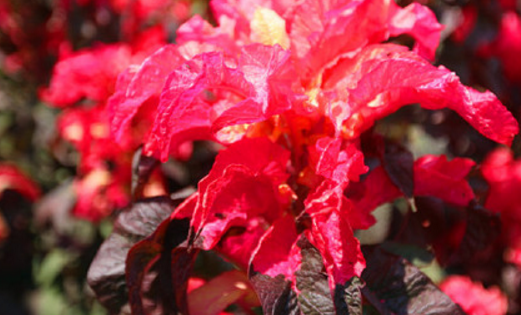
This effect basically needs no elaboration. After Amaranthus tricolor grows to maturity, its leaves take on a complete bright red color, very stunning and beautiful, so its ornamental value is very high. It is often planted in fields and gardens by people to decorate the home. In the cold winter, when a little bit of scorching red suddenly appears in the silent air, it unconsciously warms the heart; in addition, Amaranthus tricolor is sometimes planted in gardens and along both sides of streets, and while beautifying the cityscape, it also saves a sum of money, because the cost of Amaranthus tricolor is not considered too high.
2. Effects of Amaranthus tricolor after being used as medicine
First, Amaranthus tricolor is somewhat helpful in treating dysentery. The effect of Amaranthus tricolor in treating dysentery is recorded in many medical classics. In ancient times, people basically all used Amaranthus tricolor to treat dysentery, and to this day, in traditional Chinese medicine, many prescriptions for treating dysentery still include this medicinal material, Amaranthus tricolor. Second, it treats vomiting blood and flooding and spotting, among others. It seems Amaranthus tricolor truly lives up to its name, being entirely red after maturity, and it is quite effective in treating blood-related diseases such as vomiting blood. Finally, when used medicinally, Amaranthus tricolor is cool in nature, bitter in taste, and also has a certain effect of improving eyesight. Many folk remedies are related to Amaranthus tricolor; for example, decocting Amaranthus tricolor in water and taking it as a drink can treat red and white dysentery, and taking it as a soup can treat brain leakage, among others.
3. Economic value of Amaranthus tricolor
In ornamental terms alone, the economic value of Amaranthus tricolor is still not very apparent; the main factor still depends on its effects after being used as medicine. Due to the large demand in the medical field, it will bring certain economic benefits to growers, and Amaranthus tricolor can even rely on this to drive local economic development.