Cultivation and Propagation Methods, Precautions and Value of Red Flower Banana (Musa coccinea) in the Banana Family
Red Flower Banana is also known as Red Banana, Ornamental Banana, Finger-to-Sky Banana, and Red Hime Banana. So what are the cultivation methods and precautions for Red Flower Banana? How to propagate it? What value does it have? According to available information, when cultivating Red Flower Banana, attention should be paid to water and fertilizer. It is quite fond of fertilizer, but its requirements for fertilizer are not high. During the growing season, it can be fertilized about once every half a month. During the stage of flower bud growth and differentiation, some phosphorus fertilizer and potassium fertilizer can be applied to promote flower bud differentiation.
I. Cultivation Methods and Precautions for Red Flower Banana?
Light and Temperature
Red Flower Banana prefers a warm environment and requires ample light. It can tolerate partial shade and is not very cold-hardy. During its growth period, Red Flower Banana needs suitable temperatures, maintained between 24°C-30°C. In summer, it generally should not exceed 35°C. In winter, if the temperature does not drop below 15°C, it can continue to bloom, but if the temperature falls below 4°C, it is prone to cold damage. The environment should have ample sunlight. In spring and autumn, ample sunlight is beneficial for leaf growth and flower development. Note that it should not be kept in shade for extended periods, as this will affect blooming. In summer, it is necessary to avoid prolonged exposure to strong sunlight, which can scorch the leaves, so appropriate shading is needed.
Pot and Soil Selection
For cultivating Red Flower Banana, a large-diameter clay pot can be chosen. The soil should be loose, fertile, rich in humus, and well-draining acidic soil. It can be made by mixing garden soil, peat soil, and coarse sand in a certain ratio.
Watering and Fertilizing
During the growing season, Red Flower Banana requires the pot soil to remain moist. Watering should be done more frequently. During dry periods, it is also necessary to spray water regularly to maintain a certain level of air humidity, but waterlogging must be strictly avoided.
The growth of Red Flower Banana requires sufficient nutrient support, so reasonable fertilization is necessary. At the time of planting, a sufficient base fertilizer should be applied. After that, during the growing season, fertilizer should be applied once a month, using well-rotted dilute fertilizer water. Before Red Flower Banana blooms, attention should be paid to applying some phosphorus and potassium fertilizer to promote flowering.
Precautions:
Pruning
Red Flower Banana has abundant flowers and leaves and grows relatively quickly. During the growing season, yellow leaves, old leaves, and broken leaves need to be pruned. After flowering, the remaining branches should be cut off to benefit the sprouting of new branches and leaves, and to maintain ventilation and light penetration, so that the plant grows well.
Repotting
As Red Flower Banana grows, it needs to be repotted to ensure good growth. Generally, Red Flower Banana is repotted once a year.
Pests and Diseases
During the growth of Red Flower Banana, diseases such as anthracnose and leaf blight may occur, as well as damage from pests such as scale insects, whiteflies, and banana borer moths.
II. How to Propagate?
1. Overview of Red Flower Banana Propagation Methods
Like other plants, Red Flower Banana has many propagation methods, but the two most important are seed propagation and division propagation. Among them, seed propagation has a relatively high survival rate. If you are not very confident in your cultivation skills, it is best to use seed propagation, i.e., sowing seeds, for propagation. If you have certain propagation and cultivation skills and want to shorten the growth cycle of Red Flower Banana, then you should use the division propagation method.
2. Seed Propagation of Red Flower Banana
Seed propagation, as the name suggests, is a method of propagating Red Flower Banana using mature seeds. Before sowing the seeds, the soil needs to be prepared. The minimum requirement of Red Flower Banana for soil is that it is loose and breathable, and does not compact. If the soil is fertile and has sufficient nutrients, that would be even better. After the soil is prepared, the seeds need to be selected. The selected seeds should be plump and free of scratches, as only excellent seeds can improve the survival rate of Red Flower Banana. When sowing the seeds, they should be sown evenly. After sowing, the seeds should be covered and watered thoroughly.
III. What Value Does It Have?
The Value of Red Flower Banana
Red Flower Banana is a beautiful flowering plant, so its ornamental value is naturally very high.
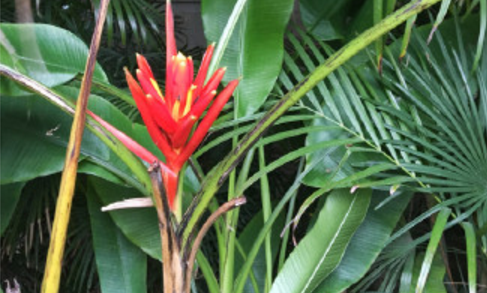
Red Flower Banana generally blooms in summer and autumn, and it is very beautiful when in bloom. The plant is slender and delicate, bearing a flower torch, and the fiery red, vivid bracts are very beautiful. It is an excellent flowering ornamental plant.
Because the flowering period of Red Flower Banana is very long, people can plant it in courtyards, generally at wall corners, beside windows, and by ponds, to create a beautiful scene.
In addition, its upright, vivid inflorescences can be cut for use as cut flower material.
It should be noted that the roots and some other parts of Red Flower Banana are toxic and cannot be eaten. This must be kept in mind when cultivating Red Flower Banana.