How to grow Ageratum conyzoides seeds? Flowering and propagation methods
Ageratum conyzoides, also known by the alias Sheng Hong Ji, and also called Xian Xia Hua, Mao She Xiang, Die Zi Cao, etc. So how do you grow Ageratum conyzoides seeds? When does it bloom? How do you propagate it? According to available information, Ageratum conyzoides prefers a warm growing environment and requires ample sunlight. Ageratum conyzoides is relatively intolerant of cold, and its tolerance for high temperatures is also relatively poor; when temperatures are too high, its growth suffers. However, Ageratum conyzoides still has fairly strong growth ability and is relatively tolerant of pruning.
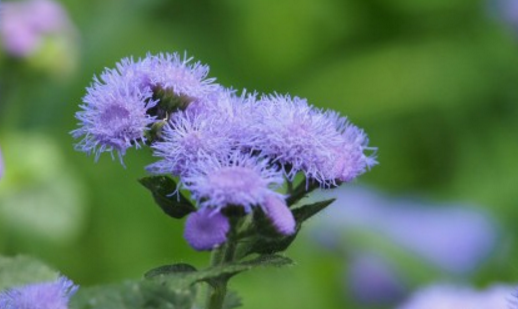
I. How to grow Ageratum conyzoides seeds?
1. Soil preparation
Different flowers all need different soils for sowing, so choosing the right soil plays a crucial role in the subsequent growth and development of Ageratum conyzoides. The planting soil for Ageratum conyzoides needs to use garden soil, then add an equal amount of farmyard manure, and then add a small amount of decomposed manure and mix them evenly together. With soil prepared in this way, the seeds will sprout very easily, and after development the Ageratum conyzoides will also grow very robustly.
2. Sowing
Because the seeds of Ageratum conyzoides are very small, the work of sowing becomes relatively less easy. The sowing time is generally determined according to the flowering period of Ageratum conyzoides, so that by adjusting the sowing period of Ageratum conyzoides you can regulate its flowering period. If you need them to bloom around Labor Day, you can sow at the end of August and the beginning of September of the previous year; in this case they need to be placed in a greenhouse to overwinter, and only in late April of the following year can they leave the greenhouse. However, under normal circumstances, Ageratum conyzoides is sown in a greenhouse in February each year, or sown in the open field in April.
When sowing, you need to put the prepared soil into a pot, then level it and press it down, then water it thoroughly, and then place the seeds of Ageratum conyzoides on top of the soil. The seeds of Ageratum conyzoides are not light-demanding, so you need to put a layer of soil on top of the seeds, but it must not be too thick; it only needs to be just enough to press down the seeds. After about a week you can see the seeds sprout into seedlings.
3. Planting out
Planting out is done when the seeds have sprouted into seedlings and grown several leaves. First you need to choose a suitable flower pot; generally a flower pot with a diameter of around ten-plus cm is enough. Then the potting soil should mainly consist of garden soil and sandy soil. Then plant the young seedlings of Ageratum conyzoides into the soil, press the soil firm, water thoroughly, and place them in a shady spot for about a week before they can be moved to a sunny place to grow.
4. Daily management
Do not water too much; generally just keep the soil moist. In the early stage of growth, you can appropriately water a bit more, which can let Ageratum conyzoides grow well.
As for fertilizing, generally during the growth period you can apply organic fertilizer once or twice, a thin fertilizer is enough.
Because Ageratum conyzoides likes sunlight, you can let it bask in the sun more.
II. When does it bloom?
Flowering period:
This plant can be said to bloom from January at the start of the new year to December at the end of the year, so its flowering period should be calculated as year-round.
Care during the flowering period:
1. Timing and frequency of watering
Because this plant can bloom year-round, you must always manage the amount of water given. When we see that the surface layer of the soil in the pot shows signs of turning white and drying out, we can water it. It is worth noting that the amount of water must be sufficient; you cannot just give a half watering and be done with it. When the hotter season arrives, because this plant grows very vigorously at this time, you need to water it twice a day to replenish moisture.
2. Amount of fertilizer applied
Because this plant blooms frequently, its demand for nutrients is very large, and we need to replenish fertilizer in time so that it can absorb sufficient nutrients. During its peak growing season, that is, in the hotter season, you can water it with diluted fertilizer water once every 10 to 15 days, and you can appropriately add some phosphorus and potassium fertilizer, which can not only dwarf the plant but also enhance the vivid color of the flowers, thereby increasing the ornamental value of the flowers.
3. Pruning the plant
Because this plant blooms all year round, and if we want to enjoy the plant and hope to see a beautiful scene of compact plants with many flowers, we need to pinch the tips multiple times. Generally, pinching the tips and removing the growing points should reach 3 to 4 times, and after the first batch of flowers has bloomed, the plant should be pruned in time. Generally we can keep old branches 5 to 6 cm tall, and all the parts above should be cut off, while also thinning out and cutting away branches that are too dense.
4. Maintaining humidity
This plant likes to grow in a humid and slightly dry climate environment, so the air humidity it requires is between 50%-70%.
III. How to propagate?
1. Seed propagation of Ageratum conyzoides
The seeds of Ageratum conyzoides are relatively small, so sowing requires greater care. Usually, early February is suitable for sowing in a greenhouse, and early April can also be used for open-field sowing. The growing soil is suitable with farmyard manure and garden soil at half each, mixed with a small amount of leaf mold, mixed evenly, and then sifted. Put the growing soil into a suitable container, gently press the medium firm, then water thoroughly; after the water has seeped in, the seeds can be evenly broadcast on the wet soil. Note that the covering soil should not be too thick; it is appropriate as long as it can cover the seeds tightly. Afterward, just keep the potting soil moist. After about 10 days or so, the seedlings will emerge. When the seedlings have grown 2 pairs of true leaves, they can be pricked out; note that the seeds of Ageratum conyzoides are small, so the young seedlings grow relatively slowly.
2. Cutting propagation of Ageratum conyzoides
The advantage of cutting propagation is that it can promote Ageratum conyzoides plants to take shape early and bloom early, and apart from low temperatures in winter, cuttings can be taken in other growing seasons, with a relatively high survival rate. First, prepare healthy, large mother plants; in winter, place them in a greenhouse. In early spring, select robust-growing Ageratum conyzoides branches and keep 2-4 true leaves. The length of the branches is about 5-6 cm, with the cut located below a node, and they can be inserted as soon as they are cut. The cutting depth is about 1/3-1/2 of the length of the cutting. In hot seasons, after cutting, they need to be placed in a cool, ventilated place to prevent harm from high temperatures and sun exposure. Generally after about 10 days they will take root, and then they can be pricked out.