Lychnis senno varieties: an in-depth guide to care and propagation
Lychnis senno is a relatively cold-hardy plant that loves light and does not need frequent shading. So what varieties of Lychnis senno are there? What are its care methods? How is it propagated? According to available information, Lychnis senno is mainly used as a garden flower, for planting in flower beds and borders. It can also be grown in pots, or used as a cut flower.
I. What varieties of Lychnis senno are there?
Lychnis fulgens (large-flowered lychnis)
Lychnis fulgens is a perennial herbaceous plant, with a plant height of about 50——80cm, and relatively long hairs on the plant. When it blooms, it bears cymose inflorescences; the petals number 5, with deep divisions at the front, and the color is mainly bright red. The flowering period of Lychnis fulgens is from June——September, and it sets fruit after flowering, from August——October.
In terms of growth habits, Lychnis fulgens likes cool and humid environments and is relatively cold-hardy. Its distribution range is quite wide, and it is found in many countries.
Lychnis wilfordii (silky-petaled lychnis)
Lychnis wilfordii is also one of the varieties, with a plant height of 45——125cm, and the plant is mostly hairless. When Lychnis wilfordii blooms, usually about 7——20 flowers cluster at the top of the stem. The bright red petals number 5.
Lychnis cognata (shallowly lobed lychnis)
Lychnis cognata is a perennial herbaceous flower, with a plant height of about 25——90cm, and curved long hairs on the plant. When it blooms, usually 3——7 flowers cluster together, and the flower color is mostly orange-red and light red; the flowering period is from July——September.
Lychnis chalcedonica (wrinkled-leaved lychnis)
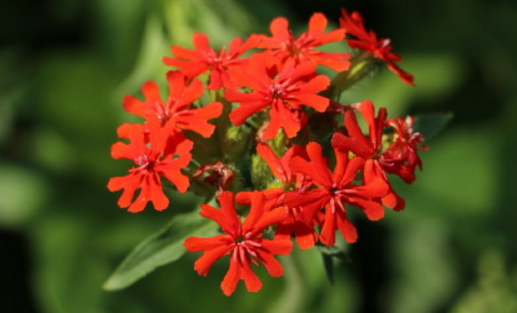
Lychnis chalcedonica is a perennial herbaceous plant, with a plant height of 60——90cm. When it blooms, the small flowers number about 10—50, forming a cymose inflorescence; the flowers are bright red or brick red, and the flowering period is from May—June. It is relatively cold-hardy and likes well-drained soil. The flowers are beautiful and vivid, making it a good flower for cut flowers and potted plants, and suitable for borders.
Lychnis dioica (dioecious lychnis)
Lychnis dioica is a biennial or perennial herbaceous flower. The plant height is about 90cm, and when it blooms, the flowers are purplish red or pink; it generally blooms during the day and has no fragrance.
II. What are the care methods?
Soil
When growing Lychnis senno, suitable soil needs to be chosen. It does not have high requirements for soil; generally, choosing well-drained soil is enough. Basically, calcareous soil rich in humus will do, and sandy soil is also a very good choice.
Watering
When growing Lychnis senno, watering is also very important. It relatively likes moisture. When growing it, water more frequently in spring, watering 3——6 times per month.
Light and temperature
In terms of light and temperature, the needs of Lychnis senno must be met. It requires sufficient light, and the temperature must be suitable; its suitable growth temperature is between 15℃——35℃.
Propagation methods
For the propagation of Lychnis senno, generally seed sowing propagation or division propagation is chosen, but it can be done in either spring or autumn.
Notes:
Pruning
When growing Lychnis senno, pruning should be carried out at the right time; this can extend the flowering period and also make it grow well. In the early stage of growth, when the plant grows to about 20cm and has 7——8 leaves, pinch out the growing tips promptly.
Pests and diseases
Leaf spot is a common disease of Lychnis senno; in addition, there is lychnis rust. When Lychnis senno begins to show disease, treat it promptly; fungicides or chemical agents can be used for treatment.
III. How is it propagated?
1. Seed propagation of Lychnis senno
Lychnis senno can be propagated by seed, and the propagation time is in spring and autumn. Spring sowing is generally in March——April, while autumn sowing is in August——September; in northern regions, sowing can be done in a greenhouse.
When sowing Lychnis senno, relatively loose soil can be chosen; generally, a sowing bed or a seedling tray is enough. Put in the soil and water it thoroughly, then mix the seeds with fine sand and broadcast them. After sowing, note that a layer of soil should be covered on top.
After sowing, note to maintain a suitable temperature; generally, seedlings emerge in about 7——10 days. After germination, note to maintain ventilation. Once one leaf has grown, the seedlings can be separated, and when 5 leaves have grown, they can be transplanted and planted out.
2. Division propagation of Lychnis senno
Lychnis senno can be propagated by division. Division is generally carried out in spring and autumn, usually once every 2——3 years. Take the Lychnis senno plant out, then divide it into several plants; note that each newly divided plant must carry buds.
When dividing, be careful to avoid breaking all the roots.
If many roots of Lychnis senno are accidentally broken, then the broken roots need to be collected and used for root cutting propagation, maintaining a semi-shaded environment; they still root fairly easily.