Bonsai Making and Care Methods for Euonymus of the Order Celastrales, Differences from Holly, and Its Effects
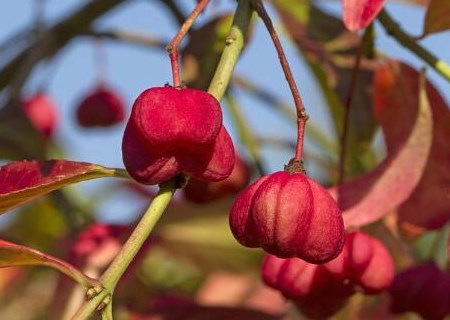
The winged branches of Euonymus are unique, its autumn leaves are brilliantly red and eye-catching, and the split fruits are also red, making it very beautiful. It can also be made into bonsai and is truly an excellent ornamental tree. So do you know what the bonsai making and care methods for Euonymus are? What is the difference from holly? What effects and functions does it have?
I. Bonsai making and care methods for Euonymus
1. Making
When making a Euonymus bonsai, you should choose a suitable flower pot and soil, and pot the Euonymus plant. Euonymus is generally repotted once every 2——3 years, and repotting is carried out in spring and autumn. Be careful to replace it with new soil and prune the roots.
After potting, note that to maintain the plant shape of Euonymus, timely pruning is needed. Pruning is generally carried out in spring and autumn. Through pruning, a good plant shape of Euonymus can be maintained.
2. Care
To grow a Euonymus bonsai, first place it in a suitable location. Euonymus likes light and likes air circulation. It is generally placed in a place with sufficient light, but in summer, pay attention to appropriate shading. In winter, it is generally cared for indoors, and it is sufficient to bury the pot for cultivation.
For watering, generally do not water unless dry; just pay attention to keeping it moist. In autumn, water should be withheld, and in winter, water once a week.
It is relatively fond of fertilizer, and generally needs fertilizing once every two weeks. Be careful to avoid excessive vegetative growth, and when fertilizing, mainly use phosphorus and potassium fertilizer.
Euonymus bonsai also requires attention to pests and diseases, and pesticide spraying for prevention and control is needed every year in April.
II. What is the difference between Euonymus and holly
Celastraceae is a family in the subclass Rosidae of the class Dicotyledoneae. Trees or shrubs, often climbing. Stipules small or absent, early deciduous; leaves simple, alternate or opposite. Inflorescences axillary or terminal cymes or racemes; flowers bisexual, sometimes unisexual; calyx small, 4-5-lobed, persistent; petals 4-5; stamens 4-5, alternating with the petals; ovary superior, 1-5-locular, each locule with 1 to many ovules. Samaras, berries, or capsules; seeds often with an aril.
Aquifoliaceae trees or shrubs, evergreen or deciduous; leaves simple, alternate, rarely opposite or pseudoverticillate, blades usually leathery, papery, rarely membranous, serrate, glandular-serrate, or spinose-dentate, or entire, petiolate; stipules absent or small, early deciduous. Flowers small, actinomorphic, unisexual, rarely bisexual or polygamous, dioecious, arranged in axillary, extra-axillary, or subterminal cymes, pseudoumbels, racemes, panicles, or fascicles, rarely solitary; calyx 4-6-parted, imbricate, persistent or early deciduous; petals 4-6, free or basally connate, usually rounded, or with 1 inflexed small tip at the apex, imbricate, rarely valvate (as in Phelline Labill.); stamens as many as the petals and alternating with them, filaments short, anthers 2-locular, introrse, longitudinally dehiscent; or 4-12, in one whorl, filaments short and thick or absent, connective thickened, anthers elongated or thickened into petal-like forms (as in Sphenostemon Baill.), (staminodes present in female flowers, often sagittate); disk absent; ovary superior, carpels 2-5, connate, 2- to many-locular, each locule with 1, rarely 2, pendulous, transverse, or curved ovules, style short or absent, stigma capitate, discoid, or shallowly lobed (abortive pistil present in male flowers, subglobose or pulvinate). Fruit usually a berry-like drupe, with 2 to many pyrenes, usually 4, rarely 1, each pyrene with 1 seed; seeds with abundant endosperm, embryo small, erect, cotyledons flat.
III. What effects and functions does Euonymus have
"Explanation of names" Guijian, Shenjian.
"Flavor" Bitter, cold, nontoxic.
"Main indications"
1. Postpartum stagnant blood (hard and distended umbilical and abdominal region, lochia not flowing smoothly). Use Angelica sinensis (stir-fried), Euonymus (with the central wood removed), and Carthamus tinctorius, 1 liang each. Take 3 qian per dose, decoct with 1 large bowl of wine until reduced to 70 percent, and take warm before meals.
2. Malaria. Use Euonymus and pangolin scales (coal ash), 2 qian 5 fen each, grind together into powder. Take 2 or 3 fen each time, into the nose when the illness occurs. Another formula: use 1 fen of Euonymus powder, 1 qian of arsenic, and 1 liang of Trogopterus dung, grind together into powder. When the illness occurs, take 1 qian mixed with cold water.