Crocus-like Tritonia (Montbretia) fire flower: home cultivation methods, precautions, propagation, and effects and functions
The fire flower likes full sunlight and is cold-tolerant. In the middle and lower reaches of the Yangtze River, its corms can overwinter in the open ground. So what are the home cultivation methods and precautions for the fire flower? How does it propagate? What effects and functions does it have? According to available information, the fire flower is suitable for growing in well-drained, loose and fertile sandy loam, and during the growing period the soil needs sufficient moisture. It is native to South Africa. In northern China it is mostly grown in pots, while in the south it can be cultivated in the open ground.
I. What are the home cultivation methods and precautions for the fire flower?
Light
It likes full sunlight, so be sure to maintain sunlight exposure for the fire flower.
Temperature
One of the characteristics of the fire flower is its cold tolerance. In the middle and lower reaches of the Yangtze River, its corms can overwinter in the open ground. In northern China, however, it is best to place it indoors in a spot that easily receives sunlight during winter.
Soil
It is suitable for growing in well-drained, loose and fertile sandy loam, and during the growing period the soil needs sufficient moisture.
Water
During the growth period, pay attention to watering and keep the soil moist, and during the fire flower's reproductive period, be sure to ensure there is sufficient moisture in the soil.
Fertilizing
The growth of the fire flower is in fact the elongation growth of its stolons, and its spreading ability is very strong. Therefore, before planting, the soil should be thoroughly plowed, sufficient base fertilizer applied, and the bed formed into raised beds. After sprouting in mid-March, apply 1 topdressing each at the bud stage and after the flowers fade, so that the leaves are lush and the flowers abundant and plump renewal corms are formed. In this way, generally the early corms will bloom as soon as June of the same year, while the weak ones will bloom the following year.
Precautions:
Cold tolerance
The fire flower is native to Africa; its so-called cold tolerance is actually based on African temperatures. Friends in northern China must really pay attention in winter, and it is best to move it indoors.
Water
Pay attention to the two periods when the fire flower needs relatively more water: the growth period and the reproductive period.
Space
The stolon growth of the fire flower requires relatively large space, so pay more attention when planting it~ leave sufficient space for it.
II. How does it propagate?
1. Propagation method
Division of corms
2. Propagation method and steps
The fire flower's corms have a relatively strong natural propagation ability, and division of corms is commonly used for propagation.
The fire flower is generally suitable for division once every 3 years; the best time is to dig up the corms in spring before new buds sprout, then divide and plant them.
Before planting, first prepare the soil the fire flower likes, which requires well-drained, fertile sandy soil.
In addition, because the fire flower grows by elongation of stolons, the plant has a relatively strong spreading ability. Therefore, before planting, the soil needs to be thoroughly plowed and formed into raised beds; also, do not forget to fertilize!
The planting depth is 3—5 cm. It must not be too deep, otherwise the fire flower will simply fail to sprout!
III. What effects and functions does it have?
1. Landscape value
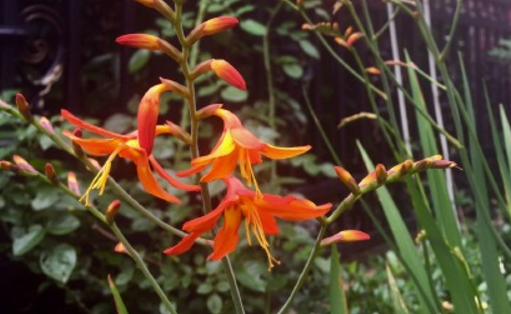
The fire flower is not only brightly colored, with flowers in three colors: red, orange and yellow, giving it high ornamental value, but it also has outstanding heat resistance; the hotter the weather, the more abundantly it blooms, making it a main summer landscape feature in many gardens.
The fire flower is a main plant in roadside green belts and is also an important material for cut flowers. In areas of a city where fire flowers are planted, viewed from afar they form a beautiful scenic line.
2. Absorbing radiation
As a potted plant, the fire flower can absorb the radiation produced by computers at home; keeping it beside a computer can reduce the harm radiation does to people's bodies.
I wonder whether you recognize, or have come to recognize anew, this unique plant. I hope that through the editor's description you can come to like it.
During the growth of the fire flower, it is extremely prone to leaf spot disease, which greatly affects its appearance. You can dilute chlorothalonil with clean water and spray it on the leaf surfaces.