Cultivation Methods, Disease Control and Uses of Sea Lavender (Plumbaginaceae)
In China, sea lavender is mainly distributed on hillsides and meadow saline soils in Northeast China, Inner Mongolia, ** and other areas, so what are the cultivation methods for sea lavender? What about its diseases and their control? What uses does it have? According to available information, sea lavender prefers a cool climate environment and strong light, and flowers well after low-temperature treatment. The low temperature is between 10-16°C; if the plants are given low-temperature treatment during the seedling stage, later high temperatures will not affect flowering; if the seedlings are not given low-temperature treatment and are planted directly under high temperatures, flowering will be noticeably inhibited or they will not flower at all.
I. What are the cultivation methods for sea lavender?
1. Soil and fertilizer selection for sea lavender
Sea lavender needs loose soil; you can choose sterilized leaf mold or mix peat and perlite evenly in a 1:1 ratio; sea lavender has a relatively high demand for boron, so adding borax to the base fertilizer can effectively regulate soil fertility while also adjusting soil pH. For topdressing, you can choose diluted soybean cake water and quick-acting nitrogen, phosphorus and potassium applied indirectly.
2. Temperature control for sea lavender
After sowing, sea lavender needs low-temperature vernalization to help it flower; when the autumn temperature is 18-21°C, sowing usually results in sprouting in about 5 days; after sprouting, the seedlings can be placed under low-temperature treatment below 16°C, and after 3 days they can be kept at normal temperature for care.
When the first true leaf appears, the seedlings can be separated; when the leaves reach 5~6, they can be planted out. Planting is generally carried out in October-November, and the flowering period is June-August. The suitable temperature is 18~20°C during the day and 10~15°C at night, and the minimum should not fall below 0°C.
3. Light control for sea lavender
Sea lavender needs a ventilated and well-lit environment, which can effectively reduce the occurrence of diseases. For the cultivation method, you can choose double-row cross planting, or three-row planting; plum-blossom-shaped planting is also very common in field cultivation. Sea lavender likes light, so attention must be paid to light during the growing process. Of course, exposure to blazing sun is not acceptable either; shading treatment is needed at noon in summer.
4. Later care for sea lavender
During the vigorous period of inflorescence emergence and growth in sea lavender, the supply of water and fertilizer must be sufficient, otherwise it is easy to cause short flower branches and sparse flowers. When the sea lavender grows and sends up shoots, netting or stakes are needed to prevent lodging. After harvesting the first flush of flowers, promptly remove old branches and dead leaves to help promote new bud germination and avoid consuming more nutrients. It should be noted that sea lavender is a taproot plant, so it must be transplanted with soil during the seedling stage to prevent root damage and increase the survival rate.
II. What about its diseases and their control?
1. Viral disease
Pathogen
There are many viruses that harm sea lavender, such as sea lavender virus, cucumber mosaic virus, and tomato bushy stunt virus
Symptoms
The plant becomes shorter, the leaves also become smaller, and the plant and leaves become deformed.
Control measures
The most important thing is to choose good, healthy seeds for planting, or to carry out virus-free and harmless cultivation and breeding; if virus-infected plants are found, they must be dealt with promptly, and the diseased plants should be destroyed to prevent reinfection; if there are signs of viral infection, chemical treatment should be used.
2. Blight disease
Pathogen
Botrytis cinerea
Symptoms
Gray-brown round spots appear on the leaves, and later this causes the leaves to wither and die, until the entire plant dies.
Control methods
If diseased plants are found, they must be destroyed promptly to prevent infection of other healthy plants; treat the seeds before planting and disinfect them with chemicals; during cultivation, pay attention to watering management, and when watering, be careful not to wet the leaves and flowers; the indoor environment should be kept dry; if diseased plants are found, chemical treatment should be carried out.
3. Brown spot disease
Pathogen
Cercospora
Symptoms
Yellow-brown spots appear on the lateral leaves, and later they turn tea-brown.
Control methods
After diseased plants are found, spray treatment should be carried out promptly; continuous chemical treatment is needed to be effective.
III. What uses does it have?
1. Scientific research value of sea lavender
Sea lavender is a plant that is salt-alkali tolerant, drought tolerant and highly adaptable. In China it is developed and utilized as a wild groundcover plant, and it is one of the important ways to achieve high-quality greening of saline-alkali land. Under salt stress, sea lavender can maintain a relatively good cell membrane structure and maintain higher SOD activity to ensure the normal progress of its physiological activities; the surface of the salt gland structure of sea lavender has a beautiful flower
petal shape, and the salt glands can secrete the salt absorbed into the plant body back outside, thereby avoiding ion toxicity.
2. Medicinal value of sea lavender
As a traditional Chinese medicine, the whole plant of sea lavender can be used medicinally, especially the root, and it has effects such as reducing fever, relieving pain, enriching the blood, reducing inflammation, reducing swelling and detoxifying, and can treat symptoms such as gastric ulcers and edema due to spleen deficiency.
In recent years, chemical studies on sea lavender have shown that it contains large amounts of polysaccharides. Further molecular biology research found that the polysaccharides extracted from sea lavender can regulate gene expression in tumor cells and thereby promote tumor cell apoptosis, thus achieving an anti-tumor purpose.
3. Ornamental value of sea lavender
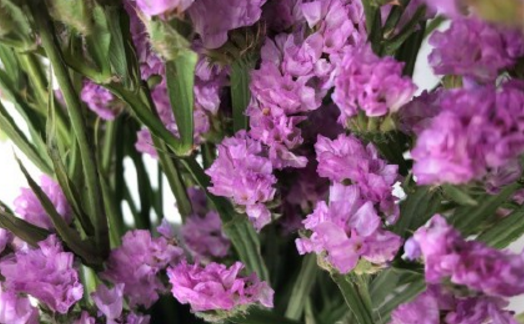
Plants of the genus Limonium have ornamental characteristics such as a long flowering period, rich flower colors, and high value both as individuals and in groups. In particular, the flower colors are diverse, appearing in many colors such as golden yellow, pale yellow, pure white, light purple and pink. The plants (including flower stems) are all below 1 m, making it easy to create a brightly colored group landscape in urban greening.
4. Economic value of sea lavender
In addition to the above values, sea lavender, as a sunrise industry, has very good market prospects. As a cut flower material and dried flower decoration, sea lavender is receiving more and more attention and is used very widely. In the flower market and home decoration market, demand exceeds supply, and its development potential is unlimited.