What is the difference between Ageratum conyzoides and Praxelis clematidea, how do you sow the seeds, and is it toxic?
Ageratum conyzoides, also known as "shenghongji", "xianxiahua", "maoshexiang", "diezicao" and so on, so what is the difference between Ageratum conyzoides and Praxelis clematidea? How do you plant the seeds? Is it toxic? According to available information, although Ageratum conyzoides and Praxelis clematidea both belong to the Asteraceae family, Ageratum conyzoides belongs to the genus Ageratum, while Praxelis clematidea belongs to the genus Eupatorium; the two are in the same family but different genera.
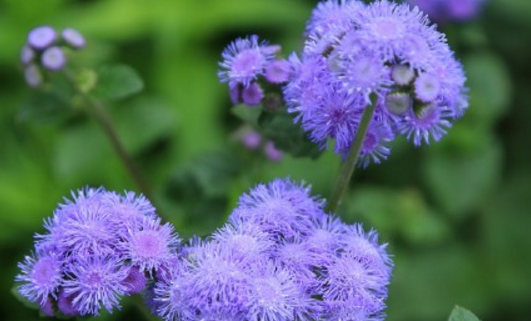
I. What is the difference between Ageratum conyzoides and Praxelis clematidea?
1. Differences in family and genus between Ageratum conyzoides and Praxelis clematidea
Although Ageratum conyzoides and Praxelis clematidea both belong to the Asteraceae family, Ageratum conyzoides belongs to the genus Ageratum, while Praxelis clematidea belongs to the genus Eupatorium; the two are in the same family but different genera.
2. The leaves of Ageratum conyzoides and Praxelis clematidea are different
The leaves of Ageratum conyzoides are broadly ovate or ovate, with a relatively rounded leaf shape, rather blunt serrations, and inconspicuous marginal serrations, while the leaves of Praxelis clematidea are ovate, broadly ovate or rhombic, with a more pointed leaf shape and obvious marginal serrations. In terms of leaf scent, after rubbing the leaves of Praxelis clematidea you can smell a pungent odor similar to cat urine, while the scent of Ageratum conyzoides is relatively faint.
3. The involucres of Ageratum conyzoides and Praxelis clematidea are different
This difference is relatively obvious: the involucre of Ageratum conyzoides is cup-shaped, while that of Praxelis clematidea is long-tubular or bell-shaped.
4. The uses of Ageratum conyzoides and Praxelis clematidea are different
Although both plants are invasive species, Ageratum conyzoides does have a certain ornamental value and medicinal effect. As things stand now, however, Praxelis clematidea only causes harm, and controlling Praxelis clematidea is a relatively important task, because wherever it goes it excludes other grasses and seriously affects the plant diversity of that place. Moreover, Praxelis clematidea can also severely deplete soil nutrients, damaging the fertility and cultivability of the soil; in addition, Praxelis clematidea secretes a toxic, foul odor, which is not conducive to livestock foraging.
II. How do you plant the seeds?
1. Preparation of the soil
Different flowers all need different soil for sowing, so choosing the right soil plays a crucial role in the subsequent growth and development of Ageratum conyzoides. The planting soil for Ageratum conyzoides requires garden soil, then an equal amount of farmyard manure, plus a small amount of decomposed manure, all mixed evenly together. With soil prepared in this way, the seeds will germinate very easily, and the Ageratum conyzoides will also grow very robustly after development.
2. Sowing
Because the seeds of Ageratum conyzoides are very small, the work of sowing becomes relatively less easy. The sowing time is generally determined according to the flowering period of Ageratum conyzoides, so that its flowering period can be regulated by adjusting the sowing period. If you want them to bloom around Labor Day, you can sow at the end of August and the beginning of September of the previous year, which means they need to be placed in a greenhouse to overwinter, and they can only leave the greenhouse in late April of the following year. However, under normal circumstances, Ageratum conyzoides is sown in a greenhouse in February each year or sown in the open field in April.
When sowing, you need to put the prepared soil into a pot, then level and press it down, water it thoroughly, and then place the seeds of Ageratum conyzoides on top of the soil. The seeds of Ageratum conyzoides are not light-requiring, so you need to put a layer of soil on top of the seeds, but it must not be too thick; just enough to slightly hold the seeds down. After about a week you can see the seeds sprout.
3. Planting out
Planting out is done when the seeds have sprouted and grown a few leaves. First you need to choose a suitable flower pot; generally a flower pot about ten-odd cm in diameter is enough, then the potting soil should be mainly garden soil and sandy soil, then plant the Ageratum conyzoides seedlings into the soil, press the soil firm, water thoroughly and place in a cool, shady spot for about a week before they can be moved to a sunny place to grow.
4. Daily care
Do not water too much; generally just keep the soil moist. In the early stage of growth you can water a little more appropriately, which allows Ageratum conyzoides to grow well.
As for fertilizing, generally during the growth period you can apply organic fertilizer once or twice; a light fertilizer is enough.
Because Ageratum conyzoides likes sunlight, it can be given plenty of sun.
III. Is it toxic?
This plant is not toxic, and it is also a plant that can be made into medicine. In Africa and the Americas, people often use it to clear heat and detoxify, as well as to reduce inflammation and stop bleeding. In China, it is usually used to treat colds and fever, to treat eczema, and for bleeding from external injuries and burns.
Uses:
1. Landscape value. Because this plant grows in clumps, appearing very dense, and its flower color is light purple; this elegant color, paired with small and densely packed flowers, makes it most suitable for planting in flower beds or as ground cover. Of course, this plant is also very suitable for planting in small courtyards, along roadsides, and in parks as an accent. Dwarf varieties can be grown as potted plants for viewing, and tall varieties can be used for cut flowers, in vases, or to make flower baskets.
2. Medical uses. This plant has many kinds of functions, but the effects are roughly the same in almost every place. In Yunnan, this plant is usually used to treat acute gastroenteritis or to treat respiratory tract infections, tonsillitis, acute gastroenteritis, and kidney or bladder stones; some people also use its relatively tender leaves to treat dysmenorrhea. In Beijing, it is mainly used to treat colds and fever. In Guangxi, this plant is used to treat vomiting and diarrhea, otitis media, bleeding from external injuries, stomach pain, as well as symptoms such as centipede bites, influenza and so on.
3. Flower language. This plant has the meaning of “respect and love”.