How to propagate ornamental peach? Pruning time, pruning methods and main value
Ornamental peach is a variety of the Prunus genus and is fairly common in daily life. Ornamental peach has strong ornamental value, and its double-petaled flowers are very beautiful and deeply loved by people. So do you know how to propagate ornamental peach? What are the pruning time and pruning methods? What are its main values?
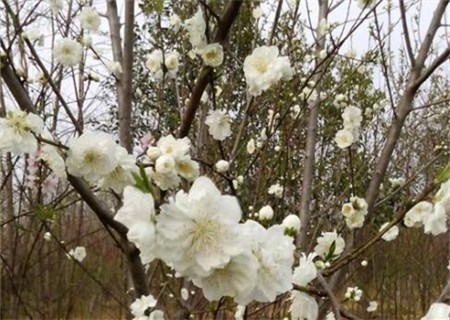
I. How to propagate ornamental peach
1. Propagation method
In order to maintain the superior traits of ornamental peach varieties, when propagating ornamental peach we often choose grafting for propagation.
2. Grafting method
When using grafting to propagate ornamental peach, we must first choose an ornamental peach plant in good growing condition, then select wild peach (Prunus davidiana) as the rootstock. We generally carry out bud grafting or scion grafting in spring or summer, and in this way the survival rate of grafting can reach more than 90%. When bud grafting in summer, first cut off a woody bud plate. Generally speaking, the suitable time for grafting buds in southern regions is June to July, and in the north it is July to August. Cut the scion from the mother tree, trim the branches and leaves well, keep the leaf stalk, and leave a little woody part on the inner side of the bud. The stem is 3 to 5 cm from the ground; generally choose the vertical part on the north side of the tree, cut a suitable notch in the bark, fit the scion tightly against the cut notch, then wrap it well with string to prevent the bud scion from drying out in the wind.
3. Care management after grafting
If within half a month after bud grafting the leaf stalk of the scion turns yellow, that indicates the grafting succeeded; if the leaf stalk turns black, that indicates the plant did not survive. After confirming that the grafted bud has survived, after the scion and rootstock have fully fused, we should cut off the rootstock 1 cm above the grafted bud. After new buds sprout, completely remove the rootstock sprouts. At the same time, apply fertilizer to promote lignification of the new buds, so that the successfully grafted young plant has the ability to resist cold. After that, it is enough to pay attention to controlling aphids.
II. Pruning time and pruning methods for ornamental peach
Pruning time:
Pruning ornamental peach during the growing season often varies according to variety, tree age, tree vigor, and climatic conditions. The pruning time and frequency should be arranged according to the actual conditions of the cultivation site. It is generally carried out from after flowering to around August, and can be pruned 2 to 5 times.
Pruning methods:
1. Bud removal and sprout removal means promptly removing the water sprouts inside the canopy, the back buds on scaffold branches, the competitive buds below the cut, and the buds on the upper part of branches after flowering; for tender double shoots, "remove one and keep one," and for young trees remove strong shoots and keep weak shoots. Through this method, useless new buds and shoots can be reduced, nutrients can be saved, light can be improved, and the number of wounds caused by thinning branches during winter pruning can be reduced.
2. Pinching means removing a small section of tender shoot at the top of a branch. Through pinching, the elongation growth of the branch can be controlled, prompting the lower part of the branch to form fuller flower buds. In the early stage of new shoot growth, pinching can also promote the early sprouting of secondary shoots, and such secondary shoots can differentiate fuller flower buds.
3. Twisting shoots means twisting the upper half of a non-lignified and upright vigorous growing branch 180°, and tucking it into the leaf axil on the lower side (be careful to prevent it from springing back up). Through this method, its growth direction is changed, growth is controlled, and it is prompted to transform into a flowering and fruiting branch, while also improving light.
4. Branch pulling means pulling the main branches or side branches open and fixing them at the angle required by the tree shape. The most suitable opening angle is about 80°. If the opening angle is not large enough, the phenomenon of "strong upper part and weak lower part" is likely to appear. It also must not be pulled into a bow shape, otherwise vigorous branches will sprout at the bent part. Through "branch pulling," tree vigor can be moderated and the appearance of "bare legs" on the lower part of branches and trunks can be prevented.
Generally, for large branches more than three years old, this can be done from May to September, while the main branches of young trees can only be pulled open from June to July. Pruning ornamental peach during the growing season often varies according to variety, tree age, tree vigor, and climatic conditions. The pruning time and frequency should be arranged according to the actual conditions of the cultivation site. It is generally carried out from after flowering to around August, and can be pruned 2 to 5 times.
III. What are the main values of ornamental peach
1. Landscaping
Ornamental peach has large flowers and brilliant color, is beautiful when blooming, and has an ornamental period of as long as 15 days. In landscaping it is widely used by lakesides, streams, both sides of roads, and parks, etc. In small-scale greening projects such as courtyard greening accents and private gardens, it is also used for potted viewing, and is also often used for cut flowers and making bonsai. A common one is also the weeping ornamental peach. Ornamental peach has a wide range of landscaping uses and outstanding greening effects, and it shows especially good results in the year it is planted. It can be planted in rows, in groups, or as a solitary plant, and shows especially good greening effects in the same year. Ornamental peach is one of the commonly used colorful nursery stock in landscaping, and is usually used together with nursery stock such as purple-leaf plum and purple-leaf sand cherry.
2. Medicinal use
The gum secreted on the trunk of ornamental peach, commonly known as peach gum, can be used as an adhesive, etc. It is a kind of polysaccharide substance, and hydrolysis can produce arabinose, galactose, xylose, rhamnose, glucuronic acid, etc. It is edible and also used medicinally, with effects of breaking blood, harmonizing blood, and supplementing qi.
3. Ornamental use
When ornamental peach blooms, its colors are bright and beautiful, with high ornamental value, and it is easily seen in parks and other places.
4. Bonsai making
For a successfully grafted peach seedling, around the time of Awakening of Insects the following year, cut it off 1.5 cm to 2.0 cm above the grafted bud to promote growth of the grafted bud. During this period, potting and shaping pruning can be carried out at the same time. For ornamental peach, the soil can be loose, breathable, drainage-capable, and fertilizer-retentive sandy soil. For the pot, choose a purple clay ceramic pot or glazed ceramic pot whose color contrasts with the flower color. Shaping and pruning should be carried out gradually according to tree vigor and growth conditions and one's own aesthetic views, using methods such as thinning pruning, branch twisting, branch pulling, bending, heading back, flat cutting, scar making, and flower thinning.