Differences, Uses and Propagation Methods of Goldfish Plant, Shrimp Plant and Golden Shrimp Plant
Shrimp plant is also called shrimp flower, shrimp grass, fox tail wood, unicorn spitting pearls, etc. So what is the difference between shrimp plant and golden shrimp plant? What uses do they have? How do they propagate? According to available information, shrimp plant likes a humid and warm growing environment and can tolerate drought, with a suitable temperature range of 18°C——28°C. Shrimp plant likes light, but during cultivation care should be taken to avoid exposure to direct sunlight. The soil is generally chosen to be loose, fertile and well-drained.
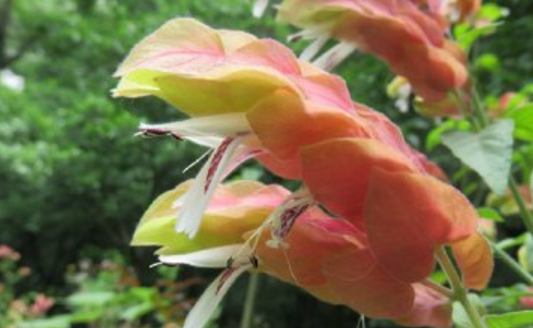
I. What is the difference between shrimp plant and golden shrimp plant?
1. Different flowers
The flowers of the golden shrimp plant are golden yellow, and the inflorescence is somewhat like a tower, standing upright. On the inflorescence there are many golden scaly inflorescence tissues, and then white petals grow out. The golden shrimp plant blooms in spring and autumn; as long as new branches grow, new inflorescences will grow at the tips of the branches, and it can bloom when the temperature is suitable. The inflorescence of the shrimp plant is somewhat like a rice ear, and the inflorescence droops; the bracts on the inflorescence are brick red or yellowish brown, covered with soft down, and the flowers are white, extending beyond the bracts. The shrimp plant can bloom all year round.
2. Different leaves
The leaves of the golden shrimp plant are oval, with opposite leaves; the leaf color is bright green, the veins are very obvious, the leaf texture is relatively firm, and the leaf margins are wavy. The leaves of the shrimp plant are ovate, the leaf color is lighter, similar to yellow-green, the leaves have thin down, and the leaves are relatively soft.
3. Different plant morphology
The golden shrimp plant is generally 30-50 cm tall and is an evergreen herbaceous plant. The stem nodes of the golden shrimp plant are relatively obvious, swollen and protruding, and the whole plant is very upright; moreover, the stems of the golden shrimp plant are square. By comparison, the shrimp plant is taller; its plant height can reach 1-2 m, its stems are relatively slender and weak, and the whole shrimp plant is covered with tiny down. From this aspect, the golden shrimp plant and the shrimp plant can also be distinguished.
II. What uses do they have?
1. Ornamental use of the shrimp plant
The shrimp plant has many varieties, with bright colors and beautiful flower forms. The bright bracts and the slender white small flowers extending from the flower body give it a unique shape; the flowering period is relatively long and its growth is neat and beautiful, so it is deeply loved by many flower growers and has high ornamental value. If it can be carefully cultivated and meticulously pruned in a suitable environment, the ornamental value of the shrimp plant will also be greatly enhanced.
2. Decorative use of the shrimp plant
The shrimp plant has a unique appearance and bright flower colors, giving people a bright and pleasant feeling. It blooms in spring and has a relatively long flowering period, so it is highly ornamental and can be grown in pots to make bonsai. Thus it can become a choice for home decoration; whether on a balcony or for indoor decoration, it can add a touch of bright and cheerful color to the home. Many people use them to decorate bright rooms.
3. Landscape embellishment use of the shrimp plant
The layered and overlapping appearance of the shrimp plant is very eye-catching, and because of its long flowering period and high ornamental value, it can be used to arrange flower beds, and can also be planted in courtyards as landscape embellishment, or planted along roadsides, where it can all play its unique role.
III. How do they propagate?
1. Cuttage propagation of the shrimp plant
Cuttage propagation of the shrimp plant can be carried out in all four seasons, mainly in spring and summer. Summer cuttage requires shading and moisture retention. First cut off a robust spike from the current year with 2-3 nodes as the cutting. Both old-branch cuttage and tender-branch cuttage are acceptable, but under the same temperature conditions, tender branches root faster. The cuttage substrate is suitably yellow sand, vermiculite or perlite, and should be disinfected and sterilized. Insert the basal 1 node into the substrate, and the room temperature should be kept below 20°C. It can take root after about 10 days and bloom the next year. After the cuttings take root, they should be transplanted into pots in time and properly shaded; after new leaves grow, move them to a place with sufficient sunlight.
2. Seed propagation of the shrimp plant
First, the seeds need to be selected; it is best to use seeds collected in the current year to ensure the seed germination rate. Choose plump and full shrimp plant seeds free of pests and diseases. Then soak the seeds in warm hot water for about 12-24 hours until the seeds absorb water and swell. For relatively small seeds, a toothpick with one end moistened with water can be used to pick up the seeds, and then stick them one by one on the surface of the substrate, with a covering soil depth of about 1 cm. Then place the sowing pot into water, with the water depth being 1/2-2/3 of the pot height, so that the water slowly seeps up. For larger seeds, they can be placed directly into the substrate and sown in spots at a spacing of 3×5 cm. The covering soil depth is about 2-3 times the size of the seeds. After sowing, the substrate can be moistened with a sprayer, and later water again when the pot soil is slightly dry. At the same time, attention should be paid to controlling the force of watering to avoid washing the seeds up due to excessive force.