Red Tip Photinia (Photinia × fraseri) Growing Methods, Precautions, and Pruning and Cutting Techniques
Red Tip Photinia offers red leaves to admire in early spring, white flowers in early summer, fruit in autumn, and evergreen leaves in winter. So what are the growing methods and precautions for Red Tip Photinia? How do you prune it? What is the cutting method? According to available information, Red Tip Photinia prefers light and can tolerate shade; it prefers a warm, humid climate, tolerates drought but not waterlogging. Red Tip Photinia is quite cold-hardy and can tolerate low temperatures. Its requirements for soil selection are not very high.
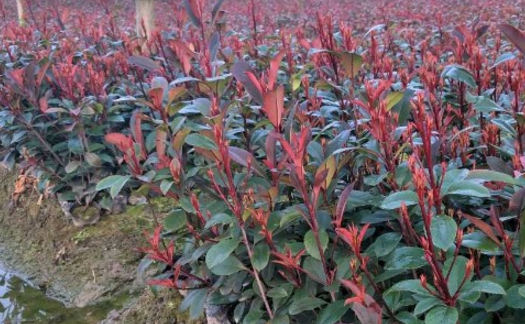
I. What are the growing methods and precautions for Red Tip Photinia?
Soil for growing Red Tip Photinia
The potting soil should preferably be loose, fertile, and acidic or neutral; sandy soil is best for planting, as it favors aeration.
Growth habits of Red Tip Photinia
Red Tip Photinia prefers a warm and humid environment, and it also adapts very well to temperature, able to withstand low temperatures of minus 18°C, so it can be grown in every region of our country.
Fertilizing Red Tip Photinia
Fertilizing Red Tip Photinia is best done on the principle of light, frequent applications. In spring, apply about once every half month; in summer and autumn, apply a compound fertilizer once every half month. If you can use the method of digging trenches and burying the fertilizer, that would be even better.
Pruning Red Tip Photinia
Red Tip Photinia has very strong growth capacity, so it needs frequent pruning. Red Tip Photinia can be pruned in every season, but mainly in winter, chiefly using the methods of heading back and thinning branches. Heavy pruning in summer is not conducive to the tree recovering its vigor.
Watering Red Tip Photinia
Red Tip Photinia prefers a humid environment, but you must not overwater it. If waterlogging occurs, it will cause the plant's roots to rot and prevent healthy growth. Watering between 8 and 10 a.m. each day, or between 4 and 6 p.m., is better.
Pests and diseases of Red Tip Photinia
Red Tip Photinia's resistance to pests and diseases is fairly good. Among diseases, it is relatively prone to leaf spot and anthracnose; among pests, it is prone to scale insects, longhorn beetles, aphids, and similar pests.
II. How do you prune it?
Spherical pruning of Red Tip Photinia
Red Tip Photinia has very strong growth capacity. Even without pruning, it can form a spherical shape, but to make Red Tip Photinia's shape more attractive and more ornamental, it still needs to be pruned. The best pruning times are once during the growing season and once during the dormant season, in May to June and in November each year.
Single-trunk tree-form pruning of Red Tip Photinia
For the single-trunk tree form of Red Tip Photinia, before pruning you must first select one main trunk, then, based on the main trunk, decide which side branches to keep and which to remove. Remove the side branches about half a meter above the ground. During pruning, note that after each side-branch pruning you must also adjust the crown in time.
Cylindrical pruning of Red Tip Photinia
To achieve a cylindrical shape, Red Tip Photinia must first have a sufficiently large foundation before pruning can be carried out. During pruning, you must control the arc and height of Red Tip Photinia's shape well, so that the result looks better. According to professionals, the cylindrical pruning of Red Tip Photinia involves the greatest amount of pruning, but it is also the best-looking of the styles.
III. What is the cutting method?
Cutting time for Red Tip Photinia
The most suitable cutting times for Red Tip Photinia are April to June and August to October each year, carried out when the branches of Red Tip Photinia have become woody.
Selection of cuttings for Red Tip Photinia
For cuttings, choose branches that are growing vigorously and are about one year old in growth period; that is, when the red leaves on the new shoots begin to turn green, you can cut them off and use them as cuttings. The cuttings should be about 5 cm to 8 cm long. Be sure to keep the terminal bud on the branch. For larger leaves, leave a small half; for smaller leaves, keeping a large half is more suitable. In addition, make sure the cut surface of the cutting is flat and smooth.
Precautions for cutting Red Tip Photinia
Moisture retention for the cuttings must be done well, with timely watering and shading. When cutting the cuttings, it is best to use professional tools so as to reduce the wound, and the scissors should be disinfected from time to time to prevent cross-infection by viruses. The time for cutting the cuttings and the time for inserting them are best on cloudy days, or before 10 a.m. or after 4 p.m. The cut surface of the cutting should be treated with a rooting agent to speed up rooting and increase the survival rate of Red Tip Photinia.