Differences Between Four-Season Osmanthus and Golden Osmanthus, and Solutions for Leaf Drop and Failure to Bloom
The flowers of the four-season osmanthus are slightly white or pale yellow, with a fainter fragrance and thinner leaves. It is a variety of osmanthus in the genus Osmanthus. So what are the differences between the four-season osmanthus and the golden osmanthus? What should you do if it drops leaves? What should you do if it does not bloom? According to available information, the four-season osmanthus prefers a warm and humid climate and has a certain degree of cold resistance, but it is not tolerant of severe cold. It likes light and is also shade-tolerant, and seedlings need a certain amount of shade. It has low requirements for soil and prefers slightly acidic soil on high, dry terrain that is rich in humus, with deep, fertile, moist, and well-drained sandy soil being most suitable.
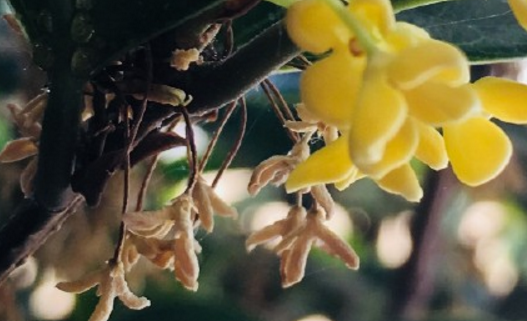
I. What are the differences between the four-season osmanthus and the golden osmanthus?
1. The four-season osmanthus and the golden osmanthus have different fragrances.
The fragrance of the golden osmanthus is very rich. Among common osmanthus varieties, the golden osmanthus has the strongest fragrance. The fragrance of the four-season osmanthus is slightly fresher and more delicate. This is one of the more obvious differences between the golden osmanthus and the four-season osmanthus.
2. The four-season osmanthus and the golden osmanthus have different flower colors.
The flower color of the golden osmanthus transitions from lemon yellow to golden yellow, while the flowers of the four-season osmanthus are slightly whiter, and even when yellow, they are extremely pale yellow. In this way, the four-season osmanthus and the golden osmanthus can also be easily distinguished directly by flower color.
3. The four-season osmanthus and the golden osmanthus have different leaf forms.
The leaves of the golden osmanthus are relatively thick, and the leaf color is also relatively dark, belonging to dark green, with a strong gloss. The leaves of the golden osmanthus are oval, with raised leaf tissue on the upper surface, looking uneven. The four-season osmanthus has serrated edges, the leaf tips are pointed, and the upper side of the leaves is dark green while the lower side is light green.
4. The four-season osmanthus and the golden osmanthus have different flowering periods.
The flowering period of the golden osmanthus is from late September to early October, and the first flowering is a bit more fragrant than later flowerings. The four-season osmanthus, however, blooms year-round, with a small number of flowers opening in every season, though of course it blooms most in autumn.
5. The four-season osmanthus and the golden osmanthus have different habits.
The golden osmanthus has strong adaptability and is suitable for planting in shady places; the golden osmanthus is shade-tolerant. The four-season osmanthus is suitable for growing in places with relatively abundant sunlight and a warm, humid climate. The four-season osmanthus is very cold-resistant, and if there is no especially severe cold wave in winter, it can generally overwinter outdoors.
6. The four-season osmanthus and the golden osmanthus have different values.
The golden osmanthus is beautiful and grows well. In addition, its flower color is deep, its fragrance is strong, and its flowers are relatively dense, so it is mainly used for ornamental cultivation. Of course, the golden osmanthus can also be used to extract aromatic oil, and its flowers and roots can also be used as medicine. The four-season osmanthus has a certain resistance to some harmful substances, so it is suitable as a greening tree species planted within gardens, or on both sides of roads, lawns, or courtyards.
II. What should you do if it drops leaves?
Daily care
According to past observations, if one side of the four-season osmanthus is close to a wall or if two four-season osmanthus plants overlap each other, the side close to the wall or the overlapping part will quickly become sparse, seriously affecting the tree posture and visual effect of the entire crown. Therefore, when planting, attention should be paid to choosing a place with good ventilation and sufficient sunlight. In addition, the four-season osmanthus cannot be polluted by smoke and dust, otherwise it will not bloom. When there is too much standing water, the leaves of the four-season osmanthus will turn yellow and fall off, and even the entire tree may die. Therefore, when watering, be sure not to water too much, and it is best not to have standing water.
Disease prevention and control:
In fact, if leaf spot disease occurs, it will also cause the leaves of the four-season osmanthus to fall off. Its leaf spot disease develops from the edges of the leaves toward the tips. In the early stage of the disease, small white spots appear on the leaves and then gradually expand. Leaf spot disease generally occurs from July to November, and is more likely to occur in environments with high temperature, high heat, and poor ventilation. Therefore, leaf spot disease must be prevented and controlled early!
III. What should you do if it does not bloom?
The four-season osmanthus does not bloom because of insufficient light.
When growing the four-season osmanthus, insufficient light can cause it not to bloom. The four-season osmanthus has a fairly high demand for light, because light may better promote flower bud differentiation. Generally, four-season osmanthus grown in places with sufficient light blooms well, but if kept shaded for a long time, it will cause excessive growth of branches and leaves, affecting flower bud formation.
When growing the four-season osmanthus, be sure to meet its light requirements and plant it in a place with sufficient sunlight and good ventilation so that it can be fully exposed to sunlight.
The four-season osmanthus does not bloom because of severe pollution.
When growing the four-season osmanthus, especially when it is used as a road greening tree species, it may be exposed to a lot of polluted air, leading to the accumulation of harmful substances and affecting flowering.
Therefore, be sure to pay attention to the surrounding environment and reduce pollution sources.
The four-season osmanthus does not bloom because of standing water.
The four-season osmanthus is relatively afraid of standing water. When growing the four-season osmanthus, if it is watered too much, standing water easily occurs, leading to root rot. If this happens, the four-season osmanthus will find it relatively difficult to bloom.
When growing the four-season osmanthus, it is necessary to choose dry, well-drained sandy soil, and watering should also be moderate.
The four-season osmanthus does not bloom because of improper fertilization.
When growing the four-season osmanthus, insufficient fertilizer leads to inadequate accumulation of nutrients, while blind fertilization will also bring adverse effects to the four-season osmanthus. All of these will affect the formation of flower buds and flowering of the four-season osmanthus.
Therefore, when growing the four-season osmanthus, mastering the timing of fertilization and applying fertilizer in appropriate amounts are key.