How to grow Erythrina corallodendron? Propagation methods, precautions and value explained
Erythrina corallodendron is also called ivory flower, rooster flower, coral erythrina, and four-season tree. So what are the cultivation methods and precautions for Erythrina corallodendron? How do you propagate it? What value does it have? According to available information, Erythrina corallodendron has no special requirements for soil, and generally loose, breathable soil is fine. In autumn, collect the seeds and store them in mixed sand at around 5°C, then sow in March of the following year. It can bloom in 3-5 years, with the flowering period from June to July.
1. What are the cultivation methods and precautions for Erythrina corallodendron?
Pot and soil selection
Erythrina corallodendron is a relatively large woody flowering plant, so pot cultivation requires choosing a larger flower pot. The soil should be a well-drained, fertile, loose sandy loam. It does not have high demands for fertility, but the soil must not be too poor. In soil that is too poor or too dry, Erythrina corallodendron will grow poorly.
Light and temperature
Erythrina corallodendron likes a growing environment with plenty of light and can tolerate partial shade. It is best to provide about 5 hours of light per day. It likes a warm climate, can tolerate high temperatures, and has poor cold tolerance. The suitable temperature for growing Erythrina corallodendron is between 20°C——28°C. In winter, it needs to be kept warm, and if conditions allow, it can be moved into a greenhouse to overwinter.
Watering and fertilizing
Erythrina corallodendron likes a moist environment, but it should not be waterlogged. Watering should be moderate. During the hot, dry summer, increase watering to keep the potting soil moist. If needed, spray water on the leaves. In winter, when temperatures are low, reduce watering, especially after it is placed in a greenhouse. As for fertilizing, apply fertilizer once every half month during the growing period, and apply phosphorus and potassium fertilizer once or twice during the flowering period. After autumn begins, stop fertilizing.
Precautions:
Repotting
Erythrina corallodendron is a large plant, and as it grows it needs to be repotted. Generally, repot once every 2 to 3 years in spring, and pruning can be done together with repotting.
Pruning
Erythrina corallodendron can be pruned in spring. Cut off dead branches and long branches to encourage more flowering branches. Pruning can also be done in winter to help it overwinter better.
Pests and diseases
The common diseases of Erythrina corallodendron are mainly root rot, wilt disease, and anthracnose, while the main pests are aphids and scale insects. For diseases, spray treatments such as Bordeaux mixture can be used. For pests, insecticides can be used, or more environmentally friendly homemade insecticides can be used to kill the insects.
2. How do you propagate it?
Erythrina corallodendron likes warmth and moisture and is very tolerant, withstanding high temperatures and cold. It also has few requirements for soil. The main propagation methods are sowing and cuttings.
Sowing
The collected seed pods of Erythrina corallodendron are not suitable for exposure to strong sunlight. After drying in the shade, remove the seeds and store them mixed with sand in a low-temperature environment. Wait until March of the following year to begin sowing. Before sowing, soak them in hot water, and after it cools, soak for about 24 hours, then sow.
Cuttings
For cuttings of Erythrina corallodendron, it is recommended to choose early spring and select woody branches as cuttings. After trimming and cutting, insert them into moist sand and keep them moist. Roots develop after about one month. After the cuttings sprout, be careful to remove weak side shoots. For potted Erythrina corallodendron, proper pruning should be carried out, and fertilizer and water should be applied as little as possible. Suppress its growth so the plant is suitable for pot cultivation. The advantage of cuttings is that after sprouting they can become a decorative feature and can bloom for indoor enjoyment.
3. What value does it have?
The meaning of Erythrina corallodendron: glory. It is the national flower of Argentina, which shows that Erythrina corallodendron has many values. The main ones include economic value and ornamental value.
Economic
The wood of Erythrina corallodendron is relatively soft and can often be used to replace cork in making stoppers. In addition to this value, the bark of Erythrina corallodendron is also useful. The bark contains certain substances that can be used to make anesthetics and analgesic sedatives.
Ornamental
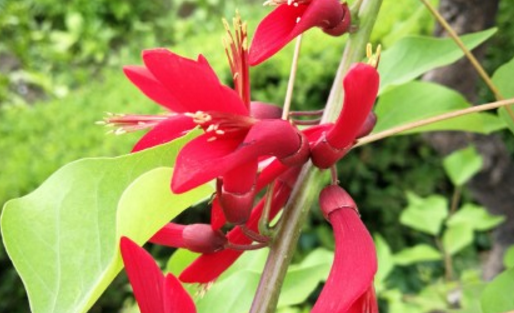
When Erythrina corallodendron blooms, it is gorgeous and vivid, like freshly harvested red coral. The deep red inflorescence as a whole looks more like a red crescent moon, dazzling and eye-catching. It is a very beautiful ornamental plant. Erythrina corallodendron is widely used in parks and courtyards to beautify the environment. Not only that, choosing one to plant indoors is also a very wonderful decorative touch!