Lianban Orchid 'Da Xuesu' Care Guide: What to Do When Leaves Turn Yellow and How It Differs from Cymbidium goeringii
Da Xuesu, commonly known as Da Suxin and also called Yuandan, is also named Broad-leaf Suxin because of its wide leaves. So what are the care methods and precautions for Da Xuesu? What should you do when the leaves turn yellow? What is the difference between it and Cymbidium goeringii? According to available information, Da Xuesu prefers a warm and humid environment, with no severe cold in winter and no extreme heat in summer. It likes soil rich in humus, and the relative air humidity should be quite high. Its requirements for light are not high.
I. What are the care methods and precautions for Da Xuesu?
Temperature and Light
The suitable temperature for the growth of Da Xuesu is between 15 and 28°C. In winter, as long as the temperature does not drop below 0°C, it can generally overwinter safely. In summer, when the temperature rises above 30°C, attention should be paid to heat protection and cooling, and the maximum temperature should not exceed 35°C.
Because the growing environment of Da Xuesu is relatively shaded, its requirements for light are not high, and it is relatively shade-loving. During the growing period, the light should be slightly weaker. With a little less light, the leaves will have a better gloss.
Humidity Requirements
The humidity requirements of Da Xuesu mainly refer to two aspects: air humidity and potting soil humidity.
Its requirements for potting soil humidity are similar to those of other orchids, requiring it to be “mainly moist, appropriately on the dry side.”
Da Xuesu has higher air humidity requirements than other orchid species, maintaining it at 60%-80%. However, it still needs a relatively good ventilation environment. When cultivating Da Xuesu, special attention must be paid to properly handling this contradiction: it is necessary both to create conditions to increase air humidity and to strengthen ventilation in the cultivation environment.
Soil Requirements
Da Xuesu originally grows in humus-rich loam. When planting Da Xuesu, the soil generally chosen is soil rich in humus. The soil should contain abundant humus, with more organic matter such as bark, leaves and peanut shells mixed in, and the amount of these organic materials added should be no less than 30%.
Fertilizing
Da Xuesu is relatively fond of fertilizer. During the vigorous growth period, more fertilizer should be applied. If the soil is fertile, the amount of fertilizer can be reduced, and some foliar fertilizer can be applied. Plant-based fertilizers cannot be used directly and must be fermented before application.
Note that fertilizer should be applied lightly and frequently, and must not be excessive.
Precautions:
Propagation Method
Da Xuesu propagates by division of clumps to produce new shoots.
Other Precautions
The growth of Da Xuesu should follow its natural patterns, and one should not seek quick results.
Maintain air humidity and pay attention to potting soil humidity.
The growing environment of Da Xuesu is relatively shady and damp, so attention should be paid to routine insect control and sterilization, and to the prevention and control of pests and diseases.
II. What should you do when the leaves turn yellow?
Pruning
Generally, yellowing leaves caused by normal metabolism are nothing to worry about. You only need to prune off the yellowed leaves to keep the appearance of Da Xuesu neat.
Pay Attention to Water Control and Ventilation
During the usual growth of Da Xuesu, attention should be paid to controlling watering and ensuring ventilation, avoiding excessive air humidity that can lead to disease and yellow leaves.
Reasonable Fertilizing
Control the amount and frequency of fertilizing, apply light fertilizer frequently, and promptly supplement the various lacking elements. For yellowing leaves caused by improper fertilizing, you can remove the plant from the soil and pot, replace it with new growing medium, and replant Da Xuesu. Water the replanted Da Xuesu once, and after watering thoroughly, place it in a semi-shaded area to recover. After it resumes growth, apply dilute liquid fertilizer or compound chemical fertilizer.
III. What is the difference between it and Cymbidium goeringii?
1. The difference between Da Xuesu and Cymbidium goeringii in leaves
The leaves of Da Xuesu and the leaves of Cymbidium goeringii are very similar in appearance. However, there are also very obvious differences.
The leaves of Da Xuesu are emerald green in color, with a leaf length of 50-70CM and a leaf width of about 1-1.3CM. A single Da Xuesu plant can produce 5 to 7 clustered leaves. The leaves are arch-shaped and semi-drooping.
The leaves of Cymbidium goeringii are similar to those of Da Xuesu. The leaves are clustered, narrow and long with sharp tips, rough at the edges, and have fine serrations. The leaves of Cymbidium goeringii are generally clustered in groups of 4-6, 20-60cm long, with a few reaching up to 100cm, and 0.6-1.1cm wide.
Comparing the two, it can be seen that the leaves of Da Xuesu are larger and thicker.
2. The difference between Da Xuesu and Cymbidium goeringii in flowers
The flowers of Da Xuesu and Cymbidium goeringii are very different, and this is a very good distinguishing feature.
The flowers of both Da Xuesu and Cymbidium goeringii likewise have three petals each facing in three directions, like a small fan. The lip is shorter than the petals, with the tip curled backward. The difference lies in the shape and color of the petals.
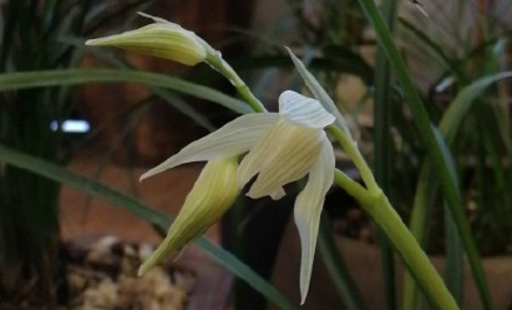
The petals of Da Xuesu are milky white in color, with light green vein patterns. The petals are narrow and long, with relatively sharp tips. The main petal is upright, and the side petals are flat-shouldered or slightly drooping-shouldered. On the snow-white lip there are faint hidden red spots, commonly known as “water stains.”
The petal colors of Cymbidium goeringii flowers include light yellow-green, green-white and yellow-white, and sometimes also pale red. The petals are narrow and long and rounded, with acute or rounded-obtuse tips, ovate-lanceolate in shape, and slightly curved. There are purplish-brown stripes at the base of the midrib.
Da Xuesu belongs to the type with multiple flowers on one stem, with at least 3 flowers and up to 7 when it blooms the most, while when Cymbidium goeringii blooms, the flowers are solitary, and only occasionally 2 flowers open.
3. Other differences between Da Xuesu and Cymbidium goeringii
In addition to some differences in external morphology, Da Xuesu and Cymbidium goeringii also differ in growth habits and cultivation methods. Overall, the cultivation of Da Xuesu is similar to that of Cymbidium goeringii, but its requirements are somewhat higher.