Cymbidium goeringii var. serratum vs Cymbidium goeringii: Differences and Answers to Common Care and Growing Questions
Cymbidium goeringii var. serratum can be grown in most areas south of the Yangtze River, with Yunnan as the main growing region. So what are the differences between Cymbidium goeringii var. serratum and Cymbidium goeringii? How do you care for it? What are the common growing problems and solutions? According to available information, Cymbidium goeringii var. serratum is not picky about its growing environment; whether in a warm indoor space, or on hillsides, in valleys, or in mountain gullies, it can grow. It is also not strict about soil choice, and can grow in red soil, podzolic soil, or humus soil. Its suitable growing temperature range is quite wide, from 15—35 degrees, and its flowering period is from December to March of the following year.
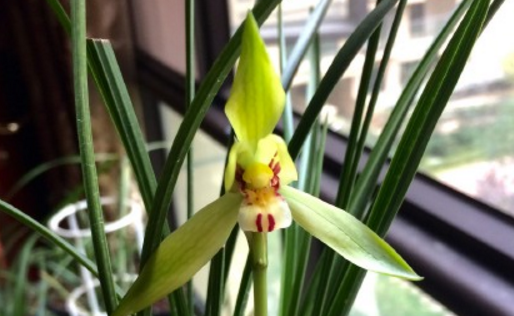
I. What are the differences between Cymbidium goeringii var. serratum and Cymbidium goeringii?
1. Differences in plant shape between Cymbidium goeringii var. serratum and Cymbidium goeringii
Cymbidium goeringii var. serratum has a semi-pendant plant shape, not upright, with relatively scattered leaf bases, and the petiole area is mostly shallow U-shaped, appearing “soft as if boneless,” with a kind of delicate beauty of its own; the point where the petiole of Cymbidium goeringii meets the root is firm and strong, with an obvious waist, and is stiffer compared with Cymbidium goeringii var. serratum.
2. Differences in leaves between Cymbidium goeringii var. serratum and Cymbidium goeringii
The leaves of Cymbidium goeringii var. serratum are narrower than those of Cymbidium goeringii, with a long, narrow leaf shape, no petiole ring, and obvious veins; when held against sunlight, the veins appear transparent. Cymbidium goeringii leaves are relatively wider; the leaf surface of Cymbidium goeringii var. serratum feels rougher to the touch, while Cymbidium goeringii leaves feel smooth. In the image below, the left side shows the leaves of Cymbidium goeringii var. serratum, and the right side shows the leaves of Cymbidium goeringii.
3. Differences in roots between Cymbidium goeringii var. serratum and Cymbidium goeringii
Cymbidium goeringii var. serratum has thick, enlarged roots, with inconspicuous pseudobulbs but obvious root tips; before the shoot buds emerge from the soil they are relatively plump and strong, with weak glossiness, and the pseudobulbs are mostly arranged in a straight line; Cymbidium goeringii has an inconspicuous pseudobulb where root and leaf meet, the pseudobulbs are mostly distributed in a staggered way, and before emerging from the soil they are relatively pointed and sharp, with strong glossiness.
4. Differences in flowering between Cymbidium goeringii var. serratum and Cymbidium goeringii
Cymbidium goeringii var. serratum blooms a single flower in spring, with thick, plump petals; apart from a few hybrid orchids that have fragrance, it is generally unscented and mostly bears a single flower. Cymbidium goeringii bears multiple flowers on one scape, mostly 2-4 flowers, and its fragrance is relatively obvious; on the market, most people distinguish the two by floral fragrance.
II. How do you care for it?
1. Water supply for Cymbidium goeringii var. serratum
Cymbidium goeringii var. serratum has average water tolerance, so during care it must not be watered too much and must not be allowed to stand in water. When the soil surface is dry, water lightly just enough to moisten the pot surface. In summer, generally moisten the pot once every other day and water thoroughly twice a month; in autumn, moisten the pot twice a week and water thoroughly once a month. In winter, control water appropriately and moisten the pot once a week.
2. Light management for Cymbidium goeringii var. serratum
Cymbidium goeringii var. serratum needs a relatively long light period for growth. In summer and autumn it needs appropriate shading, while in winter and spring no shading is needed. Insufficient light may make Cymbidium goeringii var. serratum less likely to bloom, so it should be brought out into the sun more often.
3. Temperature and humidity control for Cymbidium goeringii var. serratum
Cymbidium goeringii var. serratum likes warm winters and cool summers. Its most suitable growing temperature is 15-28℃. In spring and autumn, temperature does not need much attention. In summer, when the temperature exceeds 35℃, growth slows, and it can be cooled by shading and misting. In winter, when the temperature is below 10℃, it needs to be moved indoors to prevent frost damage. The suitable air humidity is 70-80%, and the suitable humidity in winter is 50-60%.
4. Fertilization measures for Cymbidium goeringii var. serratum
The growing medium for Cymbidium goeringii var. serratum is rich in nutrients, so no chemical fertilizer is needed during cultivation. Mixing an appropriate amount of cake fertilizer or sheep manure into the once-a-year repotting or soil change can provide enough nutrition for Cymbidium goeringii var. serratum; generally no fertilizer is applied in between.
5. Ventilation management for Cymbidium goeringii var. serratum
In a well-ventilated environment, Cymbidium goeringii var. serratum promotes respiration of the orchid plant, speeds up metabolism, and encourages growth; if ventilation is poor, it easily causes large-scale reproduction of bacteria and mold, bringing rot and mildew diseases that are bad for orchid growth. When choosing a ventilated location, wind force must be fully considered, avoiding strong winds and cold winds that damage or break the leaves.
III. Common growing problems and solutions?
1. Tip burn in Cymbidium goeringii var. serratum
Causes of tip burn in Cymbidium goeringii var. serratum
When the leaf tips of Cymbidium goeringii var. serratum are pale white or light brown, the cause is mostly improper watering (too dry or too wet); water temperature and room temperature are also important influencing factors. If the leaf tips are black, it may be due to excessive fertilization or too high concentration, causing tip burn.
Solutions for tip burn in Cymbidium goeringii var. serratum
When watering, note that the water should be left standing for at least one night in advance to ensure the chlorine in the water has fully evaporated; it can also be placed in scattered light for about 3 hours. Never use freshly drawn water directly for watering. On one hand, the water temperature is relatively low; on the other hand, the bleach and fungicide in the water have not fully evaporated, and after the plant absorbs them it is difficult to metabolize them. During watering, note that it is enough to keep the soil surface moist; do not water too much, and of course do not let it become too dry.
If tip burn is caused by excessive fertilization, then the pot should be soaked as soon as possible, with the water changed multiple times, to wash away part of the excess fertilizer in the soil.
2. Collapse of seedlings in Cymbidium goeringii var. serratum
Causes of seedling collapse in Cymbidium goeringii var. serratum
When watering, water accumulates in the heart of the shoot; under direct sunlight, the water evaporates too quickly and takes moisture away from the plant, causing dehydration and seedling collapse, and even causing scorch spots; old seedlings and diseased seedlings can also cause seedling collapse.
Solutions for seedling collapse in Cymbidium goeringii var. serratum
Water along the edge of the pot and gently, to avoid damaging the roots on the soil surface or splashing water onto the leaves. If water has already splashed onto the leaves, first place the flower in a shaded area, and after the water evaporates, place it in the sun.
Old seedlings and diseased seedlings should be cleaned up in time, and after touching diseased seedlings, wash your hands promptly to avoid pathogens infecting more plants.
3. Stunted seedlings in Cymbidium goeringii var. serratum
Causes of stunted seedlings in Cymbidium goeringii var. serratum
Water temperature and room temperature being too high or too low can both cause stunted seedlings.
Solutions for stunted seedlings in Cymbidium goeringii var. serratum
Pay attention to controlling water temperature; some water can be left standing first as reserve water for watering the flowers.
In summer, the flowers can be slightly shaded; in winter, they can be moved indoors, or covered with a simple plastic tunnel for insulation.