What varieties of Brassica oleracea (ornamental kale) are there? A detailed guide to cuttings and eating
Ornamental kale is also called peony cabbage, flower cabbage and green leafy kale, so what varieties of ornamental kale are there? Can it be propagated by cuttings? Can it be eaten? According to available information, ornamental kale prefers a cool climate and is fairly cold-hardy, so even in the cold winter people can see it growing. Ornamental kale can tolerate shade, but its leaves grow better under sufficient light. It has a fairly high demand for water and cannot be allowed to dry out, otherwise it grows slowly, but note that it also cannot be waterlogged.
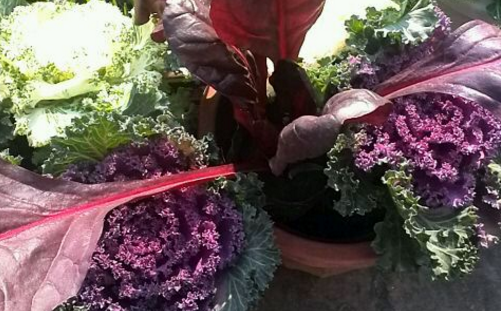
I. What varieties of ornamental kale are there?
1. Flowering ornamental kale
It is an ornamental variety, a plant of the Brassicaceae family, native to Europe. The plant form is elegant, it is easy to cultivate, and the ornamental period is long, so it can also be viewed in winter; its ornamental value is fairly high, making it an important material for flowerbed arrangement, and it can also be used for potted display and as cut-flower decoration, etc. Sowing takes place from mid-July to early August, planting out takes place in mid-to-late August, and the ornamental period is from November to December.
2. Dongfang Lüneng (Eastern Green Tender)
Good quality, storage-tolerant, good growth vigor, leaf color dark green, no wax bloom, the edges of the tender leaves curl into wrinkles. This variety has characteristics such as heat tolerance, cold tolerance, fertilizer tolerance, late bolting and a long harvest period. It can be cultivated in open fields in spring and autumn as well as in greenhouses or cold frames in winter. It generally takes 50 days from sowing to harvest, and the yield is high.
3. Apeida
An improved first-generation hybrid introduced from the Netherlands. Medium height, leaf color blue-green, fairly strong curling, neat and elegant appearance, excellent quality, extremely strong stress resistance; it can be used not only for open-field cultivation in spring and autumn, but also for protected cultivation in winter.
4. Bailuoqun (White Skirt)
Tall-growing, round-leaf type, colors early, the heart leaves are milky white and form a sharp contrast with the green edges of the outer leaves, the edges of the whole leaf are slightly wrinkled and appear wavy. The plant type is neat, the plant height is about 40 cm, it is extremely cold-hardy and can withstand a low temperature of -10°C, grows vigorously and has good disease resistance.
II. Can it be propagated by cuttings?
Ornamental kale can be propagated by cuttings
First, we can see that ornamental kale can indeed be propagated by cuttings.
If ornamental kale is grown in a pot, it generally bolts and flowers in March and April in spring. At this time, it is best not to throw it away, but to continue watering and fertilizing, so that after the flowers fade, the old stems of the ornamental kale will sprout a large number of tillers; old stems that have not sprouted tiller buds can be cut off, and then watering and fertilizing should continue for care, and by autumn cuttings can be taken.
In August and September, the tillers that have already grown can be cut off and used for cuttings according to your own needs.
How to take cuttings of ornamental kale
First, according to your own needs, decide the number of cuttings and prepare the potting soil; choose a clean flowerpot and soil, with river sand or perlite being best, and set it aside after disinfection.
Then the cuttings to be rooted need to be trimmed. After cutting off the tillers of the ornamental kale, keep 3 or 4 leaves on each bud, and then insert them for rooting.
When taking cuttings, pay attention to the density, and do not let the leaves overlap. After inserting them, water first, then place the flowerpot in a shady place, and water according to the condition of the cuttings to ensure they do not wilt.
Basically, ornamental kale cuttings can take root in about one week, and can be transplanted in half a month.
Precautions for taking cuttings of ornamental kale
Note that generally after the cuttings are cut off, the remaining plant can continue to be cultivated, producing multi-headed ornamental kale plants, and can even be made into old-stump bonsai.
Also, taking cuttings in June can produce ornamental kale cut flowers. If you do not take cuttings, you can simply let the tillers continue to grow, which is also fine.
If ornamental kale is placed in a vase, it also roots easily, and in a fairly bright room it can be displayed for a long time.
III. Can it be eaten?
Because in daily life we mostly see the brilliant and colorful ornamental kale in roadside flowerbed decorations, we subconsciously think it can only be used for viewing. In fact, ornamental kale is a horticultural variety of edible cabbage, so of course it can be eaten, and its taste is quite good; it even has the reputation of being the best vegetable for the human body, and long-term consumption has many benefits.
The benefits of eating ornamental kale
Ornamental kale is rich in nutrients and is praised as one of the best vegetables for the human body. Ornamental kale contains a large amount of vitamins A, C and B2 as well as various minerals, especially calcium, iron and potassium, whose content is very high, more than three times that of ordinary cabbage. Eating more ornamental kale can effectively supplement calcium, and the vitamin C content of ornamental kale is extremely high, making it the preferred vegetable for treating night blindness in children. In addition, ornamental kale is low in calories and is an ideal food for bodybuilding and weight loss. As an ingredient, it can be cooked in many ways, such as stir-fried, served cold with dressing, or made into soup, and in Western cuisine it is mostly used with other vegetables to make salads.