Solanaceae Capsicum ornamental pepper varieties, seed propagation, and benefits and effects explained in detail
Ornamental pepper, also called five-color pepper, and it also has other names such as cluster pepper and five-color chili. So what varieties of ornamental pepper are there? How do you propagate it by seed? What benefits and effects does it have? According to information, ornamental pepper is a variety of chili pepper and a perennial herbaceous plant with a short plant type. Ornamental pepper often blooms at the branch tips. The flowers are relatively small, but after blooming they produce fruit, and the fruit is its main ornamental part.
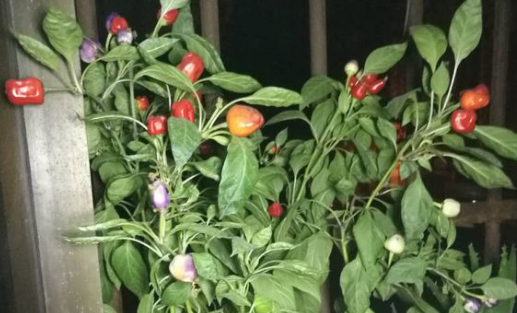
I. What varieties of ornamental pepper are there?
1. Upright type
The fruit points upward and is round, heart-shaped, or conical, with the fruit borne singly in the leaf axils. The fruit color changes from white to red, or from white or yellow to blue-purple and then to red. In addition, there are also single-colored types, as well as types that change from green or white to yellow or red.
2. Clustered type
Also called Buddha's hand pepper, most of the fruit of this variety is clustered at the tips of the branches, mostly in a long heart shape or conical shape, and the color is mostly from white to red or from green to red.
3. Pendant type
The fruit is borne in the leaf axils. The fruit hangs downward and is mostly irregularly conical. Depending on the variety, the size varies, and the fruit color changes from green to red or yellow.
4. Lantern type
The fruit is borne in the leaf axils. The fruit hangs downward and is mostly truncated-conical, round-square, and also multi-ribbed in shape, with smooth rounded corners; the fruit color generally changes from green to white, red, yellow, or black-purple, and so on. There are also distinctions in length, shortness, height, and dwarfness.
In addition, it can also be divided according to plant type into tall, medium, and dwarf, with the tall type reaching up to 1 m, while the dwarf type is only 10 cm.
II. How do you propagate it by seed?
1. Seed propagation of ornamental pepper
The sowing time is generally chosen in late spring, carried out indoors or in the open field when the weather is clear and warm. The suitable germination temperature is between 25-30°C, and after sowing it germinates in about 5-10 days. During the seedling stage, liquid fertilizer needs to be applied 1-2 times, and when the plant height reaches 8-10 cm, it is then transplanted for cultivation.
In a greenhouse environment, sowing is generally carried out in late March. Sowing can be done in indoor pots or in a seedbed. When 3-4 true leaves have grown, transplanting is carried out. In mid-to-late June, it is planted out in the open field. If it is to be grown as a potted ornamental, it can be planted in early June into a flowerpot with a pot diameter of about 20 cm, and it can begin to bear fruit in August.
2. Raising seedlings and sowing of ornamental pepper
The suitable germination temperature for ornamental pepper plants needs to be above 25°C. If a plastic film greenhouse is used for heat preservation, then cultivation can be carried out in all four seasons, and sowing can be done in a seedbed or in pots.
Choose fertile, loose soil with good drainage and air permeability. The soil needs to be sieved and disinfected by methods such as sun exposure, fumigation, and high-temperature treatment to kill bacteria and insect eggs in it.
Before sowing, the seedbed needs to be sprayed with sufficient water. After the water seeps in, evenly scatter the seeds into the soil, then cover with fine soil at a thickness of about 1 cm, and finally spray water once more. When the temperature is low, a film arch needs to be built.
After the young shoots emerge, water with 1-2 applications of human manure and urine or appropriately apply a 0.1% urea solution. After watering, remember to spray clear water to wash away the fertilizer liquid remaining on the leaf surface, so as to avoid burning the young leaves. When 5-6 true leaves have grown, it can be transplanted.
III. What benefits and effects does it have?
1. Ornamental value of ornamental pepper
Ornamental pepper is an excellent fruit-ornamental potted plant. The fruit colors are diverse, with five colors: red, purple, white, green, and yellow. They are glossy, lively, and bright. The fruit is also small, each one pointing upward, dotted among the leaves, making it look dainty and cute, and very endearing.
2. Nutritional value of ornamental pepper
Ornamental pepper is rich in vitamin A, B, and C as well as β carotene, sugars, fiber, calcium, phosphorus, iron, and others, which can help enhance immunity, fight against free radical damage, and protect vision. Regularly eating ornamental pepper can not only nourish hair roots but also strengthen nails. For the skin, it also has the function of activating cell tissues, can promote metabolism, and makes the skin smooth, delicate, fair, and radiant, with certain beauty benefits. In addition, it has a preventive effect on fragile bleeding of microvessels, retina, cerebral blood vessels, gum bleeding, and so on, and it is also a food relatively suitable for people with diabetes to eat.
3. Medicinal value of ornamental pepper
Ornamental pepper has effects such as warming the middle and strengthening the stomach, and dispelling cold and dampness. Taken internally, it can be used to treat stomach cold with fullness and bloating, indigestion, loss of appetite, wind-cold common cold, and so on; used externally, it can promote blood circulation in the skin and also has a good effect on treating chilblains, rheumatic pain, and so on.