Myrtales Lythrum salicaria Care Methods, Precautions, Propagation and Differences from Lavender
Lythrum salicaria, also known as water willow, water willow, verbena, opposite-leaf lotus, and detoxifying herb, so what are the care methods and precautions for Lythrum salicaria? How to propagate it? What is the difference from lavender? According to information, Lythrum salicaria likes a warm growing environment and requires sufficient light; generally the growing environment needs good ventilation. Lythrum salicaria likes a moist environment and is suitable for growing in shallow water; it can also be cultivated on dry land. The soil is generally required to be fertile and loose.
I. Care Methods and Precautions for Lythrum salicaria?
Pot and Soil Selection
When choosing a flower pot for potted Lythrum salicaria, you can choose flexibly according to your needs. You can choose a larger-diameter flower pot and plant several plants together in a clump, or you can choose a small flower pot with a diameter of about 20cm for a miniature potted plant. For potted Lythrum salicaria, pond mud is needed, and the soil is required to be fertile.
Light and Temperature
Lythrum salicaria likes a warm growing environment with sufficient light. It needs light and the environment must be kept ventilated. Lythrum salicaria is also relatively cold-tolerant; in winter, it can overwinter outdoors.
Water and Fertilizer Management
Lythrum salicaria mostly grows in swamps or near wetlands. It likes water and moisture and grows better in shallow water, so during the growing period, you need to ensure there is water in the flower pot. In cold winter, the pot should also be kept moist, and you can water it frequently. However, Lythrum salicaria does not need frequent fertilization; adding some base fertilizer in the potted room is enough. However, if Lythrum salicaria shows yellow leaves, you can apply some fertilizer.
Propagation Methods
The propagation of Lythrum salicaria is mainly by division and cuttings, and it can also be propagated by sowing. All are relatively easy to survive.
Precautions:
Pruning
During the growth of Lythrum salicaria, in order to control plant height, pinching is needed. Pinch 1 to 2 times to dwarf the plant. After Lythrum salicaria blooms, remove the spent flowers, which can promote the germination of new flower buds and allow the next batch of flowers to bloom. Usually, you can prune overly dense branches and leaves to help ventilation. In winter, cut off the old branches of Lythrum salicaria to help it overwinter.
Pests and Diseases
Lythrum salicaria has relatively few pests and diseases, but it can be harmed by leaf spot disease, which causes spots on the leaves. Sometimes, Lythrum salicaria can also be harmed by red spiders due to poor ventilation; just use insecticide to kill the insects. The growing environment of Lythrum salicaria must be kept ventilated.
II. How to Propagate?
1. Cutting Propagation Method
If you want to propagate Lythrum salicaria by cuttings at home, you first need to know that its growing period is from June to August each summer, and this is also the best time for cuttings.
When taking cuttings, select healthy young branches with good growth, about 10 cm long. Remove the leaves from the bottom one-third cleanly, insert them into a flower pot filled with moist pond soil, and they will take root in about ten days.
2. Division Propagation Method
The division propagation of Lythrum salicaria should be carried out in early spring or late autumn.
When dividing, take out the entire underground root system intact, carefully cut off a part with a blade, let it dry slightly in the shade, and then plant it directly. In winter, there is no need to put it indoors, but avoid too low temperatures.
III. What Is the Difference from Lavender?
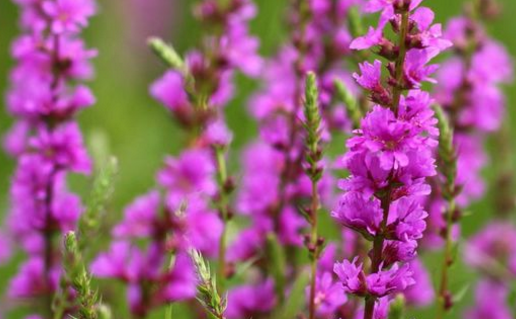
The height of Lythrum salicaria is between 30 cm and 100 cm, and under normal circumstances it can grow to about 1 m, slightly taller than lavender. Its stem is four-angled and has many branches. The leaves grow symmetrically, generally about 5 cm long and about 10 cm wide. The flowers of Lythrum salicaria are purplish-red, in long spikes. The flowers are relatively small and grow densely. The flowering time is July-August.
Lavender likes to grow in clumps and has many branches. Under normal circumstances it grows upright. The height varies according to the variety, generally in two height ranges: 30-40 cm and 45-90 cm. However, in places with relatively high altitude, some lavender can also grow to a height of 1 m. The leaves are oval-shaped with leaf tips, and the leaf edges generally curl backward. The inflorescence of lavender is spicate, about 20 cm long; the lower half of the corolla is like a tube, and the upper half is somewhat lip-shaped. The most common color of lavender is purple-blue, but there are also lavenders of other colors, such as pink, deep purple, white, etc. The flowering time is June-August.