White-flowered Anacampseros (Anacampseros albissima) Home Care Tips: Repotting, Transplanting, and How to Solve the Problem of Not Blooming
White-flowered Anacampseros is commonly known as "Avonia albissima." So what are the home cultivation and care tips for Anacampseros? How do you repot and transplant it? What should you do if it does not bloom? According to available information, the white-flowered Anacampseros belongs to the genus Anacampseros in the family Portulacaceae. It is native to the desert regions of South Africa and Namibia, and prefers a cool, dry, and sunny environment. It is tolerant of drought and partial shade, and dislikes excessive moisture and strong light. It also fears stuffy, humid conditions, and is slightly cold-hardy.
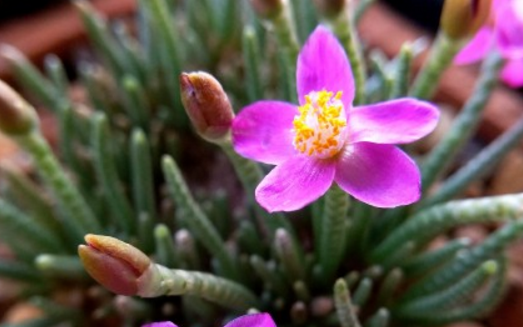
I. Home Cultivation and Care Tips for White-Flowered Anacampseros
Pot and Soil Selection
The potting soil should be loose, breathable, well-draining, and have a certain degree of granulation. You can mix 1 part leaf mold or peat moss with 3 parts coarse sand or vermiculite, and add a small amount of calcareous materials such as bone meal. You can also use materials such as akadama soil.
Light Treatment
The white-flowered Anacampseros is native to the desert regions of South Africa. From the end of September to April of the following year is its main growing season, when the slender branches at the top of the rhizome begin to sprout and grow. It can be placed in a sunny spot for care.
Watering and Fertilizing
For watering, follow the principle of "do not water if not dry, water thoroughly when you do." Avoid waterlogging in the soil to prevent the tuberous roots from rotting.
Because it grows slowly and needs few nutrients, it generally does not require additional fertilizing.
Precautions:
In summer, pay attention to ventilation to avoid root rot caused by stuffy heat.
Repotting and transplanting should be done during the dormant period or early growth stage of the white-flowered Anacampseros. Transplanting at this time causes little damage to its root system and allows it to continue growing well.
Avoid water accumulation in the potting soil, which affects growth and easily causes root rot.
II. How to Repot and Transplant?
1. Soil Selection for Repotting and Transplanting White-Flowered Anacampseros
The potting soil should be loose, breathable, well-draining, and have a certain degree of granulation. You can mix 1 part leaf mold or peat moss with 3 parts coarse sand or vermiculite, and add a small amount of calcareous materials such as bone meal. You can also use materials such as akadama soil.
2. Season Selection for Repotting and Transplanting White-Flowered Anacampseros
Repot every spring. Never transplant or repot during the high-temperature and strong-light period of summer; at that time, appropriate shading should be provided.
3. Matching the Growth Period for Repotting and Transplanting White-Flowered Anacampseros
It is best done during the dormant period or early growth stage of the white-flowered Anacampseros. Repotting during these two stages has little effect on its growth and does not damage the root system.
4. Precautions for Repotting and Transplanting White-Flowered Anacampseros
When repotting, keep as much soil as possible around the plant's roots and try to avoid bare-root transplanting. This is because transplanting with soil is easier to succeed than bare-root transplanting.
When repotting, if the original pot is a soft plastic pot (or a paper cup), it is recommended to cut it open, as this will not damage the plant's root system.
III. What to Do If It Does Not Bloom?
Although Anacampseros is known as the "epiphyllum" of the Portulacaceae family, the editor believes that while the epiphyllum blooms at night and its owner can slowly wait for it in the dark, Anacampseros usually blooms in the afternoon during the day, and we often miss its beautiful moment because of some trivial matters.
If there is cloudy and rainy weather or insufficient light in the cultivation environment, it may even be difficult for it to open!
At this time, what the owner needs to do is place it in a well-ventilated spot with the best light, and then wait for the surprise to arrive!