How to grow Euphorbia tirucalli (Caryophyllales, "General's Staff")? Detailed guide to propagation methods and benefits and uses
Euphorbia tirucalli belongs to the cactus family, Cylindropuntia genus, and is native to Peru and Argentina. Also known as "General's Pillar," so how do you grow it? How do you propagate it? What benefits and uses does it have? According to the information available, Euphorbia tirucalli is actually very easy to grow, and rough, low-maintenance care is recommended. Euphorbia tirucalli is a cactus family plant, and its flowers are red. Euphorbia tirucalli needs plenty of sunlight and well-drained soil. The soil can be 1 part peat soil, 2 parts loam and sand, and you can also add small gravel to the soil to ensure good drainage.
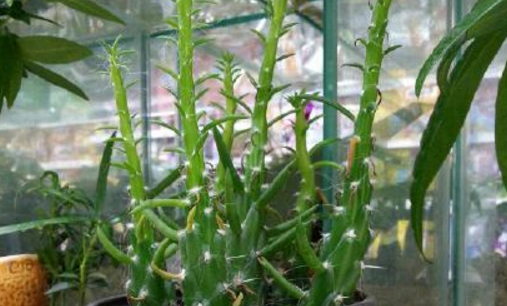
I. How do you grow Euphorbia tirucalli?
1. Growth habits of Euphorbia tirucalli
Euphorbia tirucalli, also called "General's Pillar," is a species under the cactus family, Cylindropuntia genus, and Peru and Argentina are its places of origin. It tolerates partial shade and dislikes damp shade. It likes a growing environment with plenty of sunlight, dry and warm, and is fairly drought-tolerant. The suitable growing temperature is roughly between 18-30°C, and in winter the room temperature needs to be kept above 5°C. When the temperature is too low, the leaves will turn slightly red.
2. Care tips for Euphorbia tirucalli
Euphorbia tirucalli is very easy to keep alive, but it grows slowly, and its growing season is in spring and autumn. In summer, pay attention to ventilation and protect it from scorching sun; in winter, do a good job of keeping it warm. Some may bloom in winter.
Light
Place it in a warm, well-ventilated environment to grow, give it plenty of light, and in summer prevent scorching sun and provide appropriate shading.
Watering
It requires alternating dry and wet periods. Never water unevenly or too much, otherwise it may cause leaf drop and root rot. Be sure to water thoroughly, and wait until the potting soil is completely dry before watering a second time.
Fertilizer
In the early growth stage of Euphorbia tirucalli, you can apply 5-10 granules of granular fertilizer, with fertilization roughly every 7-10 days.
Potting soil
For the soil, it is suitable to choose well-drained, well-ventilated peat soil mixed with small gravel for planting.
Toxicity
Euphorbia tirucalli belongs to the cactus family and is toxic. It is not edible, so it is best to keep it away from children. If poisoning occurs, go to the hospital immediately for proper treatment.
II. How do you propagate it?
1. Cutting propagation of Euphorbia tirucalli
When propagating Euphorbia tirucalli, the cutting method is the one most commonly used. Under normal conditions, cuttings of Euphorbia tirucalli can be taken in May-June, but if a suitable temperature can be maintained, cuttings can be taken in all four seasons.
When propagating Euphorbia tirucalli by cuttings, the method is actually very simple. Cut a branch off the Euphorbia tirucalli plant, put it in a shady place to let the wound dry, and then take the cutting.
Put the cutting medium in a flower pot; clean plain sand soil is enough. Insert the Euphorbia tirucalli cutting into the soil, then just keep the soil appropriately moist. Note: do not water too much. Once the Euphorbia tirucalli has taken root, it has survived.
2. Grafting propagation of Euphorbia tirucalli
When growing Euphorbia tirucalli, besides using the cutting propagation method, you can actually also use grafting propagation, which can speed up the growth rate of Euphorbia tirucalli.
Choose some plants from the Euphorbiaceae family, Euphorbia genus, such as Euphorbia antiquorum or Euphorbia royleana, etc., as the rootstock, and use the flat grafting method to graft Euphorbia tirucalli onto it. The propagation results are also quite good this way.
3. Seed propagation of Euphorbia tirucalli
Seed propagation is also one of the more commonly used propagation methods for Euphorbia tirucalli. However, compared with cutting propagation and grafting propagation, seed propagation is still relatively difficult to carry out and has relatively low feasibility. So when propagating Euphorbia tirucalli, it is recommended to mainly use cuttings and grafting.
III. What benefits and uses does it have?
1. Ornamental value of Euphorbia tirucalli
The overall ornamental quality of the Euphorbia tirucalli plant is quite good, and it is suitable for potted cultivation and viewing.
The entire plant of Euphorbia tirucalli is emerald green, and the whole stem is covered with long spines, giving it a rather unique ornamental value. Generally speaking, Euphorbia tirucalli is a relatively small plant, but after being grown, some Euphorbia tirucalli can also grow to about 2 m-4 m, and the side buds grow in clusters, so it can be called a giant.
What is relatively rare is the flowers of Euphorbia tirucalli. Although it is relatively rare for Euphorbia tirucalli to bloom, its flowers are mostly in summer, and when it blooms it produces red or orange-red flowers that can last for several days. Its ornamental value is still quite good.
2. Purifying effect of Euphorbia tirucalli
Besides having relatively good ornamental value, Euphorbia tirucalli also has the effect of beautifying the environment and purifying the air. Euphorbia tirucalli can carry out respiration, mostly at night, and can absorb carbon dioxide and release oxygen. At the same time, it can also absorb toxic gases and prevent radiation.
So, do not underestimate this Euphorbia tirucalli; it also has great uses. Growing a pot of Euphorbia tirucalli indoors is not only nice to look at, but can also purify the environment.