How much is alfalfa per ton now? Plus key points on planting and utilization techniques
Alfalfa is also known as purple alfalfa, pasture alfalfa, alfalfa, and luzerne. Its seeds are ovate, 1-2.5 mm long, smooth, and yellow or brown. The flowering period is May to July, and the fruiting period is June to August. So how much does alfalfa currently cost per ton? What are the key points on planting and utilization techniques? According to the Zhengzhou forage planting base, dried alfalfa hay is 1000-1500 yuan per ton, while dried Zengrun forage grass and sweet elephant grass are 2000-3000 yuan per ton.
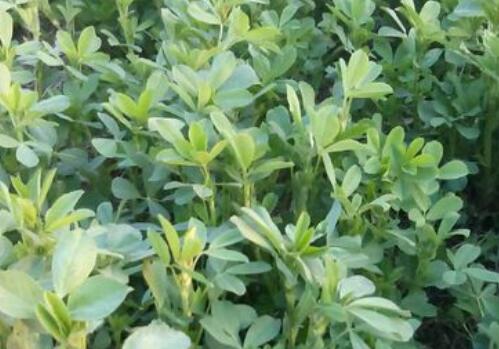
Prospects and benefits of alfalfa planting:
Planting alfalfa yields 1500 kg of hay per mu, with an output value of 950 yuan, a production cost of 270 yuan per mu, and a harvest cost of 60 yuan, giving a net income of 620 yuan per mu; while wheat sown in the same period yields 396 kg per mu, with an output value of 356 yuan, a production cost of 208 yuan per mu, and a harvest cost of 20 yuan, giving a net income of 128 yuan per mu. It can be seen that planting alfalfa can bring 490 yuan more income per mu than planting wheat. This is the benefit comparison in the year alfalfa is planted. In a year-round production comparison, for agricultural production using a wheat—corn rotation on nearby plots, the yields of wheat and corn per mu are 450 kg and 400 kg respectively, with a total output value of 725 yuan, a production cost of 535 yuan, and a net income of only 190 yuan per mu. Even counting the output value of wheat straw and corn stalks at 150 yuan, the net income per mu is still only 340 yuan, which is still lower than the net income benefit of planting alfalfa. The benefit of feeding forage grass to livestock and poultry varies depending on the animal species, but it is certainly longer than the industrial chain of simply growing grain and has greater value-added potential. Compared with crops such as corn and wheat, alfalfa is simpler to cultivate and manage, saves labor, requires less input, has a long effective period, and offers good planting benefits.
Key points on alfalfa planting and utilization techniques:
Alfalfa is a perennial legume forage grass with good palatability and high nutritional value. It is a high-quality forage grass for feeding cattle, sheep, and other herbivorous livestock. The following briefly introduces the key technical points for planting this forage grass:
I. Planting techniques
1. Land selection: Choose plots with deep soil layers, loose soil, and poor water accumulation. Try not to choose plots where legume crops were previously planted, or plots with acidic soil (such as pine needle soil), for planting alfalfa.
2. Land preparation: Deeply plow the plot 25-30 cm. For land with deep-rooted, tuberous-rooted, tuberous, or rhizomatous weeds, plow when the weather is clear and fine. 15 days before plowing the soil, choose clear weather with direct sunlight and use a sprayer to apply herbicide to remove weeds. After plowing, exposure to the sun first helps break up compacted soil clods appropriately, and second helps dry out most weed roots and stems, which is equivalent to a physical weed removal process.
3. Applying base fertilizer: Before sowing, apply sufficient base fertilizer in combination with land plowing. Both farmyard manure and nitrogen fertilizer are acceptable. The application rate of farmyard manure is 1000-1500 kg/mu. If there is no organic fertilizer, apply 5-10 kg of urea and 30-40 kg of calcium superphosphate per mu. After fertilizing, plow and prepare the land and promptly form seedbeds. The seedbed surface is required to be level with no large soil clods.
4. Seed treatment: Before sowing, clean and air-dry the seeds for 2-3 days, then carry out coating or rhizobium inoculation treatment. During rhizobium inoculation, mix 10 kg of seeds with each 1 kg of rhizobium. If coated seeds are used, sow directly.
5. Sowing: The sowing period should be from April to August, when the minimum soil temperature is above 5°C and the soil moisture content is generally 18%-23%.
Sowing rate: 0.5-1 kg per mu; for broadcast sowing, increase the sowing rate by 20%.
Sowing depth: Determined by soil moisture conditions, generally 3-5 cm. It should be shallower when soil moisture conditions are good and deeper when moisture conditions are poor.
Sowing methods: ① Narrow-row drilling, with row spacing of 15-20 cm, followed by harrowing and compaction after sowing; ② For broadcast sowing, level the land, sow evenly, harrow to cover soil and compact, with seed depth of 3-5 cm; ③ For plastic film planting, form ridges at a ridge spacing of 30-40 cm, with a ridge surface width of 50-60 cm and a ridge height of 5 cm, cover with 70 cm wide plastic film, punch holes in the film and sow, with hole spacing of 10-20 cm.
II. Field management and utilization
1. Shallow harrowing and loosening soil: After the soil thaws in early spring and before alfalfa sprouts, carry out shallow harrowing and soil loosening to raise soil temperature and help greening. 2. Weeding: During the alfalfa seedling stage, weed once each when the seedlings reach 5 cm and 10 cm in height. 3. Fertilization: Before loosening soil and irrigation, apply 20-30 kg of calcium superphosphate per mu. During the growth period, apply 0.5 kg of potassium dihydrogen phosphate per mu mixed with 75 kg of water for spraying. 4. Irrigation: Where irrigation conditions are available, irrigate once during spring greening and after each cutting. 5. Cutting frequency: Alfalfa is cut 2-5 times each year. Generally, with better water and heat conditions, a longer frost-free period, and a higher management level, the cutting frequency is greater. 6. Stubble height: The general stubble height after cutting is 8-10 cm. If the cutting frequency is more than 4 times, leave a higher stubble; if the cutting frequency is fewer than 4 times, the stubble height may be appropriately lowered. However, at the last cutting in autumn, the stubble height should be kept above 10 cm. 7. Time of the last cutting: The last cutting each year should be set no less than 20 days before the temperature drops to 5°C. Otherwise, it will affect the safe overwintering of alfalfa and its production capacity the following year.
III. Disease control
The main diseases of alfalfa include downy mildew, rust, and leaf spot. Control methods: sow disease-free seeds; cut and utilize diseased alfalfa in time; fertilize scientifically and do not apply excessive nitrogen fertilizer; once disease is found, apply 0.1 kg of 70% thiophanate-methyl wettable powder per mu mixed with 50 kg of water for one spray.
The main insect pests of alfalfa include aphids, alfalfa plant bugs, alfalfa noctuid moths, and thrips. Control methods: remove weeds to reduce pest sources; cut at the proper time; when pests appear, apply 50 ml of 50% phoxim emulsifiable concentrate per mu mixed with 50 kg of water for spray control, with a safety interval of 30 days.
Pesticide safety interval: refers to the allowable interval in days from the last pesticide application to harvest or feeding. Whether it is an insecticide or fungicide, its safety interval must be guaranteed to be 30 days.