Growing and Harvesting Times, Yield per Mu, and Cultivation Techniques for Cruciferous Green Vegetables
Green vegetables, also known as baby bok choy, rapeseed greens, or small rapeseed greens. They are cultivated in all provinces north and south in China, especially widely in the Yangtze River Basin. The tender leaves of green vegetables are used as a vegetable and are one of the most common vegetables in China. So when are green vegetables planted and harvested? What is the yield per mu? How are they planted? What are the techniques? Learned from a cultivation base in Yunnan, green vegetables have thick and long leaf stalks, green stalks are dark green, pink stalks are grayish green, and there is abundant wax. The plant height is 70 cm, and the spread is 50 cm. The weight per plant is about 2.5 kg, and the yield per mu is about 7000—9000 kg.
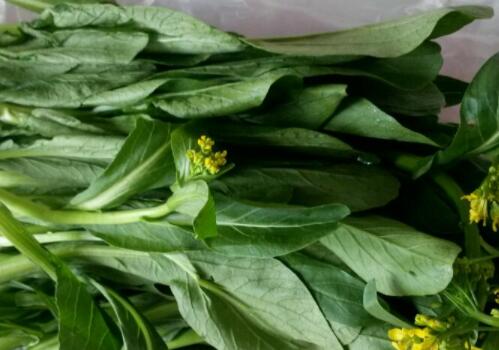
When are green vegetables planted and harvested?
1. The planting season for green vegetables is generally from August to October, and they can be planted every year, but autumn and winter seasons are best, and in the northern winter they should be planted indoors.
2. March Slow grown from open-field seedlings is harvested from late February to late March, April Slow grown from greenhouse seedlings is harvested from late March to early April, and May Slow is harvested from late April to early May. Remove the roots with a kitchen knife, and market as cleaned vegetables.
How are green vegetables planted? What are the techniques?
1. Plot selection: For cultivating green-stalked green vegetables, it is best to choose plots with deep, loose, and fertile sandy loam or clay loam, convenient drainage and irrigation, and crop rotation.
2. Sowing period: Sowing at the proper time is a key measure for disease prevention and high yield. For cultivation as small green vegetables, they can be sown year-round and harvested year-round. For cultivation as large green vegetables, sow from August to October and harvest from November to February of the following year.
3. Sowing method: Green vegetables can be direct-sown or raised as seedlings and transplanted. For cultivation as small green vegetables, use direct sowing, adopting wide-bed and high-ridge broadcast sowing cultivation, with a bed width of 1.5-2 m. For cultivation as large green vegetables, both direct sowing and seedling transplanting are acceptable. For direct sowing, adopt wide-bed and high-ridge multi-row hole sowing, sowing about 10 seeds per hole, covering with fine soil after sowing, with a seeding rate of about 200 g per mu. For seedling transplanting, keep the seedling age at about 25—30 days and transplant when there are 4-5 leaves.
4. Field management:
1. Thinning and transplanting: Whether direct-sown or seedling-transplanted, thinning must be carried out. At 1-2 true leaves of the seedlings, carry out the first thinning, removing weak seedlings and overly dense seedlings, retaining large and strong seedlings, and for direct-sown ones promptly check for gaps and replant. At 3-4 leaves, carry out the second thinning. At 5 leaves, for direct-sown ones carry out final thinning, and for seedling-transplanted ones carry out transplanting. The plant and row spacing: plant spacing 1.1—1.2 chi, row spacing 1.2—1.3 chi, planting about 4000 green vegetables per mu. Transplanting is best carried out after 4 p.m., and water thoroughly to settle the roots.
2. Watering: During the seedling stage, water lightly after each thinning. Under normal conditions, judge by the degree of dryness or moisture of the plot, watering once every 3—4 days on sunny days, following the principle of watering when dry and stopping when moist. For field-grown green vegetables raised as seedlings and transplanted, water thoroughly to settle the roots at transplanting, then water moderately according to seedling condition and the degree of dryness or moisture of the plot.
3. Fertilization: For cultivation as small green vegetables, apply 2000-2500 kg of human manure and urine per mu during the seedling stage, plus 5-10 kg each of ordinary superphosphate and potassium sulfate, applied diluted with water. For field cultivation of green vegetables, fertilization should be mainly nitrogen fertilizer, with appropriate additional phosphorus and potassium fertilizer, and applied after transplanting and survival, generally with 2—3 topdressings. The number and concentration of fertilizations depend on seedling condition. The first topdressing is after the greening stage, applying 40 kg of urea per mu diluted with water, or clear manure water diluted with water. Afterward, appropriately increase phosphorus and potassium fertilizer according to growth, either by root topdressing, that is, applying in holes, or by foliar spraying. For early autumn sowing, the early temperature is high and growth is fast, so topdress promptly so that the plants enter the rosette stage earlier, benefiting the growth of the edible part. For late autumn sowing, in colder areas, do not apply much fertilizer before spring, otherwise it is prone to freezing damage during overwintering. After spring begins, water and fertilize promptly so that vegetative growth is vigorous and yield and quality are improved. When used for pickling, stop watering and topdressing about half a month before harvest to avoid excessively high moisture content, increase the fiber content of the green vegetables, and improve processing quality.
4. Intertillage and earthing up: Carry out intertillage 1-2 times during the entire growth period. For direct-sown ones, shallow hoeing after the second thinning, and deep intertillage of 5-6 cm after final thinning. For field-grown green vegetables raised as seedlings and transplanted, carry out the first shallow hoeing after transplanting survival and the greening stage, and deep intertillage of 5—6 cm before entering the rosette stage.
5. Pest and disease control:
(1) Weeds: Use spare time to promptly remove weeds by hand.
(2) Diseases: ① Damping-off: This is the main disease at the seedling stage. Pay attention to drainage, sow appropriately thinly, and thin and final-thin promptly. At the early stage of onset, spray with 800 times dilution of 3% hymexazol-metalaxyl, spraying 2-3 times consecutively. ② White spot disease: It mainly harms leaves. At the early stage of onset, spray with 500—600 times dilution of 50% thiophanate-methyl or 500 times dilution of 50% carbendazim. ③ Soft rot: At the early stage of onset, spray with 1500 times dilution of 72% agricultural streptomycin, or 800 times dilution of 5% kasugamycin. The affected parts must be thoroughly sprayed. ④ Viral disease: At the early stage of onset, use 50 ml of 7.5% zhibingling diluted in 50 kg of water, or 50-60 g of 20% virus A wettable powder diluted in water for spraying. Also, 25 ml of 15% nonylphenol copper can be diluted in 50 kg of water for spraying. ⑤ Clubroot: Apply 2000—3000 g of 70% chloronitrobenzene wettable powder per mu plus 50 kg of fine soil mixed into medicinal soil, and apply in furrows or holes before sowing. Alternatively, use 800 times dilution of 75% chloronitrobenzene wettable powder, or 500 times dilution of 50% thiophanate-methyl wettable powder, or 500 times dilution of 75% chlorothalonil wettable powder to drench roots, using 0.3—0.5 kg of liquid per plant.
(3) Insect pests: ① Beet armyworm, diamondback moth, and cabbage webworm: During the damage period, apply 50-60 g of Bacillus thuringiensis wettable powder per mu diluted in 50 kg of water and spray evenly. Alternatively, use 50 ml of 2.5% rotenone oil diluted in 50 kg of water and spray evenly, or 50 ml of 0.3% azadirachtin emulsifiable concentrate diluted in 50 kg of water for spraying. ② Cabbage aphid: Apply 20-30 g of 10% imidacloprid wettable powder per mu diluted in 50 kg of water and spray evenly. Alternatively, use 20-25 g of 2% matrine aqueous solution diluted in water and spray evenly.
6. Harvest: When used for pickling, full maturity is required, the outer leaves turn yellow, and some even need to bolt before harvest. At this time, the pickles processed from harvesting have good color, high cellulose content, and are resistant to storage. The specific suitable harvest time should be based on the growth condition and appearance of the green vegetables and the purchasing time of the purchasing company.