The Best Planting Time and Method for Herbaceous Peony Roots, Plus Market Prospects and Cost Per Mu
Herbaceous peony has a long cultivation history in China and is one of the traditional famous flowers. The tree peony is called the king of flowers, while the herbaceous peony is called the minister of flowers. The herbaceous peony is a famous ornamental flower and is widely planted in gardens. So how do you plant herbaceous peony roots? When is the best time to plant them? What are the market prospects? How much capital is needed per mu?
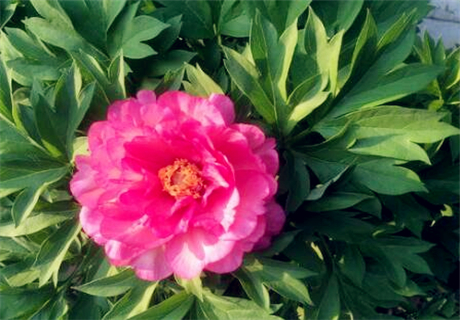
I. How do you plant herbaceous peony roots?
1. Dig out the herbaceous peony roots, minimizing damage to the roots. After digging them out, remove the soil, cut away the decayed parts of the old roots, and divide them by hand at the natural gaps into individual divisions; usually 4-5 divisions are enough. Do not divide them into too many, and each division should carry 2-5 young buds.
2. When there are few mother plants but a large planting task, each division can also carry 1-2 buds, but recovery growth will be slower. When dividing, the thick roots should be retained.
3. If the soil is moist, herbaceous peony roots are brittle and break easily. You can let them dry for a day before dividing. After dividing, let them dry slightly in the shade, dip them in nutrient-containing mud, and then plant them.
4. The best planting time for herbaceous peony roots is autumn, concentrated in the period from August to the end of September.
Note that this time should not be too early or too late. In autumn, herbaceous peonies grow many new roots and new buds, so if transplanting is carried out in autumn, the injured roots can heal and grow well, which makes growth better the following year.
5. Precautions for planting herbaceous peony roots
After herbaceous peony roots are planted in place, be careful not to transplant them frequently, as this will injure the root system.
When growing herbaceous peonies, pay attention to reasonable fertilization. After fertilizing, water thoroughly and loosen the soil.
After Frost's Descent, cut off the withered branches and leaves. During overwintering, maintain light and temperature, and do not let the soil become too dry.
II. What are the market prospects for herbaceous peony cultivation?
The market prospects for herbaceous peony cultivation are good, with wide uses and multiple values.
1. Medicinal value
The roots of herbaceous peony are fresh, crisp and juicy, and can be used medicinally. According to analysis, herbaceous peony roots contain paeoniflorin and benzoic acid, and their uses vary by species. Traditional Chinese medicine holds that Baishao in Chinese materia medica mainly refers to the root of herbaceous peony, which has antispasmodic, analgesic and menstrual-promoting effects. It is effective for conditions such as abdominal pain in women, gastric spasm, dizziness, gout and diuresis.
2. Ornamental value
Herbaceous peonies can be used in specialty gardens, as cut flowers, and as flowerbed flowers. Herbaceous peony flowers are large and brightly colored, with good ornamental value. When paired with tree peonies, they can visually extend the flowering period, so they are often planted together with tree peonies. The herbaceous peony is one of the top ten famous flowers and can also be used as a cut flower.
3. Other uses
The seeds of herbaceous peony can be pressed for oil, which is used to make soap and mixed into paint as a coating. The roots and leaves are rich in tannins and can be used to extract tannin extract. They can also be used as a botanical pesticide to kill soybean aphids and control wheat stem rust, among other uses.
III. How much capital is needed to plant one mu of herbaceous peony?
1. Seedlings: planting input is 3200 plants per mu × 0.6 yuan/plant = 1920 yuan/4 years, with an average input of 480 yuan.
2. Fertilizer input: 300 yuan per mu is needed, divided into two applications, one as base fertilizer and one as topdressing two years later.
3. Pesticide input: 150 yuan per mu is needed for soil conditioner and insecticide, averaging 40 yuan per year.
4. Labor input is 800 yuan; planting cost per mu is 100 yuan, management cost is 200 yuan, and weeding, topdressing, etc. total 500 yuan.
5. Land leveling and digging costs are 2000 yuan.
Land rent can be determined according to local land rent conditions: 1+2+3+4+5=4880 yuan.
From this it can be seen that the average cost per mu for planting herbaceous peony can be greatly reduced.
IV. Profit analysis of herbaceous peony cultivation
Revenue (4 years): calculated at an annual dry product yield of 2 kg per plant, 3000 surviving plants per mu, and a guaranteed minimum price of 5 yuan per kg for fresh product. 3000 × 2 kg × 5 yuan/kg = 30000 yuan/mu, averaging 7500 yuan/mu per year.
Calculated at the current price of 10 yuan/kg for annual dry product per kg: 3000 plants × 2 kg/plant × 10 yuan/kg = 600000 yuan/year, averaging 15000 yuan per year. After deducting planting input and land rent, the annual income per mu from Baishao, etc. should be between 6000 yuan and 13000 yuan.
Because herbicides can be used for management of this variety, and management in the early stage (the first 2 years) saves labor and time, while management in the later stage (the last two years) is simple, it is suitable for large-scale planting. Also, because this variety is suitable for intercropping under forests, in orchards and on hillside land, it greatly reduces the cost of land rent. It is an incomparably good variety for large land-transfer operators and farm/mountainland contracting households to plant.