How to grow lettuce all year round? Planting time and methods for lettuce
Lettuce, also known as mai zai cai, e zai cai, wo zai cai and so on, is one of everyone's favorite vegetables, with a crisp, tender texture and a slightly sweet, unique flavor. So, how do you grow lettuce? Is it available all year round? When is the best time to plant it?
I. How do you grow lettuce?
1. Choose and sow good seed: choose suitable varieties according to your needs, such as glass lettuce, Emperor, Caesar, head lettuce, curly-leaf lettuce, Dahu 659 and so on.
2. Prepare the seedbed: for raising lettuce seedlings, it is best to use fertile sandy loam with good water and fertilizer retention. Seedbed soil mix: for a 10 sq m seedbed, use 10 kg of decomposed organic fertilizer, 0.3 kg of ammonium sulfate, 0.5 kg of superphosphate, and 0.2 kg of potassium sulfate, mix thoroughly and spread flat, rake fine, water thoroughly to moisten the bed, and sow after the water has seeped in.
3. Sowing and raising seedlings: to broadcast evenly, a small amount of fine sandy soil can be mixed into the seeds when sowing; after sowing, cover with 0.3-0.5 cm of moist soil and cover with plastic film to retain moisture. The sowing rate is 30-50 grams per mu. When the seedlings begin to emerge, promptly uncover the plastic film on the bed surface to prevent leggy growth. The seedbed temperature should be controlled at 18°C-20°C during the day and 12°C-14°C at night. Pay attention to ventilation; if there is strong direct sunlight, shade is needed. When the seedlings grow to 2-3 true leaves, thin them to a spacing of 6-8 cm between plants and rows; when they reach 4-5 true leaves, they can be transplanted. During the seedling stage, generally do not water unless the soil is short of water.
4. Scientific fertilization: lettuce requires clay loam rich in organic matter with strong water and fertilizer retention; lettuce likes slightly acidic soil, with a soil pH of 5-7 being suitable. For every 1000 kg of lettuce produced, it absorbs 2.5 kg of nitrogen, 1.2 kg of phosphorus, and 4.5 kg of potassium, among which head lettuce requires more potassium. During the growing period, nitrogen, phosphorus, and potassium fertilizers need to be used together. The plot for transplanting lettuce should be deeply plowed and finely prepared; before transplanting, apply sufficient base fertilizer, with 3000-3500 kg of decomposed farmyard manure per mu; after applying, plow deeply, water thoroughly to moisten the soil, and make beds after the soil dries.
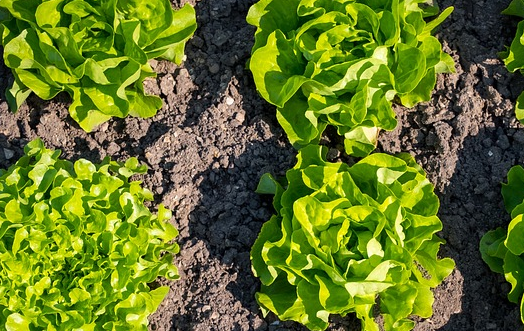
5. Careful transplanting: the day before transplanting, irrigate the seedbed to moisten the seedling clumps; the next day, lift the seedlings with as much soil as possible to reduce root damage. When transplanting, first open furrows on the bed surface, 4-6 cm deep, planting 3 rows on a 70 cm bed; after opening the furrows, apply 25 kg per mu of compound fertilizer and then irrigate; after the water seeps in, place the seedlings at 24 cm spacing, cover with soil, and close the furrows; rake the bed surface flat, cover with plastic film, and guide the seedlings out through the film.
6. Post-transplanting management: lettuce likes moisture and requires a sufficient water supply throughout the growing period. Water once 5-7 days after transplanting to help the seedlings recover. After watering to help the seedlings recover, for plots without plastic film, carry out 2 rounds of intertillage to loosen the soil and remove weeds. After that, water 3-4 times, and apply nitrogen and phosphorus fertilizers in stages along with watering, at 15-20 kg per mu. Stop watering before harvest to facilitate storage and transport.
7. Disease and pest control: the main diseases of lettuce include downy mildew, soft rot, viral disease, and sclerotinia, among which sclerotinia and soft rot are more harmful. Measures can include crop rotation, appropriately reducing planting density, not watering too much, frequently shallow hoeing, keeping the soil surface dry, promptly pulling out diseased plants, removing dead leaves and burning them in a centralized way. After the disease appears, agricultural streptomycin and amobam can be sprayed. In hot and humid seasons, spraying chlorothalonil once every 5-7 days can serve as prevention. The main pests include aphids, thrips, cutworms and so on, controlled with omethoate, fenvalerate and so on.
8. Scientific harvesting: non-heading lettuce can be harvested at the right time according to market prices; head lettuce is best harvested after the heads are firm. Harvesting too early will affect yield, while harvesting too late will cause the stem inside the head to elongate, the head to loosen, and quality to decline.
II. Is lettuce available all year round?
Lettuce is available all year round and can be planted all year round. Lettuce is a very healthy vegetable and can be harvested continuously; it is very crisp to eat, and it is rich in water, fiber, vitamins and various minerals, which benefit the work of the stomach and intestines and the central nervous system.
Most types of lettuce can be harvested in only about 8 weeks after planting. They are very easy to maintain, and you do not need much space at all to grow vegetables; their light requirements are not great either.
III. When is the best time to plant lettuce?
Lettuce likes a cool climate, so the sowing time is generally in spring and autumn. In spring, sowing usually starts from February to April, and harvest can be from May to June; in autumn, sowing can start at the end of August, and harvest can be from September to October. Because different lettuce varieties have different characteristics, when choosing the sowing time, first read the instructions for the lettuce seeds you bought, and then sow according to the sowing times above. Spring and summer are suitable for sowing loose-leaf lettuce (such as butterhead lettuce and colorful-leaf lettuce), which is more heat-tolerant; autumn and winter are suitable for sowing head lettuce (also called western lettuce), which is not heat-tolerant.