How to care for the baby's breath you bought: water or dry, and two key points
Baby's breath (Gypsophila) is a very common flower, and its flower language represents purity and innocence, care, true love, and a beautiful soul. That's why many people have started growing baby's breath themselves, so how do you care for it properly? Should it go in water or be kept dry? Here are the details:
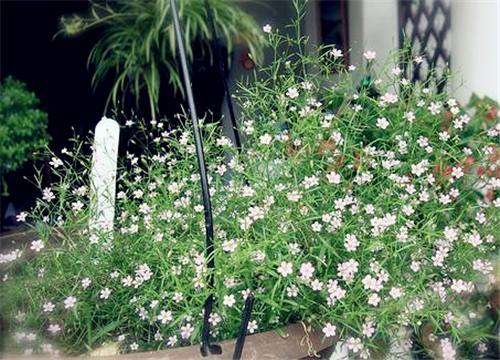
1. How do you care for baby's breath bought from a flower shop to improve its survival rate?
1. For flowers bought from a flower shop, first prepare a vase, put a little water in it, and add a little salt to the water; this can improve the survival rate. But remember, you need to change the water every five days, don't go a long time without changing it.
2. Baby's breath likes sunny, moist places, so when it's hot you must water it and let it get plenty of sun, but do not expose it to blazing sun.
3. If the baby's breath flowers dry up, there's no need to keep them in water; you can take them out and preserve them as dried flowers.
2. How do you care for baby's breath in a vase?
1. Propagation
If you choose to grow baby's breath in a vase, it is usually propagated by cuttings; cutting propagation can generally be done in autumn and spring, and roots and sprouts will appear in about a month.
2. Pinching
To make baby's breath bloom abundantly with dense branches and leaves, you can pinch the growing tips after the seedlings have taken hold, which lets it branch more and bloom more.
3. Watering and fertilizing
Like other flowers and plants, baby's breath needs a fair amount of fertilizer and water, but because baby's breath has a weak plant form, you must not apply strong fertilizer; follow the principle of applying dilute fertilizer frequently, in small amounts and more often, and water only when the soil is dry, watering thoroughly when you do.
3. How do you care for potted baby's breath?
1. You don't need to water every day; water only after the potting soil dries and the surface soil turns pale. There is no specific interval: in high summer temperatures it may be twice a day, and in low winter temperatures it may be once every 10 days. In short, water when it's dry, and don't water when it isn't.
2. Put it in a spot with plenty of sunlight; baby's breath loves sun, and only with plenty of sunlight will it bloom.
3. Baby's breath grows vigorously; places where leaves have dropped can be cut off freely, and new branches and leaves will soon grow. The more you cut, the fuller the new leaves that grow.
4. Baby's breath grows vigorously and has a long flowering period, so it uses up nutrients quickly; that's why baby's breath loves fertilizer, and you should give it some fertilizer regularly.
5. In fact, when growing baby's breath you must pay attention to these two key points. The first is that baby's breath loves sunlight, so there must be plenty of sunlight; in summer you can adjust appropriately and avoid blazing sun. The second is to keep it moist, which just means watering more, especially in summer when you can water twice a day; in winter once every two days is enough, and in autumn and spring you can water appropriately according to the changing weather.
4. Should the baby's breath you bought be put in water or kept dry?
In fact, the baby's breath you bought can be kept in water or kept dry, depending on personal preference. If you want to keep it in a vase, you must add nutrient solution so it lasts longer in water; once the flowers wilt, you can take them out and keep them dry as dried flowers.
Keeping it dry is really just cultivating it as dried flowers; you only need to put it in a windy place every day, and once it is completely dry you can make it into a dried bouquet, which keeps for even longer.
5. What fertilizer is good for baby's breath?
For fertilizing baby's breath you can use compound fertilizer; the nutrient solution and Huabao sold in flower shops can also be used, and farmyard manure works too, but it may give off an unpleasant smell if not handled well, so it is rarely used for home flower growing. Fertilize on the principle of small amounts and frequent applications, once every 7-10 days, and water after fertilizing.
Summary: The above is the compiled guide on how to care for baby's breath, and I hope it helps those of you who love growing flowers.