Do lotus flowers have to be grown hydroponically? A full breakdown of the correct planting methods
There is a saying that goes well, “If the heart is like a lotus, what is there to fear from vanity and clamor; if the heart is calm, what is there to fear from a long road to the ends of the earth.” The lotus symbolizes purity, emerging unstained from the mud, and is deeply loved by plant growers. How do you grow lotus flowers? Do they have to be grown hydroponically? What exactly are the planting methods? Let us find out together.
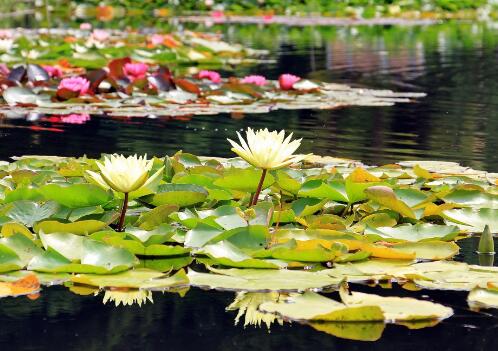
I. How to grow lotus flowers? Do they have to be grown hydroponically?
For lotus, we generally recommend soil culture, because mud is soil, and the root system of the water lotus is a lotus root seed. Without mud to hold it in place, it will float to the water surface. Even if it is fixed in place with a tool, that tool lacks the nutrients contained in the mud. Moreover, water culture not only makes growth difficult, but also easily leads to poor development and failure to bloom. However, this is not to say it absolutely cannot be grown hydroponically; if the conditions are met, it can also be grown successfully.
II. Lotus planting methods
(I) Pot culture
1. Flower pot
The flower pot is chosen according to personal preference and the overall style of the home. It can be a transparent pot or a ceramic clay one. Try to choose a flower pot with an opening that flares outward, and the wider the pot opening, the larger the flowers. The deeper the flower pot, the longer the flowering period.
2. Soil
Potted water lilies are mostly grown hydroponically, but they can also be grown in soil. When choosing soil, it is best to choose flower soil with relatively high viscosity.
3. Fertilizing
Before planting water lilies, a small amount of slow-release fertilizer can be placed at the bottom of the pot. During the growth period or flowering period, generally about 1.5-2.5 months, add slow-release fertilizer or root fertilizer about 3-5 cm away from the tuber. Note that no fertilizer should be applied after the end of September, because autumn is gradually approaching and water lilies will also enter dormancy; adding fertilizer instead causes root rot.
4. Suitable temperature
The suitable temperature for water lilies is around 25-30°C. The flowers close at night or when the temperature is relatively cold, and then bloom automatically once the suitable temperature returns.
5. Autumn and winter care
In autumn and winter, water lilies enter dormancy as the temperature drops. At this time, simply fill the water to the top and no further management is needed.
7. Pest and disease control
Common diseases include anthracnose and leaf rot, and there can also be pest problems. In daily care, fertilize appropriately, and at the same time promptly remove diseased plants and remove withered leaves. Targeted chemical agents can also be sprayed, but when spraying chemicals, be sure to move the potted water lilies outdoors first.
(II) Pond cultivation
1. Choose a pond with fertile soil, with at least 30 cm of mud at the bottom of the pond. The propagules can be planted directly into the mud. The water level should be shallow at first, kept at 2-3 cm, to facilitate warming, and then gradually raise the water level as they grow.
2. Depending on the region, deepen the water level in the pond before winter so that the rhizomes are below the ice layer and can overwinter. The advantage is a better group effect and greater growth volume; the disadvantage is that digging them up the next year is difficult, and pests and diseases are not easy to control.
3. In early spring, drain all the pond water, apply base fertilizer at the bottom (cake fertilizer, barnyard manure, crushed bones and superphosphate, etc.), cover it with fertile soil, then plant the water lily rhizomes into the soil, with 20-30 cm of water above. In the vigorous growth period in summer, the water level can be deeper, maintained at 40-50 cm, and the water flow should not be too rapid. If the pond water is too deep, you can build a planting platform or planting trough with bricks in the water, or use plastic boards to divide a long planting trough into 1 m×1 m sections to plant multiple varieties, which can avoid mixing varieties. You can also first plant them into pots or vats, then place them into the pond. During the growth period, topdressing can be appropriately applied 1-2 times. In July-August, mix 50 g of cake fertilizer powder with 10 g of urea, wrap it in paper into small packets, and push them by hand into the mud a little away from the plant roots, 2-4 packets per plant.
After planting, renew the pond by turning it over about once every 3 years to avoid crowding and decline. Before winter freezing, keep the water depth at about 1 m to prevent the pond bottom from freezing and damaging the rhizomes.