How to overwinter a potted passion fruit? Nine cultivation techniques and nutritional value explained
Passion fruit is a tropical fruit. After its introduction and cultivation in China, it is mainly distributed in the warm and humid regions of the south, and is also commonly grown as a household potted plant. So what are the nine techniques for potted passion fruit cultivation? How do you overwinter it? What nutritional value does it have?
I. What are the nine techniques for potted cultivation?
1. Choosing a container
Clay pots, ceramic pots, purple clay pots, wooden pots, plastic flower pots, etc. The specific choice should be made according to your own circumstances. In the first year of potted passion fruit, a container with a mouth diameter of about 20-25 cm can be used.
2. Potting soil preparation
A. Potting soil requirements
Choose growing materials that are widely available, low in cost, free of pests and diseases, and pollution-free, such as leaf mold, peat soil, garden soil, sand and gravel, etc. The soil is required to be loose, fertile, and rich in organic matter and calcium.
B. Potting soil preparation and disinfection
Formulas: (1) 4 parts leaf mold, 3 parts garden soil, 3 parts coarse sand, 0.5 part bone meal; (2) 7 parts garden soil, 2 parts coarse sand, 1 part expanded chicken manure, 0.5 part bone meal. After stirring these ingredients evenly, spray them evenly with a 0.1% formalin solution, then seal and fumigate with plastic film for a full day and night. The next day, remove the film and air-dry for 3-4 days before putting it into pots for use.
3. Seed selection
During the fruit ripening period, select fully mature fruits that are large, juicy, thin-skinned, and free of pests and diseases from superior mother plants; the seedling raising time is generally from September to May of the following year.
4. Seed germination treatment
Soak the seeds in water for 2-3 days, then rub and wash them by hand to remove the gelatinous outer layer of the seeds; mix every 1 kg of seeds with 10-15 g of carbendazim or thiophanate-methyl for 20-30 minutes before sowing. When sowing, spread the seeds evenly on the germination seedbed, cover with a 1-2 cm layer of fine river sand, and water after sowing.
5. Transplanting into pots
Before lifting the seedlings for transplanting, water thoroughly first to make lifting easier, and take care to protect the root system; the transplanting depth should be the depth at which the seedlings grew during germination; transplant seedlings as soon as they are taken; after transplanting, water thoroughly to settle the roots.
6. Soil replacement
After the plant has grown in the pot for 1-2 years, since the nutrients in the potting soil gradually decrease, it is then necessary to replace it with a larger pot or new potting soil, or the potting soil needs to be replaced. When changing the pot or soil, cut away some dead roots, and water immediately after changing the potting soil.
7. Fertilization
Starting from when the seedlings are about 20 cm tall, apply cake fertilizer water once every 7-10 days until the end of September. For those that have already fruited, in order to ensure fruit development, it is best to apply once every 5 days. After the fruit is harvested, apply again according to the potted seedling. Note that after fertilizing, water thoroughly. At the same time, foliar fertilization can also be carried out. The specific operation is: in the early growth stage of passion fruit, spray a 0.1%-0.3% urea solution 2-3 times; from the fruit expansion stage onward, spray a 0.3% potassium dihydrogen phosphate solution 3-4 times every 7-10 days.
8. Watering
The most suitable watering times for potted passion fruit are before 10 a.m. and after 4 p.m.; the number of waterings depends on the season and weather conditions. Generally, in early spring, water once every 2-3 days. As the temperature rises, water once every 1-2 days. After the temperature gradually drops in autumn, reduce the number of waterings, keeping the potting soil moist as appropriate.
9. Disease control
Potted passion fruit has relatively few insect pests, and the focus is on diseases. Common diseases include downy mildew, white rot, anthracnose, black spot, etc. During the dormant period of passion fruit, spray 3-5 degrees Baume lime sulfur mixture. After sprouting, spray once every 10-15 days with a 1:0.5:200 Bordeaux mixture or a 500-fold compound carbendazim solution for control.
II. How do potted passion fruit plants overwinter?
1. Temperature: cold protection in winter is very important
The optimal growing temperature for passion fruit is 20-30°C. If the temperature reaches -2°C, it will suffer severe freezing damage. It is best to grow it in areas where the lowest winter temperature is not below 0°C, or pay attention to taking cold protection and warmth measures.
2. Cold protection measures:
You can spread lime on potted passion fruit, or cover with plastic film and weeds for warmth and freeze protection, or prune in winter. Note that passion fruit does not need pruning in the first and second years. In the third year, old branches can be cut off, leaving three strong branches of about 2 m to sprout new branches again, or you may not prune, and prune when the temperature is below zero. You can also wrap the root area and soil, the main trunk, and one third of the main vine of the passion fruit with plastic sheeting, water less in winter, and water only when not dry, and it can overwinter.
[Tips] In our country, only the southern regions where it does not snow are suitable for passion fruit growth. A little farther north, if you want to grow passion fruit, you can only grow it in greenhouses; otherwise, once it encounters snowy weather, it cannot overwinter safely. In southern regions with lower temperatures, as long as the above cold protection measures are followed for cold protection, it can generally overwinter safely.
III. When does passion fruit ripen?
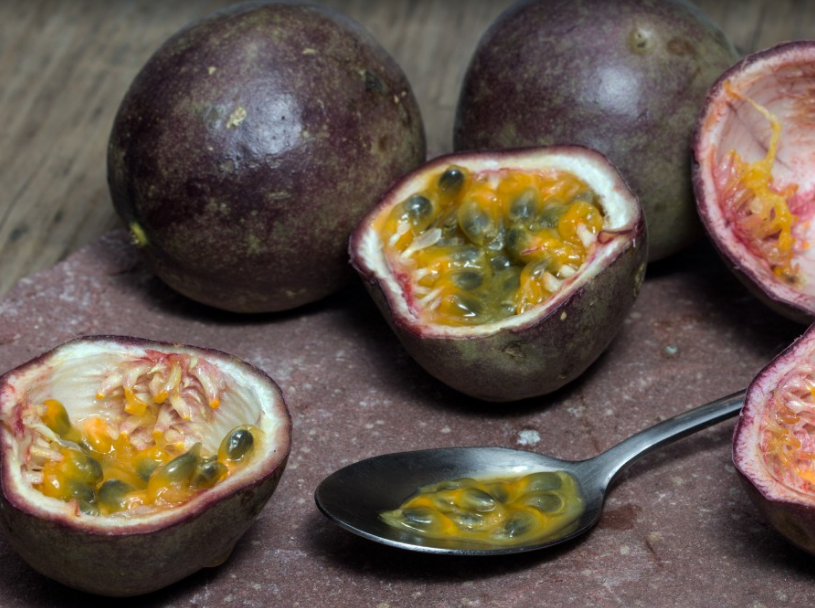
Passion fruit is named because its pulp can give off the rich aroma of more than a dozen fruits such as banana, pineapple, strawberry, lychee, lemon, mango, and sour plum. Abroad, passion fruit also has such laudatory names as “king of juices” and “money tree”. Passion fruit can be eaten raw or used as a vegetable or feed. Used as medicine, it has stimulating and strengthening effects. The pulp is juicy, and when calcium bicarbonate and sugar are added, it can be made into an aromatic and tasty beverage.
Passion fruit ripens after the end of July, and is best to eat in September-October. Some experts suggest that eating 3 medium-sized passion fruits a day is harmless. Passion fruit has miraculous health effects such as reducing inflammation and relieving pain, invigorating blood and strengthening the body, lowering lipids and blood pressure, nourishing yin and tonifying the kidneys, refreshing the mind and sobering one up, eliminating fatigue, detoxifying and beautifying the skin, and enhancing immunity during pregnancy.
IV. What nutritional value does passion fruit have?
Passion fruit is also called egg fruit, foreign pomegranate, passionflower, etc. Its place of origin is mainly the tropical regions of the Americas. Passion fruit is the fruit produced by the herbaceous vine of the genus Passiflora in the family Passifloraceae. It is mainly divided into two major types, purple fruit and yellow fruit, and is a fruit eaten for its juice.
The pulp of passion fruit contains rich juice. Fully ripe passion fruit contains 30% or more juice, and the color of its juice looks very bright. What is even more remarkable about passion fruit juice is that it not only has a rich fruity aroma, but this aroma combines the aromas of more than a dozen fruits such as banana, pineapple, strawberry, lychee, lemon, mango, and sour plum. Therefore, passion fruit also has such laudatory names as “king of juices” and “money tree” abroad.
Passion fruit can be eaten directly as a fruit raw, can be used as a vegetable to make dishes, and can also be used as medicine for certain patients. We can also use passion fruit to make beverages or foods such as fruit syrup, ice cream, jam, jelly, and fruit wine. Adding a little passion fruit juice when making other beverages can also improve the quality of the beverage.
Used as medicine, passion fruit has the effects of calming the mind and soothing the nerves, invigorating blood and relieving pain, and astringing the intestines to stop diarrhea. It can be used for the treatment of insomnia with restlessness and palpitations due to insufficient heart blood, as well as chronic diarrhea, chronic dysentery, warm pain, and diarrhea caused by weak spleen and stomach. It can also be used for the treatment of irregular menstruation, unsmooth menstrual flow, lower abdominal distension and pain, and dysmenorrhea caused by blood vessel blockage.