Osmanthus seedling planting methods and watering techniques, and what to do when the leaves turn yellow
Osmanthus is one of China's traditional top ten famous flowers. It is an excellent landscape tree that combines greening, beautification and fragrance, with both ornamental and practical value. Bonsai made from osmanthus stays evergreen in all four seasons, with abundant flowers and a fragrant scent, and high ornamental value. With proper management it can grow lush branches and leaves, bloom continuously, and produce abundant, fragrant flowers. So how are osmanthus seedlings planted? What should be done when the leaves turn yellow? How should they be watered?
I. How are osmanthus seedlings planted?
1. Planting out
Digging the hole: The size and depth of the hole depend on the size of the root ball of the osmanthus seedling. Generally it should be able to completely cover the roots of the osmanthus seedling, but it should not be too deep, as the osmanthus seedling will grow slowly if the hole is too deep. For example: for a 3- or 4-year-old young osmanthus tree with a trunk diameter of about 3 cm, the depth of the hole dug at this time should be 20-25 cm, and the diameter of the hole should be 30 cm.
Applying base fertilizer: Before transplanting small osmanthus seedlings, base fertilizer needs to be applied (if the soil layer is fertile, it is also fine not to apply base fertilizer). Farmyard rotted manure is suitable as base fertilizer, applied at about 1000 grams per mu, mixing the base fertilizer evenly with the surface loam. Do not apply too much fertilizer, because osmanthus seedlings are small; applying too much is not easily absorbed and can also cause root burn.
Pruning: Before transplanting osmanthus seedlings, in order to reduce water evaporation, some of the luxuriant branches and leaves of the osmanthus seedling can be appropriately cut away; in order to stimulate rooting, some overly long roots can also be cut, but do not damage the main root.
Planting out: Osmanthus seedlings are best planted in a southeast-facing position so that they receive maximum light. Osmanthus is not tolerant of waterlogging. When planting osmanthus, the planting height must not be lower than the height of the transplanting site, and it can also be slightly higher. After planting, fill in the soil of the hole and firm it down, then water once thoroughly.
2. Care after planting
The care work after planting osmanthus seedlings includes watering, weeding, pruning, pest and disease control, and other aspects. For details, please refer to the later maintenance work for osmanthus seedlings.
The key points for planting osmanthus seedlings are:
① The growing environment for osmanthus seedlings should be well ventilated, with sufficient sunlight, and the soil should be a fertile, slightly acidic sandy soil;
② Many people are used to planting osmanthus in spring. In fact, scientific research shows that planting osmanthus seedlings around November, that is, autumn planting, is better than spring planting in March-April;
③ Special attention should be paid to watering. In high-temperature and long-drought seasons, drought prevention and frequent watering are needed; in the rainy season, drainage to prevent waterlogging is needed, and newly planted osmanthus should be watered promptly;
④ Pay attention to intertillage and weeding. Intertillage and weeding are especially beneficial to the growth of osmanthus seedlings;
⑤ Small osmanthus seedlings can be given base fertilizer when transplanted, and after planting an appropriate amount of compound water-soluble fertilizer can be applied, at 30 kg per mu. After that, no fertilization is needed within one year. After one year, the principle should be light application of farmyard manure, applying light fertilizer frequently;
⑥ In terms of shaping and pruning, osmanthus is a flowering tree that tolerates pruning relatively well. If directional cultivation is desired, directional pruning must be carried out during the small seedling stage of osmanthus.
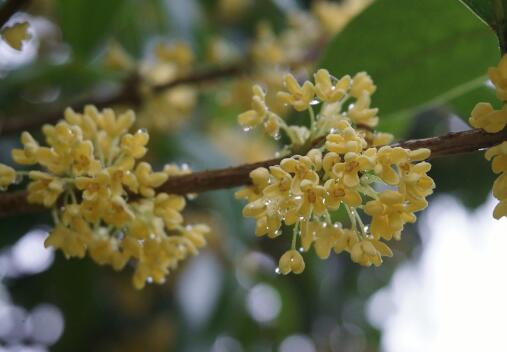
II. What should be done when osmanthus leaves turn yellow?
1. Appropriate temperature
15-28°C is the optimum temperature for osmanthus growth. If the summer temperature is too high and no cooling treatment is carried out, or it is still left exposed to the sun, its leaves can easily turn yellow. If the winter temperature is too low and appropriate insulation measures are not taken, it can also cause its leaves to turn yellow. Therefore, when growing osmanthus, pay attention to cooling in summer; it can be placed in a relatively shady place. In winter, pay attention to keeping it warm; it can be moved indoors.
2. Reasonable watering
This flower is not tolerant of waterlogging. Once it is watered too much, it can easily lead to root rot, and root rot will inevitably cause yellow leaves. Therefore, when planting this plant, be sure to choose loose soil with good drainage. In addition, daily watering should not be too frequent, nor should too much be watered at one time. Watering after the potting soil has dried is enough.
3. Correct fertilization
If there is too little fertilizer, it will cause the leaves of this plant to turn yellow. Therefore, during its growing period we should apply fertilizer reasonably. Both liquid fertilizer and compound fertilizer are acceptable, but note that the concentration applied must not be too high. In addition, we should repot and change the soil in time to ensure that the potting soil does not become compacted and that there are enough nutrients in the soil. It is worth noting that when fertilizing, do not be impatient. Applying too much fertilizer at one time or using too high a concentration is not conducive to its growth and may even cause root burn and yellow leaves.
4. Changing the soil quality
Relatively speaking, it prefers slightly acidic soil. If the soil is slightly alkaline or becomes alkalized, the leaves of this plant may turn yellow. To maintain soil acidity, a little ferrous sulfate or leftover beer can be mixed into the water when watering. Likewise, note that both the ferrous sulfate solution and the beer must be diluted, and the concentration must not be too high.
III. How should osmanthus be watered?
Watering osmanthus also requires feasible methods so that osmanthus can grow faster and more healthily.
First, the timing of watering osmanthus: In spring and summer, water frequently during high-temperature weather. Watering must be done before 10 a.m. every day. In the dry and cold season of winter, reduce the amount of watering.
Second, the water quality for watering: When watering osmanthus, ordinary tap water is enough, but the water should be placed in the sun for two or three hours.
The water temperature for watering osmanthus: In order to keep the water temperature consistent with the soil temperature and prevent the water temperature from being lower than the soil temperature, which would damage the roots, it is best to water before 10 a.m. In short, it is enough that the water temperature differs as little as possible from the day's air temperature.
Finally, the watering operation: Because the water requirement differs with the seasons, the amount of water should be measured according to the season when watering. Summer is the hottest, so in summer watering should be done before 10 a.m. or after 4 p.m., and it can be done twice a day. When watering, pour slowly, or water by spraying. If high-temperature weather occurs, spray water on the osmanthus leaves to keep the plant moist.
After watering is finished, it is best to loosen the soil a little to help the roots absorb enough water and promote growth.
IV. What should be noted when watering osmanthus?
There are many aspects to note when watering osmanthus. First, the timing of watering should be before 10 a.m., and the water temperature should be similar to the day's air temperature.
When watering osmanthus, also note that it is enough to ensure soil moisture only; do not let water accumulate, so as to avoid root rot.
In summer and just after planting, water frequently. In particular, newly planted seedlings should be watered thoroughly to promote the growth of the seedlings.