What Plant Is Water Hyacinth? A Full Breakdown of Its Benefits, Effects, and Cultivation Methods
Water hyacinth is native to Brazil. It is now widely distributed in the Yangtze and Yellow River basins of China and across the provinces of South China. It prefers warm, humid, sunny environments, is highly adaptable, and has a certain tolerance to cold. So, what plant is water hyacinth? What benefits and effects does it have? How is it best cultivated?
I. What plant is water hyacinth?
Water hyacinth is a floating herbaceous plant with well-developed fibrous roots and an extremely short stem. Its flowers are light blue and take a multi-faceted trumpet shape, with the upper petals being larger; at the center of the petals there is a distinct bright yellow spot, shaped like a phoenix eye and also like the flower spot at the tip of a peacock feather, very eye-catching and beautiful. It is often used as a landscaping material in garden water features. Planted in a corner of a small pond and enclosed with a bamboo frame, it has a quiet, wild charm.
II. What benefits and effects does water hyacinth have?
1. Pollution control
Water hyacinth can treat sewage: under suitable conditions, one hectare of water hyacinth can absorb the nitrogen and phosphorus excreted by 800 people in a single day, and water hyacinth can also remove various heavy metal elements from sewage. Therefore, the pollutant-absorbing capacity of water hyacinth is considered the strongest among all aquatic plants.
2. Purification
Water hyacinth has a strong water-purifying effect. It can be planted in shallow ponds or in pots and fish tanks; it is suitable both for viewing its flowers and its leaves, and it can also purify the water. As early as 1992, researchers at Okayama University in Japan specifically published a book titled "Water Hyacinth Saves the Earth," praising water hyacinth for purifying water and air and for reducing greenhouse gases.
3. It can be eaten
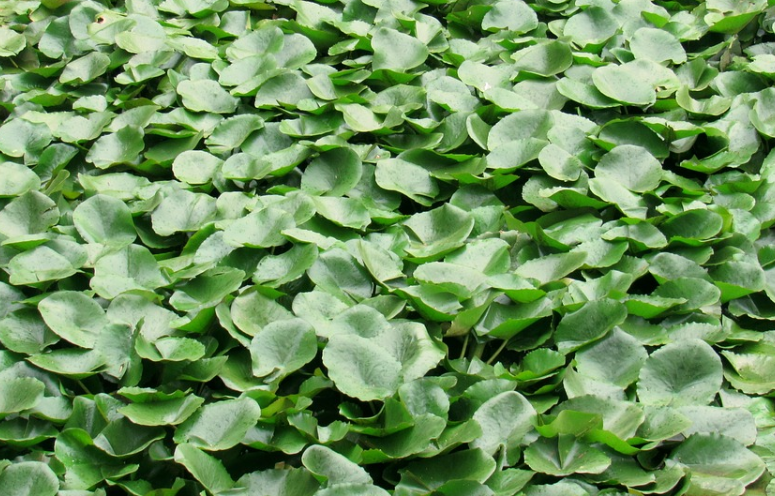
Water hyacinth is an edible plant. Experts in Wuhan have proposed the "eating theory": water hyacinth tastes like bok choy and is a genuine "green vegetable." Stir-fried water hyacinth and water hyacinth cooked in soup both taste quite good. A company once developed and produced a water hyacinth functional beverage and achieved good sales results. The flowers and tender leaves of water hyacinth can be eaten directly; they taste fresh and refreshing and have the effect of lubricating the intestines and relieving constipation. Indigenous residents in places such as Malaysia often use the tender leaves and flowers of water hyacinth as a vegetable.
4. Medicinal value
Water hyacinth can treat digestive system diseases and skin venereal diseases. Traditional Chinese medicine holds that water hyacinth is pungent and bland in nature and flavor. It can clear heat and relieve summerheat, disperse wind and promote sweating, and induce diuresis to reduce swelling. It is mainly used for skin eczema, rubella, summerheat syncope with thirst, nephritic edema, and difficult urination.
III. How is water hyacinth best cultivated?
1. Selection of seedlings
Choose new, strong plants, remove diseased and rotten leaves, and keep them as seedlings. The stocking rate is 5 kg/m.
2. Keep temperatures low to inhibit seedling growth
During the seed-preservation stage, the suitable water temperature is 13°C-15°C, and the day-night temperature difference must not exceed 2°C. Growth stops below 10°C, survival can be maintained at 4-5°C, and below 0°C the plants die. Therefore, during the seed-preservation stage, indoor temperatures should be prevented from getting too high; low-temperature storage is best, keeping the seedlings in a dormant state.
3. Ventilation and air exchange
Ventilation must be maintained every day to keep the indoor air fresh. By late April, all doors and windows can be opened during the day and closed again at 4-5 p.m.; 10 days before stocking, they should all be opened day and night for hardening off, so that the seedlings gradually adapt to the natural environment and are prepared for planting and cultivation.
4. Maintain light exposure
Water hyacinth has high light requirements; the longer the light duration, the more vigorous the photosynthesis. Regardless of whether the weather is cold or warm, it must receive 4-5 hours of light every day. Especially in spring, if it cannot receive light or be exposed to light for 2-3 days because the covering is too tight, water hyacinth will rot at the roots or even die. Therefore, the seed-preservation room should have its covering curtains opened every day to increase indoor light and raise the room temperature.
5. Changing water and fertilizing
In the water hyacinth preservation room, the relative humidity should preferably be 70%-80%. In spring, as temperatures rise, winds are strong, and water evaporates quickly, so the pond water should be sprayed frequently and the water changed regularly; generally, change the water once every two months, and the temperature difference of the water should not be too large. If low-temperature seedling preservation is used, the water does not need to be changed. In addition to applying sufficient base fertilizer before preserving the seedlings, attention should also be paid to frequent topdressing during the preservation period; it is best to use decomposed human manure and urine, diluted to a concentration of 1:20. When topdressing, do not sprinkle it directly on the seedlings.