Hawthorn Planting Methods and 2019 Planting Benefit Analysis
The hawthorn tree is a deciduous tree with leaves that are nearly ovate. It has strong adaptability, and even on thin mountainous land, its growth and development are better than other fruit trees. So how do you plant hawthorn trees? How were the planting benefits in 2019?
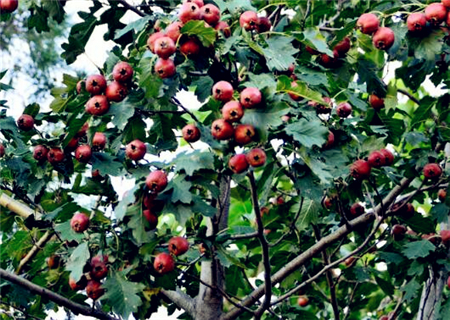
I. How do you plant hawthorn trees?
1. Site selection and seedling raising
Choose flat land, hills, and gentle mountain slopes with deep, fertile soil, with a southeast aspect being the best, followed by north and northeast aspects. Pay attention to water storage, irrigation and drainage, and drought prevention.
Seedlings grown from hawthorn seeds are called seedling rootstock seedlings. Seedling rootstock seedlings generally all need grafting before they can become hawthorns suitable for cultivation. Hawthorn seed shells are thick and hard, and the seeds do not easily absorb water, swell, or crack. In addition, the seed kernel has a long dormancy period, making emergence difficult. Therefore, before sowing hawthorn, the seeds must be pre-treated to ensure the germination rate.
2. Field management
Deep plowing and soil maturation, soil improvement: plowing the orchard land or deeply digging the soil within the tree plate is an effective measure to conserve water, eliminate weeds, loosen the soil, improve soil aeration, improve soil fertility, and promote root growth.
3. Fertilization
Band application, that is, opening trenches across the rows between rows for fertilization; whole-orchard broadcast application, that is, when the hawthorn root system has spread densely throughout the whole orchard, fertilizer can be spread on the surface and then turned into the soil to a depth of 20 cm; hole application, that is, when applying liquid fertilizer (human excrement and urine), evenly dig 6-12 holes 30-40 cm deep under the tree canopy in different directions, pour in the fertilizer, and then cover with soil.
4. Pruning branches
The pruning of hawthorn fruit trees is the same as the general pruning methods for fruit trees.
① Winter pruning
Prevent the inner canopy from becoming bare. Because the outer part of the hawthorn tree branches easily, the outer part often becomes closed, the small branches in the inner canopy grow weakly, dead branches increase year by year, and the middle and lower parts of large branches at all levels gradually become bare. To prevent the inner canopy from becoming bare, the principle of combining thinning, shortening, and cutting back should be adopted to transform and rejuvenate, thinning out whorled scaffold branches and densely growing large outer branches as well as competing branches, water sprouts, and diseased and insect-damaged branches, shortening and pruning weakened main and lateral branches, selecting and retaining buds at appropriate positions for small renewal, cultivating strong branch groups, heavily cutting back weak branches for rejuvenation, and notching above buds at bare positions to increase branches.
Few heading cuts. After the hawthorn tree enters the fruiting stage, for any fully grown new shoot, the terminal bud and the 1-4 buds below it can all differentiate into flower buds. Therefore, in hawthorn pruning, heading cuts should be used sparingly to protect flower buds.
Restoring vigor. After the hawthorn tree enters the fruiting stage, consecutive years of fruiting cause branches to droop, growth vigor to gradually weaken, scaffold branches to show scorched tips, and yield to decline. Branches should be renewed in a timely manner to restore tree vigor. For branches that have fruited for many consecutive years or other excessively long branches, drooping branches, scorched-tip branches, and multi-year water sprouts, cut them back to a strong fork at the rear, and use a branch on the upper side to lead, so as to enhance growth vigor and promote an increase in yield.
② Summer pruning
Thinning branches. Hawthorn has a strong ability to sprout new shoots. Generally, the 2-3 lateral buds at the tip of a branch can all sprout strong branches. Each year, many branches form on the outer part of the canopy, making the canopy closed and causing poor ventilation and light penetration. Develop shoots in improper positions or overly vigorous ones should be thinned out early. Remove all branches sprouted from lateral buds below the inflorescence, overcome bareness in the middle and lower parts of large branches at all levels, and prevent the fruiting position from moving outward.
Branch bending. In summer, for vigorous branches with space to grow, after new shoot growth stops in late July, bend the branches flat to moderate vigor, promote flower formation, and increase yield.
Pinching. In early to mid-May, when inner canopy branches in the tree crown grow to 30-40 cm, pinch them back leaving 20-30 cm to promote flower bud formation and cultivate compact fruiting branch groups.
Girdling. Generally carried out on auxiliary branches, with the girdling width being 1/10 of the thickness of the girdled branch. 3. Pest and disease control. The main insect pests of hawthorn are red spider mites, peach fruit borers, and peach pyralid moths, and the diseases include ring rot and powdery mildew.
5. Watering
Generally water 4 times a year. In spring, where irrigation conditions permit, water once after topdressing to promote the absorption and utilization of fertilizer. After flowering, water in combination with topdressing to increase the fruit-setting rate. After wheat harvest, water once to promote flower bud differentiation and rapid fruit growth. Apply winter irrigation, watering timely in winter to help the tree overwinter safely.
6. Pest and disease control
To control red spider mites and peach pyralid moths, from early May to early June, spray 2500-times fenpropathrin.
To control peach fruit borers, in mid-June spray the tree plate with 100-150 times parathion emulsifiable concentrate to kill overwintering-generation fruit borer larvae. In early July and early to mid-August, spray the trees with 1500-times parathion emulsifiable concentrate to eliminate fruit borer eggs and newly fruit-entering larvae.
To control ring rot, spray 800-times 80% carbendazim solution 1 week after petal fall, and thereafter spray a fungicide once each in mid-June, late July, and early to mid-August.
For hawthorn orchards with severe powdery mildew, spray 5 Baume lime sulfur mixture once before budding, and spray 600-times 50% wettable carbendazim or 50% wettable thiophanate once each at the flower bud stage and in June.
II. How were the benefits of planting hawthorn trees in 2019?
Hawthorn is a fruit tree unique to China. In recent years, it has developed rapidly, and the cultivated area has reached 7 million mu, accounting for about 10% of China's total fruit tree area. At present, most are newly planted trees or young fruiting trees. Based on current yield and cultivation management conditions, it is predicted that the national total hawthorn output will reach 3 million tons. The fresh consumption of hawthorn is not large, and the main outlet lies in processing. Therefore, growers must pay attention to figuring out deep-processing outlets.
Through processing, hawthorn can be made into various products such as hawthorn cakes, hawthorn jelly, hawthorn slices, hawthorn strips, hawthorn rolls, hawthorn jam, hawthorn juice, fried hawthorn, fruit leather, hawthorn tea, sugar-coated hawthorn balls, canned hawthorn, and candied hawthorn skewers. This shows that the economic benefits of planting hawthorn trees are considerable.